
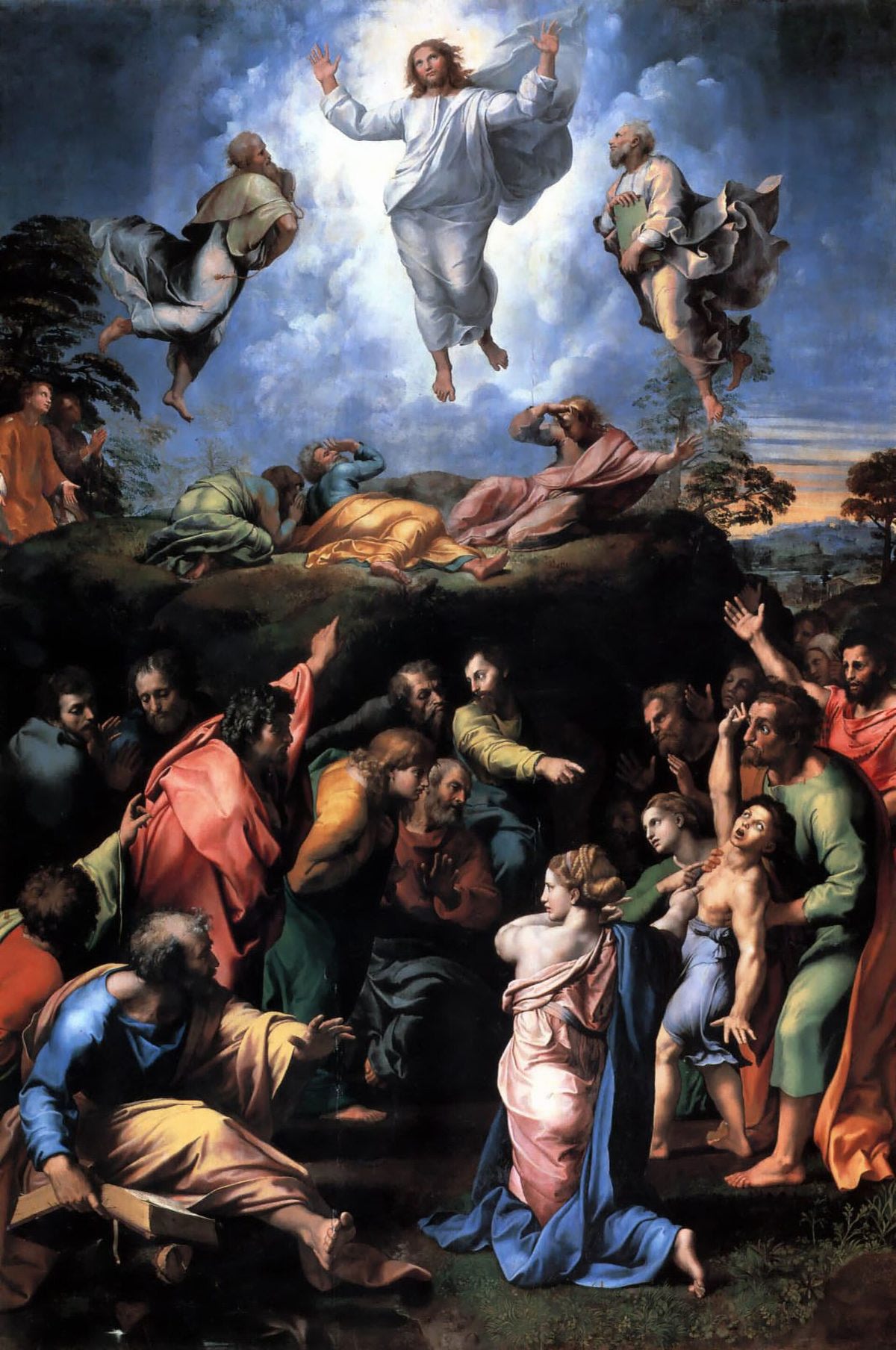
The Transfiguration
The Transfiguration — Raphael, 1516-1520
Raphael, Public domain, via Wikimedia Commons
Raphael's Transfiguration was his final painting — he died in 1520 at 37, with it not quite finished, and it was exhibited at his funeral bier. It is the largest panel painting he ever made and the most ambitious in its theological and compositional programme: the upper half shows the Transfiguration on Mount Tabor (Christ risen and radiant above, flanked by Moses and Elijah, with Peter, James, and John prostrated below in blinding light); the lower half shows the disciples below, struggling to heal a boy possessed by a demon, who could only be healed by Christ himself — the episode in the Synoptic Gospels that immediately follows the Transfiguration. The two halves of the painting are a theological meditation on the relationship between divine transcendence (above) and human helplessness (below).
The Transfiguration was commissioned by Cardinal Giulio de' Medici (later Pope Clement VII) in 1516, in competition with a Lazarus by Sebastiano del Piombo (now in the National Gallery, London) — both were intended for Narbonne Cathedral. Raphael began it around 1518 and was still working on it at his death in April 1520.
The lower section was probably completed by Giulio Romano, his chief pupil. The painting's influence was immediate and enormous: the lower section, with its crowd of distressed, gesticulating figures surrounding the possessed boy, became a model for the dramatic figure composition of the late Renaissance and Mannerism. Poussin, who called it the most beautiful painting in the world, copied it in a drawing that survived.
The compositional division of the painting — luminous calm above, agitated drama below — is the key to understanding its theology. Christ floats in an ellipse of light; Moses and Elijah are beside him; Peter, James, and John lie prostrate. The light source is internal to Christ — he is the light, not illuminated by it.
Below, the crowd of disciples and the boy's family are in urgent motion: pointing upward, gesturing to the boy, turning toward the absent Christ who alone can help. The boy's twisted, upward-rolling eyes and reaching arms create the painting's most disturbing figure. The transition from disorder to order, from below to above, is the experience the painting organises.
When standing before this work, look carefully: The Transfiguration — Raphael, 1516-1520. Give it time — what seems decorative often carries the central meaning.
When standing before this work, look carefully: The Transfiguration — upper section, Christ in light. Give it time — what seems decorative often carries the central meaning.
When standing before this work, look carefully: The lower section — the possessed boy. Give it time — what seems decorative often carries the central meaning.
When standing before this work, look carefully: Full painting in the Pinacoteca Vaticana. Give it time — what seems decorative often carries the central meaning.
Pinacoteca Vaticana, Room VIII, Vatican Museums. One of the most visited rooms in the Vatican — also contains Caravaggio's Entombment and Raphael's tapestries.