
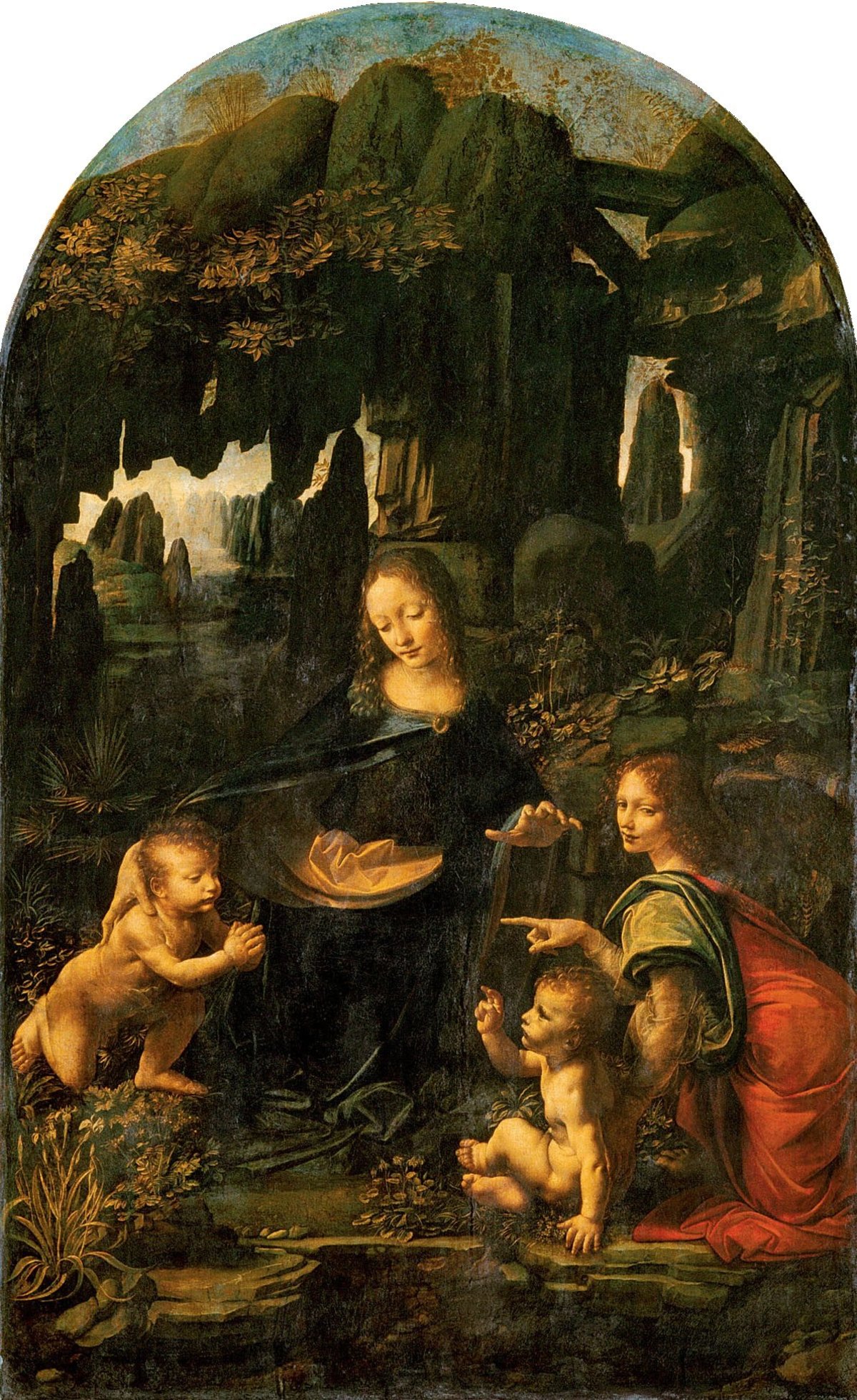
The Virgin of the Rocks
Virgin of the Rocks — Louvre version
Leonardo da Vinci, Public domain, via Wikimedia Commons
Leonardo painted two versions of the Virgin of the Rocks — one now in the Louvre (begun c.1483, the earlier and more mysterious version), one in the National Gallery in London (begun c.1495, somewhat lighter in treatment). Both depict the Virgin Mary with the infant Christ, the infant John the Baptist, and an angel in a rocky grotto of otherworldly beauty.
The composition — a pyramidal grouping of four figures illuminated from within a dark cave — is unlike anything that preceded it: the cave is geological, the light supernatural, the glances and gestures of the figures complex and psychologically charged. The Louvre version is among the most studied and debated works in existence, particularly for the angel who turns to look directly at the viewer.
The Louvre version was commissioned in 1483 for a Milanese confraternity chapel altarpiece; Leonardo became embroiled in a payment dispute and the confraternity eventually received the London version instead (or a version he began later). The exact sequence and dating remain debated.
The London version, currently in the National Gallery, differs in several details: the angel's hand in the Louvre version points across the composition at the Baptist in a gesture with no clear liturgical meaning; in the London version this pointing gesture is absent, and the two children wear halos (absent in Paris). The London version was probably completed with workshop assistance.
In the Louvre version, the angel's gaze is the most unsettling element: he turns to look directly at the viewer while pointing at the Baptist — drawing the viewer into the sacred scene and simultaneously pointing toward something (the infant John? something beyond the frame?) in a gesture whose meaning has generated centuries of commentary. Mary's protective gesture over Christ and her hovering hand over John create a triangular force-field of protection and blessing.
The geological formation of the cave is depicted with the accuracy of a naturalist: the rock formations, mosses, and plants are identifiable species, observed from life. The light has no visible source — it emanates from the figures themselves, from the space between them.
When standing before this work, look carefully: Virgin of the Rocks — Louvre version. Give it time — what seems decorative often carries the central meaning.
When standing before this work, look carefully: Virgin of the Rocks — National Gallery, London version. Give it time — what seems decorative often carries the central meaning.
When standing before this work, look carefully: The angel pointing — detail from the Louvre version. Give it time — what seems decorative often carries the central meaning.
When standing before this work, look carefully: Mary's hovering protective hand — detail. Give it time — what seems decorative often carries the central meaning.
The Louvre version is in Room 711 of the Denon Wing, Louvre, Paris. The National Gallery version is in Room C of the Sainsbury Wing, London.
Seeing both within the same trip (London to Paris) makes for one of the great art-historical comparisons. Both are usually on permanent display.