
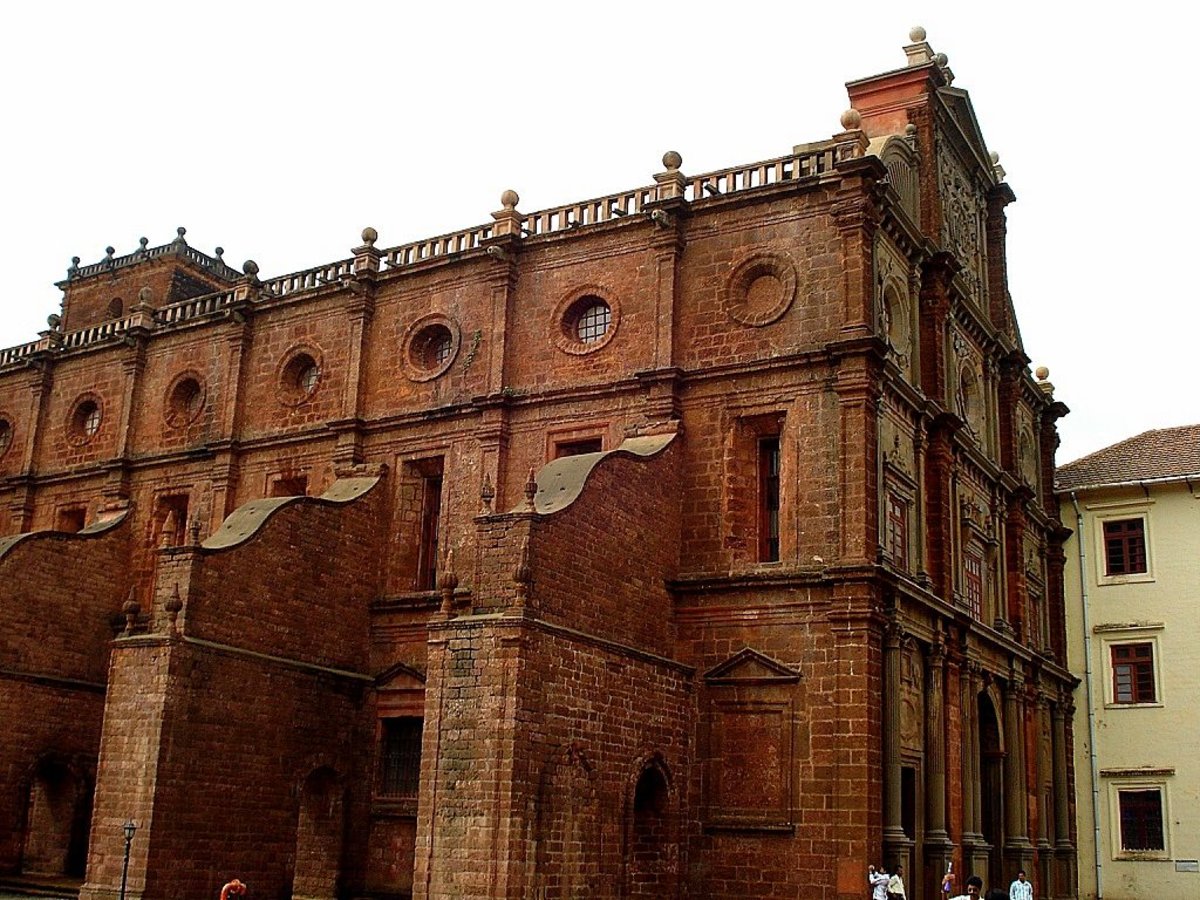
Tomb and Relics of St Francis Xavier
Basilica of Bom Jesus — Old Goa, exterior
Public domain, via Wikimedia Commons
The Basilica of Bom Jesus in Old Goa contains the incorrupt body of St Francis Xavier (1506-1552) — the co-founder of the Society of Jesus and the greatest Christian missionary of the 16th century — preserved in a gilded silver casket above the main altar of the church. The casket (made in 1655 at the cost of the Grand Duke of Tuscany, Cosimo III de' Medici) is a work of elaborate silver craftsmanship: it rests on a three-tiered mausoleum of gilt bronze and marble designed by the Italian sculptor Giovanni Battista Foggini.
The body has been exposed for public veneration on ten-year cycles (an 'exposition') since the 17th century; the most recent exposition was in 2024. The incorruption of the body — it has been continuously examined by church authorities since 1556 — is one of the most widely cited cases of hagiographic incorruption in Catholicism. The basilica itself (completed 1605) is the finest example of Portuguese Baroque architecture in Asia.
St Francis Xavier (1506-1552) was a Basque Jesuit priest who worked as a missionary in India, Southeast Asia, and Japan from 1542 until his death off the coast of China in 1552. In ten years of missionary work, he is credited with over 30,000 baptisms and the establishment of the Church in South India, Sri Lanka, Malacca, the Moluccas, and Japan.
After his death on Shangchuan Island, his body was taken to Old Goa (then the capital of Portuguese India); it was found to be incorrupt upon arrival in 1554. The body has been exposed for veneration on approximately ten-year cycles; portions of the body (a hand, the arm) have been removed and sent to Rome and other locations over the centuries.
The casket containing the body is in the Chapel of St Francis Xavier in the south transept of the basilica, elevated on the Foggini mausoleum approximately 2 metres above the floor. The casket is gilded silver with glass panels through which the body is visible during expositions.
The Foggini mausoleum below the casket is elaborately carved in marble and gilt bronze — scenes from the life of Xavier on the lower tiers. The body during exposition is seen in vestments with the face partially exposed. The smell of incense and oil lamps fills the chapel; pilgrims (including non-Christians from throughout India) come for darshan-style veneration.
When standing before this work, look carefully: Basilica of Bom Jesus — Old Goa, exterior. Give it time — what seems decorative often carries the central meaning.
When standing before this work, look carefully: The gilded silver casket of St Francis Xavier. Give it time — what seems decorative often carries the central meaning.
When standing before this work, look carefully: The Foggini mausoleum — gilt bronze and marble. Give it time — what seems decorative often carries the central meaning.
When standing before this work, look carefully: Basilica of Bom Jesus interior. Give it time — what seems decorative often carries the central meaning.
Basilica of Bom Jesus, Old Goa (Velha Goa), Goa, India. Open daily.
Free admission. Old Goa is a UNESCO World Heritage Site. Modest dress required (shoulders and knees covered).