Basilica of the Annunciation

Basilica of the Annunciation

The Basilica of the Annunciation is built on the site where the Archangel Gabriel appeared to Mary at her home in Nazareth

Type
Basilica
Country
Israel
Scroll
01At a Glance

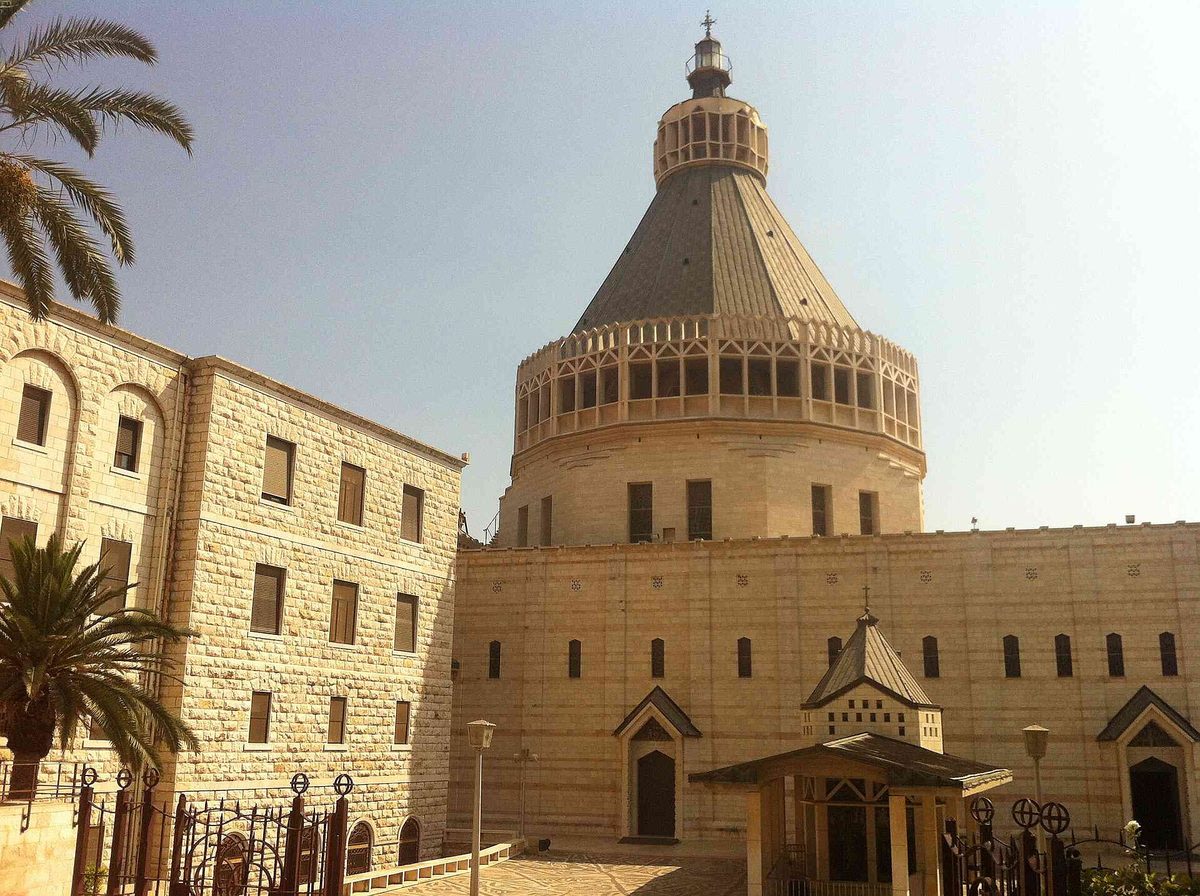
Standing tall over the Nazareth skyline in Israel is the Franciscan run Basilica of the Annunciation, built over the site traditionally believed to be the house of Mary. It is here that the Archangel Gabriel is said to have appeared to her and announced that she would bear a child, who was the son of God- an event referred to as the Annunciation. Completed in 1969, the present church was designed by the Italian architect Giovanni Muzio and built by the Chief Engineer Shlomo Lopatin. Sporting bold and audacious modernist features, the lantern topped dome of the Basilica of the Annunciation is a structure that is completely different from the traditional design found in most basilicas. The striking interiors match the exterior in spectacle and are a befitting tribute to the place which Mary called home. The Basilica is in two sections- the upper one with a soaring dome gives one a sense of great space. In true modernist style the bare concrete is covered with a pattern of dots, which gives the interiors a remarkable artistic appearance. The walls of the church and the courtyard are adorned with a series of depictions of Mary and the infant Jesus from over fifty countries, each one styled in the culture of that particular country. The Grotto of the Annunciation is in the dimly lit lower church, which is the traditional site of Mary’s house. There are remnants of structures from earlier eras, notably from the Byzantine and Crusader churches. The first church to be built here was commissioned by the Emperor Constantine, who had sent his mother St Helena to t he Holy Land to establish churches commemorating important events in the life of Jesus. The first Church of the Annunciation was built in the mid-fourth century and lasted till it its destruction, in the wake of the Muslim conquest of Palestine. When Nazareth was retaken by the Crusaders in 1102 AD, they built a new church on the ruins of the Byzantine one. The church was still not complete at the time of the capture of the city in 1187 AD, by Saladin, who however left it untouched. The Basilica of the Annunciation did not however survive the attack by the Mamluk Sultans of Egypt on Palestine and was destroyed by them in 1260. In the centuries that followed the Franciscans were in and out of Nazareth, depending on the political situation prevailing. They faced numerous hardships in the intervening years, including a massacre of some Franciscans in 1542. They did return in 1620 but could construct only a small structure that enclosed the Holy Grotto. Permission to build a new church came much later in 1730, when Dahir al-Umar, the ruler of Palestine under the Ottoman Empire, acceded to their request. This church was enlarged in 1877 and eventually demolished in 1954 to make way for the present structure.

1

Standing tall over the Nazareth skyline in Israel is the Franciscan run Basilica of the Annunciation, built over the site traditionally believed to be the house of Mary

2

Completed in 1969, the present church was designed by the Italian architect Giovanni Muzio and built by the Chief Engineer Shlomo Lopatin

3

The first church to be built here was commissioned by the Emperor Constantine, who had sent his mother St Helena to t he Holy Land to establish churches commemorating important events in the life of Jesus

4

The first Church of the Annunciation was built in the mid-fourth century and lasted till it its destruction, in the wake of the Muslim conquest of Palestine

5

When Nazareth was retaken by the Crusaders in 1102 AD, they built a new church on the ruins of the Byzantine one

02Plan Your Visit
Getting There
Casa Nova Street, Old City, Nazareth 1601205, Israel

Nazareth is in the Lower Galilee region of northern Israel, 100 km north of Tel Aviv and 40 km from Haifa. By bus from Tel Aviv: 2.5 hours. By bus from Haifa: 1 hour. By car via Route 75. In Nazareth, the basilica is in the Old City, easily reached on foot from the city centre.

Open in Google Maps →
IST (UTC+2:00)
--:--:--

The lower grotto (the Annunciation site) requires tickets at peak times. The church is busiest in early morning — arrive before 9 AM for the most meditative experience. Modest dress is required. Photography is permitted throughout. The Franciscan Terra Sancta Museum next door is highly recommended.

Opening Hours
Basilica8:00 AM - 6:00 PM Mon-Sat; 2:00 PM - 5:00 PM Sunday
Grotto8:00 AM - 5:30 PM Mon-Sat
03Must See

What to seek out, and why it matters

I
Lower level of the basilica

The Annunciation Grotto

The grotto preserved in the lower basilica is the heart of the entire site — a simple cave carved into the Galilean rock, with an altar marking the traditional spot where Gabriel stood and Mary said yes. The inscription on the altar reads Verbum caro hic factum est — The Word was made flesh here. Kneeling here, one is at the still point of Christian history.

II
Upper basilica walls

The International Marian Mosaics

The upper basilica is lined with large mosaic panels depicting the Madonna and Child, donated by Catholic communities from over 50 nations — Japan, Mexico, the United States, Poland, Nigeria, India, Australia, and many more — each in the artistic tradition of its country. The Japanese Madonna with almond eyes, the African Madonna with dark skin, the Mexican Madonna in indigenous dress — together they form the most globally comprehensive visual statement of Marian devotion in existence.

III
Main worship space

The Upper Basilica

The upper basilica, designed by Giovanni Muzio, is a soaring modern Romanesque space centred on a large circular opening in the floor through which one looks down into the grotto below — physically connecting the worship space to the cave beneath. The architectural concept expresses the Incarnation: heaven and earth, the eternal and the historical, connected through a single aperture.

IV
Around the basilica

The Old City of Nazareth

Nazareth's Old City surrounds the basilica with stone lanes, Arab Christian and Muslim shops, and the atmosphere of a Levantine market town. The Church of St Joseph (over the site of Joseph's carpentry workshop), the Greek Orthodox Church of the Annunciation, and the ancient souk are all within walking distance. Walking these lanes — the lanes where Jesus grew up — is part of the pilgrimage.

V
Basilica exterior

The View from the Basilica Courtyard

The large courtyard in front of the basilica offers a view of the modern Nazareth skyline with the ancient hills of the Galilee beyond. Standing here, one is in the hometown of Jesus of Nazareth — the most famous person in human history was born in Bethlehem but grew up here, in this city, in these hills, for the first 30 years of his life.

04Masses & Events
Daily Mass8:00 AM (Latin), various languages throughout the day

Mass celebrated in multiple languages daily for international pilgrims

Feast of the AnnunciationMarch 25

The principal feast; pilgrims from across Israel/Palestine and worldwide

Christmas and EasterDecember 24-25 and variable

Major celebrations in this, the hometown of Jesus

5Reflection & Prayer

The grotto in the lower basilica contains an inscription: Verbum caro hic factum est. The Word was made flesh here. Hic — here. In this particular place, in this particular cave, in this particular town in the hills of Galilee. The Incarnation is not an abstraction — it happened in a specific location, in a specific moment, in a specific conversation between a teenage girl and an angel. The basilica was built to say: here. Don't let the size of the building obscure the smallness of what happened in the cave beneath it.

Luke 1:38

I am the Lord's servant, Mary answered. May your word to me be fulfilled.

Read in full on Bible Gateway →
A Pilgrim's Prayer

Mary, you said yes. In a cave. In a small town. With no witnesses. With no idea of what yes would cost. The Word became flesh in your yes — which means the Word becomes flesh wherever anyone says yes to God without fully understanding the consequences. Let me say my yes. Let me mean it. And let me trust that what you found on the other side of your yes — the Word made flesh — is what waits on the other side of mine. Amen.

06More

Standing tall over the Nazareth skyline in Israel is the Franciscan-run Basilica of the Annunciation, built over the site traditionally believed to be the house of Mary. It is here that the Archangel Gabriel is said to have appeared to her and announced that she would bear a child who was the son of God — an event referred to as the Annunciation.

Architecture

Completed in 1969, the present church was designed by the Italian architect Giovanni Muzio and built by the Chief Engineer Shlomo Lopatin. Sporting bold and audacious modernist features, the lantern-topped dome of the Basilica of the Annunciation is a structure completely different from the traditional design found in most basilicas. The striking interiors match the exterior in spectacle and are a befitting tribute to the place which Mary called home.

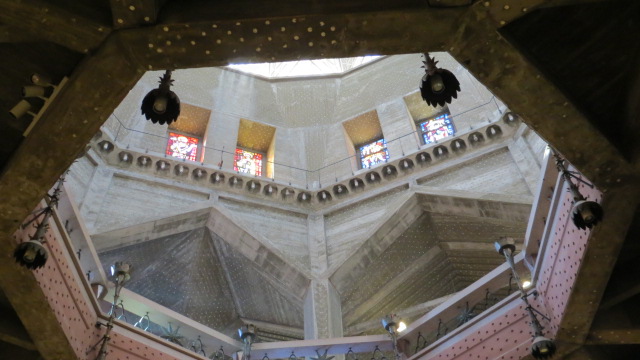
The basilica is in two sections. The upper one, with a soaring dome, gives one a sense of great space. In true modernist style, the bare concrete is covered with a pattern of dots, which gives the interiors a remarkable artistic appearance. The walls of the church and the courtyard are adorned with a series of depictions of Mary and the infant Jesus from over fifty countries, each one styled in the culture of that particular country. The Grotto of the Annunciation is in the dimly lit lower church, which is the traditional site of Mary’s house.

History

There are remnants of structures from earlier eras, notably from the Byzantine and Crusader churches. The first church to be built here was commissioned by the Emperor Constantine, who had sent his mother St Helena to the Holy Land to establish churches commemorating important events in the life of Jesus. The first Church of the Annunciation was built in the mid-fourth century and lasted until its destruction in the wake of the Muslim conquest of Palestine.

When Nazareth was retaken by the Crusaders in 1102 AD, they built a new church on the ruins of the Byzantine one. The church was still not complete at the time of the capture of the city in 1187 AD by Saladin, who however left it untouched. The Basilica of the Annunciation did not survive the attack by the Mamluk Sultans of Egypt on Palestine and was destroyed by them in 1260.

In the centuries that followed, the Franciscans were in and out of Nazareth, depending on the political situation prevailing. They faced numerous hardships in the intervening years, including a massacre of some Franciscans in 1542. They did return in 1620 but could construct only a small structure that enclosed the Holy Grotto. Permission to build a new church came much later, in 1730, when Dahir al-Umar, the ruler of Palestine under the Ottoman Empire, acceded to their request. This church was enlarged in 1877 and eventually demolished in 1954 to make way for the present structure.
Saints Associated With This Site
Part of these pilgrimages
9-day pilgrimage · Nazareth, Cana & the Jordan
Holy Land Classic
View itinerary →
15-day pilgrimage · Galilee
Holy Land + Jordan + Egypt
View itinerary →
More from Israel
Church of the Holy Sepulchre
Old City of Jerusalem
Church of the Nativity
Manger Square, Bethlehem
Church of the Visitation
Jerusalem Retreat Centre, Thrissur
Bypass road, Thalore, Thrissur