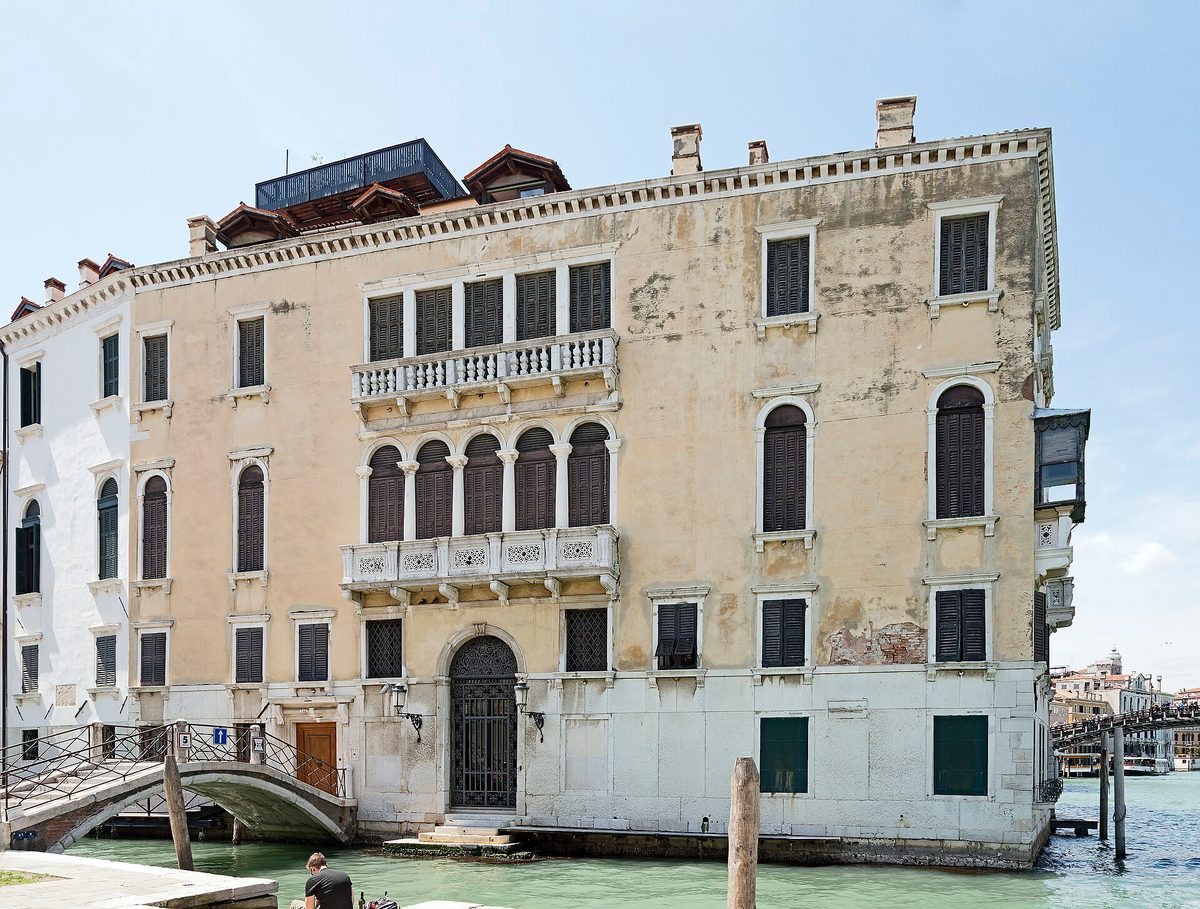
Vittorio Cini was one of the great Italian industrialists and patrons of the twentieth century — a man whose energy, vision and personal tragedy made him simultaneously one of the richest and most admired figures in the Italy of the postwar decades. Born in Ferrara in 1885 into a family of modest means, Cini built a business empire spanning shipping, utilities, insurance and real estate that placed him among the most powerful entrepreneurs in Fascist and then Christian Democratic Italy. He was a close associate of Mussolini — serving as minister for communications in 1943 — and his political associations brought him a brief imprisonment at Dachau after the Allied invasion, an experience that deepened his already serious engagement with questions of mortality and legacy. The death of his son Giorgio, killed in an aeroplane accident in 1949, transformed his philanthropic ambitions: in Giorgio's memory he donated to the Italian state the island of San Giorgio Maggiore opposite the Doge's Palace in Venice, and on it he founded the Fondazione Giorgio Cini, which has become one of the most important centres for the study of Venetian civilisation in the world. Vittorio Cini's personal art collection, housed in his Venetian palazzo on the Grand Canal at Campo San Vio, reflects the tastes of a collector of genuine cultivation and specific enthusiasms. The heart of the collection is a remarkable group of early Italian paintings — Tuscan panels from the thirteenth and fourteenth centuries, and works from the distinctive school of Ferrara, the northern Italian city that produced some of the most individual and least familiar paintings in the history of Italian art. The Tuscan panels — gold-ground Madonnas, narrative scenes from the Life of Christ and the lives of the saints, crucifixion panels and devotional diptychs — represent the tradition of sacred image-making at the moment when it was emerging from the rigid formality of the Byzantine mode into the tentative naturalism of the proto-Renaissance. The Ferrarese works, by painters of the mid-fifteenth and early sixteenth centuries including Cosmè Tura, Francesco del Cossa and Ercole de' Roberti, are characterised by a hard-edged, almost metallic intensity of colour and a predilection for sharply individualised physiognomies that give their devotional subjects a strangeness entirely unlike the warmth of the Florentine tradition. The palazzo itself, accessible from the waterside landing at Campo San Vio, preserves the character of a Venetian private house of the Renaissance period, its rooms hung with paintings and furnished with the carved furniture and decorative objects that Cini also collected. The museum is open only seasonally, which gives visits an atmosphere of privilege and exclusivity — the sense that one is entering a private world momentarily made accessible, rather than a public institution on permanent display.
Early Tuscan gold-ground panels from the thirteenth and fourteenth centuries represent the Christian devotional image-making tradition at the moment of its emergence from Byzantine formality.
Works by Cosmè Tura, Francesco del Cossa and Ercole de' Roberti bring the hard, jewelled intensity of the Ferrarese school — one of Italy's most individual painting traditions — to a Venetian palazzo setting.
Vittorio Cini's personal tragedy — the loss of his son Giorgio — infused his philanthropy with an urgency that produced one of Italy's most important cultural foundations.
The palazzo on the Grand Canal at Campo San Vio preserves the character of a cultivated private home, with paintings hung and furniture arranged as Cini intended.
Seasonal opening hours give the museum an atmosphere of privilege and discovery — one of Venice's most refined and least-known cultural destinations.
Vittorio Cini: Industrialist and Patron
Cini's career as an industrialist began in the 1910s and accelerated through the 1920s and 1930s, when his control of the SADE hydroelectric company, the Lloyd Triestino shipping line and the Venice newspaper Il Gazzettino made him one of the most powerful men in northeastern Italy. His relationship with the Fascist regime was close but ultimately costly: arrested in 1943 after the fall of Mussolini, he was transported to Dachau, where he spent several months before escaping through a bribed guard arrangement. The experience of the camp, combined with the subsequent loss of his son Giorgio, gave his later philanthropy an urgency and a personal weight that distinguished it from the more conventional charitable activities of other Italian magnates of his generation.
The Gold-Ground Panels
The gold-ground Tuscan panels in the Palazzo Cini collection belong to the tradition of the Italian painted cross, the Madonna, and the devotional diptych — image types inherited from Byzantium and adapted, in the Tuscan workshops of the late twelfth through the fourteenth centuries, to the demands of the emerging Italian patron class. The gold backgrounds of these works are not decoration but theology: they represent the golden light of the divine realm, the sacred space in which the figures of the Virgin, Christ and the saints exist independently of terrestrial time and circumstance. Against these grounds, the figures are arranged according to hierarchical rather than spatial logic — larger because more important, frontal because more authoritative — in a visual language that modern viewers must learn to read but that medieval worshippers understood intuitively.
The Ferrarese School
The Este court of Ferrara was one of the most sophisticated and idiosyncratic centres of Italian Renaissance culture, and the painters who served it — Cosmè Tura, Francesco del Cossa, Ercole de' Roberti and their successors — developed a style of painting unlike that of any other Italian school. Where the Florentines valued grace and the Venetians valued colour, the Ferrarese prized a hard, jewelled intensity: enamel-like surfaces, angular drapery that seems to be carved rather than painted, faces of disturbing individuality in which the conventional beauty of the Madonna gives way to an almost Gothic particularity. The devotional works of the Ferrarese school in the Cini collection bring this distinctive tradition to a Venetian palazzo context, their northern sharpness contrasting productively with the more familiar warmth of the Venetian and Florentine works around them.
The Fondazione Giorgio Cini
The Fondazione Giorgio Cini, established on the island of San Giorgio Maggiore in 1951, is one of the most important cultural institutions in Italy. The island, given by Vittorio Cini to the Italian state and then leased to the Foundation, houses a former Benedictine monastery that has been comprehensively restored to serve as a centre for the study of Venetian civilisation in all its aspects — art history, music, theatre, literature, navigation and the decorative arts. The Foundation's library and photographic archive are essential resources for scholars of Italian Renaissance culture, and its series of international symposia and publications have shaped the discipline for seven decades.
The Palazzo and the Grand Canal
The Palazzo Cini, built in the fifteenth century and modified in subsequent centuries, stands on the south bank of the Grand Canal at Campo San Vio, in the Dorsoduro neighbourhood that houses the Peggy Guggenheim Collection and the Gallerie dell'Accademia within a short walk. The palace façade, of Istrian stone, faces the canal with the discreet authority of a great Venetian house, its windows giving views across the water to the Palazzo Barbaro and the distant dome of the Salute. The interior rooms preserve the character of a scholarly and cultivated home — paintings hang at domestic heights, furniture occupies the spaces it was meant to occupy, and the total effect is of a collection displayed in the way its owner intended rather than rearranged for museum purposes.
Visiting
The Galleria di Palazzo Cini is open seasonally, typically from April to November, on a limited schedule of days and hours. Admission is charged and numbers are limited, making advance booking advisable during peak periods. The museum is located in Dorsoduro at Campo San Vio, reachable by vaporetto to the Accademia stop (lines 1 and 2), a five-minute walk away. The Peggy Guggenheim Collection is a two-minute walk further along the Grand Canal. Combined visits to both museums in a single afternoon are entirely practical and deeply rewarding.