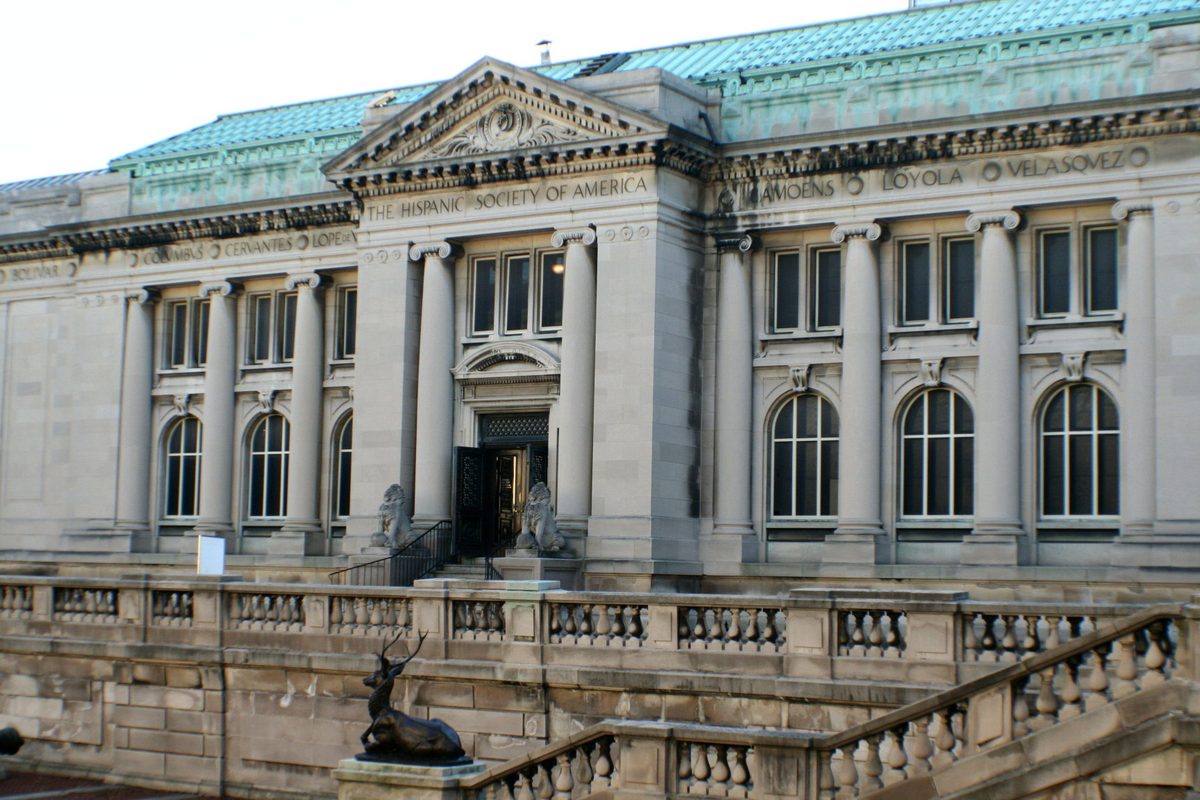
On a hilltop in Washington Heights in upper Manhattan, behind a wrought-iron gate and a bronze equestrian statue of El Cid, lies one of the most astonishing and least-visited art collections in the United States. The Hispanic Society of America was founded in 1904 by Archer Milton Huntington, a scholar and philanthropist of unusual cultivation who had inherited a vast railroad fortune and devoted it entirely to the study and promotion of the arts and cultures of the Hispanic world. Huntington's vision was ambitious: he intended the Hispanic Society to be a comprehensive museum, library and research centre covering the history, art and literature of Spain, Portugal and Latin America, freely accessible to all. In pursuit of this vision he spent decades travelling through Spain, acquiring with systematic intelligence the paintings, sculptures, decorative arts, manuscripts and books that he believed best represented the entirety of Iberian civilisation. The result is, by general scholarly consent, the finest collection of Spanish art outside Spain. The Christian art holdings of the Hispanic Society are extraordinary in both depth and specificity. El Greco — the Cretan-born master who settled in Toledo around 1577 and developed there the incandescent, spiritually charged style that made him the definitive visual voice of the Spanish Counter-Reformation — is represented by his majestic Pietà, a large canvas in which the dead Christ is displayed against a stormy sky, his body supported by the Virgin and attended by angels, with an emotional intensity that reflects both the Cretan icon tradition of El Greco's formation and the Mannerist dynamism he absorbed in Venice and Rome. Bartolomé Esteban Murillo, the Seville master whose tender, accessible images of the Virgin, the saints and biblical narrative made him the most beloved religious painter in seventeenth-century Catholic Europe, contributes the Prodigal Son — a cycle of paintings on the parable's narrative of repentance, forgiveness and reconciliation that are among the most psychologically rich treatments of the subject in all of Baroque painting. Francisco de Zurbarán, whose austere white-habited monks in contemplation became the defining image of Spanish monastic spirituality, is present in works of quiet, luminous power. The Hispanic Society has long been among the best-kept secrets of American cultural life. Free admission, a location far from the main tourist districts, and an institutional modesty that contrasts sharply with the promotional energy of larger museums have kept visitor numbers modest by comparison with the collection's importance. A major renovation and partial reinstallation has in recent years brought renewed attention to the Society's holdings, but it remains a place where serious scholars can spend hours with major works in near-solitude — an experience increasingly rare in the world of blockbuster museum culture.
The greatest collection of Spanish religious art outside Spain — El Greco, Murillo, Zurbarán and Velázquez represent the full tradition of Iberian sacred painting.
El Greco's monumental Pietà distils the entire tradition of Marian lamentation — from Byzantine icon to Counter-Reformation Mannerism — into a supreme statement of theological drama.
Murillo's Prodigal Son cycle is among the most sustained and psychologically searching treatments of biblical parable in all of Baroque painting.
Archer M. Huntington founded the Society in 1904 with his inherited railroad fortune, devoting his life entirely to the study and promotion of Hispanic civilisation.
Admission is free, and the collection remains one of the best-kept secrets of American cultural life — major works accessible in near-solitude.
Archer M. Huntington and the Foundation of the Society
Archer Milton Huntington was born in 1870, the adopted son of Collis P. Huntington, the railroad magnate whose Central Pacific Railroad formed the western half of America's first transcontinental line. Archer inherited a fortune of approximately ten million dollars at his stepfather's death in 1900, and he devoted it without reservation to his scholarly passion for the Hispanic world. He had learned Spanish as a teenager, published scholarly work on the Poema de mio Cid before he was thirty, and travelled extensively through Spain, Morocco and Latin America with a systematic attention to art, architecture and cultural history. The Hispanic Society, which he founded on land he owned in Washington Heights and housed in buildings he commissioned from his friend the architect Charles Pratt Huntington (no relation), was his life's principal achievement — the institutional embodiment of his conviction that the civilisation of the Hispanic world deserved the same serious scholarly attention that German scholarship had devoted to classical antiquity.
El Greco's Pietà
Doménikos Theotokópoulos — El Greco, 'the Greek' — came to Toledo from Rome in the late 1570s and remained there until his death in 1614, developing in the devout, austere atmosphere of the Castilian imperial capital a style of painting unlike anything seen before in European art. His elongated figures, electric colour and atmospheric intensity were the products of his training in the Cretan icon tradition, his encounter with the Venetian Colorism of Titian and Tintoretto, and his assimilation of the Roman Mannerism he encountered in the workshop of Giulio Clovio. The Pietà in the Hispanic Society is a large canvas painted late in his career, when his formal language had reached its fullest development: the dead Christ lies in the foreground with the blue-grey pallor of the recently deceased, the Virgin's face above him compressed by grief into an almost abstract intensity, and behind them a sky of roiling clouds lit by a supernatural light that has no source in the physical world. The painting distils the entire tradition of Marian lamentation — from the Byzantine threnos to the Italian Pietà — into a moment of concentrated theological drama.
Murillo and the Prodigal Son
Bartolomé Esteban Murillo painted the Prodigal Son cycle — six scenes from the parable in Luke 15:11–32 — for a private patron in Seville around 1660, and it represents one of his most sustained and psychologically searching engagements with biblical narrative. Murillo was the supreme painter of Sevillian popular Catholicism: his Immaculate Conceptions, his street children and his images of the Virgin combine tenderness, humanity and a deeply personal faith in divine mercy that made him the most reproduced religious painter in Europe during the eighteenth and nineteenth centuries. In the Prodigal Son cycle he extends his range to include psychological narrative: the young man's departure with his inheritance, his degradation among the swine, his moment of resolution, his father's embrace — each episode painted with a directness and emotional honesty that makes the parable's theology of forgiveness newly intelligible in every generation.
Zurbarán and Spanish Monastic Spirituality
Francisco de Zurbarán spent most of his career in Seville, working for the great monastic establishments — Carthusian, Dominican, Jeronymite, Mercedarian — that dominated Spanish religious life in the seventeenth century. His white-habited monks, standing in meditation or kneeling before the cross with an intensity of devotional absorption that seems to exclude the physical world entirely, became the most distinctive icons of Spanish Catholic spirituality: an art of absolute simplicity, achieved by the most refined pictorial means. The light in Zurbarán's paintings is not the warm, diffuse light of Venetian painting or the dramatic chiaroscuro of Caravaggio but something harder and colder — a Castilian light that shows the folds of a white habit with the precision of a sculptor's chisel and leaves the space beyond the figure in profound, absolute shadow.
The Library and the Sorolla Paintings
The Hispanic Society's library holds approximately 300,000 books, manuscripts and documents relating to the history of the Hispanic world, including several hundred items dating from before 1701, among them incunabula, illuminated manuscripts, and early printed Bibles and liturgical books that are primary sources for the study of Spanish religious culture. The Society's other great public asset is Joaquín Sorolla's Visions of Spain — fourteen enormous canvases, each depicting a different region of Spain in its traditional costume and landscape, commissioned by Huntington in 1911 and installed in the main hall in 1926. These monumental paintings, not Christian art in any formal sense, nevertheless reflect the deep Catholic texture of Spanish popular life — processions, pilgrimages, feast days — with an intimacy and love that makes them an extraordinary complement to the formally religious works in the collection.
Visiting
The Hispanic Society Museum and Library is located at 613 West 155th Street in Washington Heights, easily reached by the 1 train to 157th Street station. Admission is free. The main hall — the Sorolla room — is open to all visitors; access to the library and study rooms is available to scholars by appointment. The building complex, designed by Charles Pratt Huntington in a Spanish Renaissance Revival style, is itself an architectural achievement worth visiting. The society's ongoing renovation has improved visitor facilities considerably in recent years.