Thomas Aquinas Tomb at Toulouse

Thomas Aquinas Tomb at Toulouse

The relics of St Thomas Aquinas are preserved in the historic 13th century Church of the Jacobins. Click for history, timings and location.

Type
Shrine
Country
France
Location
Place des Jacobins, 31000 Toulouse, France
Scroll
01At a Glance

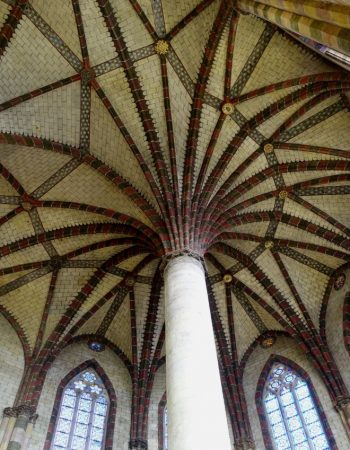
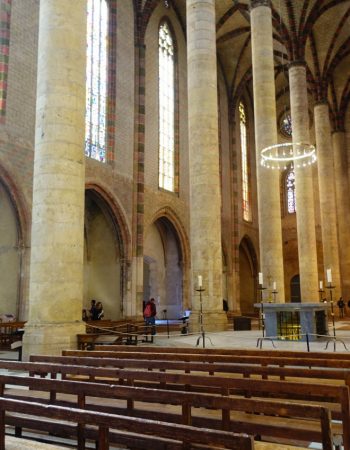
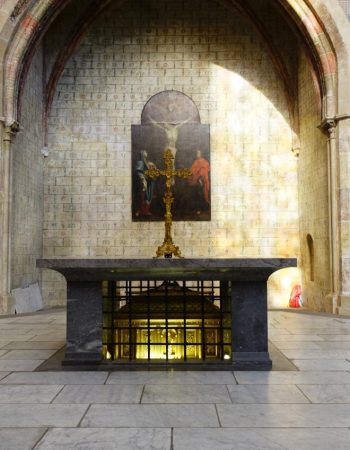
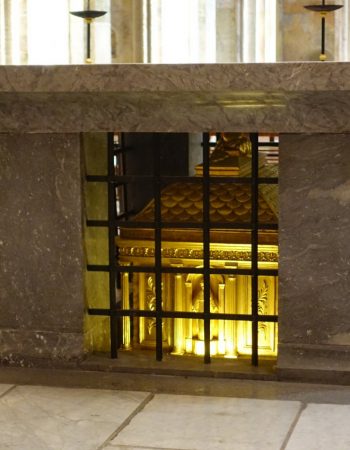
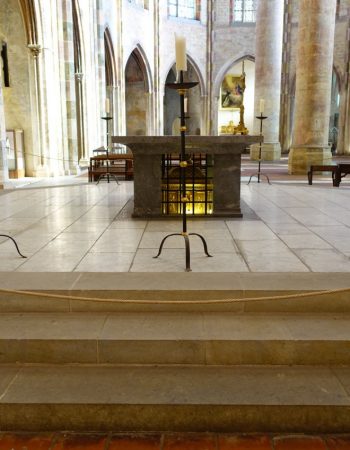
The Relics of St Thomas Aquinas at the Church of the Jacobins, Toulouse, France Standing majestically in the heart of Toulouse, France, is a huge Gothic structure of brick and stone. The main claim to fame of this building known as the Church of the Jacobins is the tomb of St Thomas Aquinas, whose remains are entombed in a golden reliquary beside the altar. One of its striking features are the huge palm tree columns that support the main nave’s ceiling. These are complemented by impressive stained-glass windows that tower alongside. Dating back to 1230, the Church of the Jacobins traces its origins to a small community of monastic preachers originally founded by St Dominic at Toulouse. It has weathered many storms in its complicated history that spans almost eight centuries. A series of historical twists and turns starting from the French Revolution led to the eventual de-consecration of the church. Although the church is no longer in active use, a part of it has been converted into a museum. A landmark event in its history was the takeover by Napoleon who used it as an armoury, besides having the walls whitewashed to cover its beautiful medieval frescoes. Appalled at the destruction, outraged citizens of Toulouse managed to convince the army to move to other barracks. A series of restorations conducted over the last 150 years have seen this beautiful structure regain much of its former glory. Today it stands in quiet solitude, having borne witness to tumultuous events like the banishment of its Dominican founders in the wake of the French Revolution, the takeover by Napoleon and the destruction brought about by two world wars. But who exactly is Thomas Aquinas and what is it about him that lends such great significance to the Church of the Jacobins? A Doctor of the Church and arguably its most influential theologian, St Thomas Aquinas was a Dominican Friar whose works have had a far reaching and profound impact on Western thought. Ranked alongside the four great Latin fathers of the Church- St Ambrose, St Augustine of Hippo, St Jerome of Stridon and the Pope St Gregory the Great- St Thomas Aquinas has been described as “one of the dozen greatest philosophers of the western world”. St Thomas was born in 1225 to an aristocratic Italian family. His father Landulf of Aquino was a man of means and power and served as a knight under the Holy Roman Emperor Frederick II. Being the nephew of Sinibald, Abbot of the Monte Cassino Benedictine monastery, it was expected of Thomas to follow his uncle into the order. Thomas showed great scholarly promise at a tender age and was enrolled by his father first at Cassino and later at the recently established studium generale (Medieval University) at Naples. It is here that Thomas was introduced to the thought of Aristotle and to the Dominican Order which had been established a few years earlier in 1215. The former was to exercise great influence on his thinking and the books he authored, while the latter shaped the nature of his calling into religious life. The decision of Thomas to join the Dominican Order was not looked upon kindly by his family. They attempted to dissuade him by means of abduction and then confinement in the family castle for nearly a year. The undeterred Thomas was firm in his resolve and eventually the family accepted the path that he had chosen for himself. Thomas was sent to Paris to enrol in University of Paris where he learnt the Arts. It was here Thomas came into contact with Albertus Magnus, a Dominican scholar who mentored him. Quiet by nature and reticent in speech, Thomas invited ridicule from his fellow students who thought him to be slow. It was Albertus who pronounced with great insight, “You call him the dumb ox, but in his teaching he will one day produce such a bellowing that it will be heard throughout the world”. St Thomas Aquinas was to resoundingly prove this prophecy correct as he went on to master his subjects and author great works on theology and philosophy, which to this day remain the cornerstone of the teachings of the Roman Catholic Church. St Thomas was the first theologian to marry the philosophy of Aristotle to the principles of Christianity. He held that reason was to be found to be in God and that the existence of God was not contrary to logic and science. The rise of Thomism and the Theology of St Thomas Aquinas Notable among his works is the Summa Theologica which is the most referred work of Theology in not just the Roman Catholic Church, but also in the Eastern Catholic Churches as well as in mainstream Protestant denominations. It is however an unfinished work as St Thomas Aquinas abandoned writing of the third part, soon after two mystical experiences that he is traditionally held to have experienced. He is said to have cryptically remarked to his secretary and fellow Dominican, Reginald of Piperno thus “Mihi videtur ut palea” or “All that I have written seems like straw compared to what has now been revealed to me”. St Thomas died on 7 March 1274, weeks before he was to present his work at the Second Council of Lyon to which he had been summoned by Pope Gregory X. In 1567, St Thomas Aquinas was proclaimed a Doctor of the Church by Pope Pius V. In the encyclical Aeterni Patris , issued by Pope Leo XIII on 4th August 1879, the theology of Thomas Aquinas was accorded central place in the doctrine of the Church. The following year he was declared patron of all Catholic educational establishments. Toulouse is one of the most important cities of France and has an international airport. Conveniently connected by train to major French cities, it is 133 kms away from Lourdes and is a popular stop for pilgrims en route to this important Catholic destination in France.

1

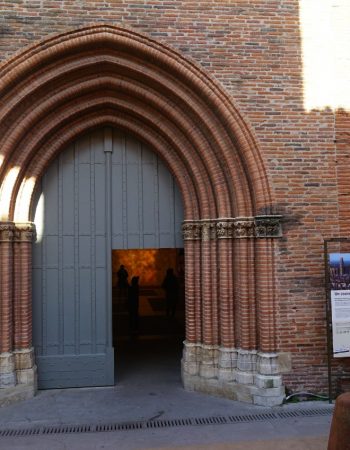
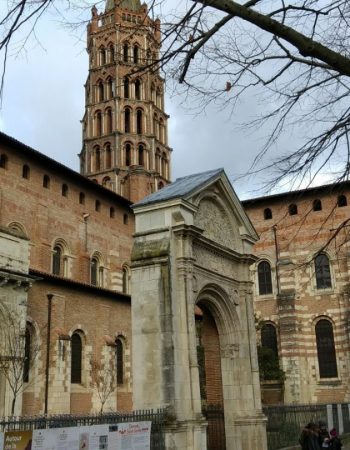
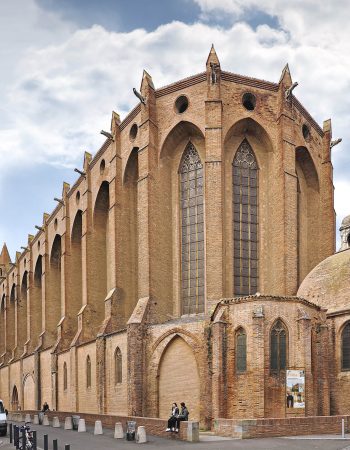
The Relics of St Thomas Aquinas at the Church of the Jacobins, Toulouse, France Standing majestically in the heart of Toulouse, France, is a huge Gothic structure of brick and stone

2

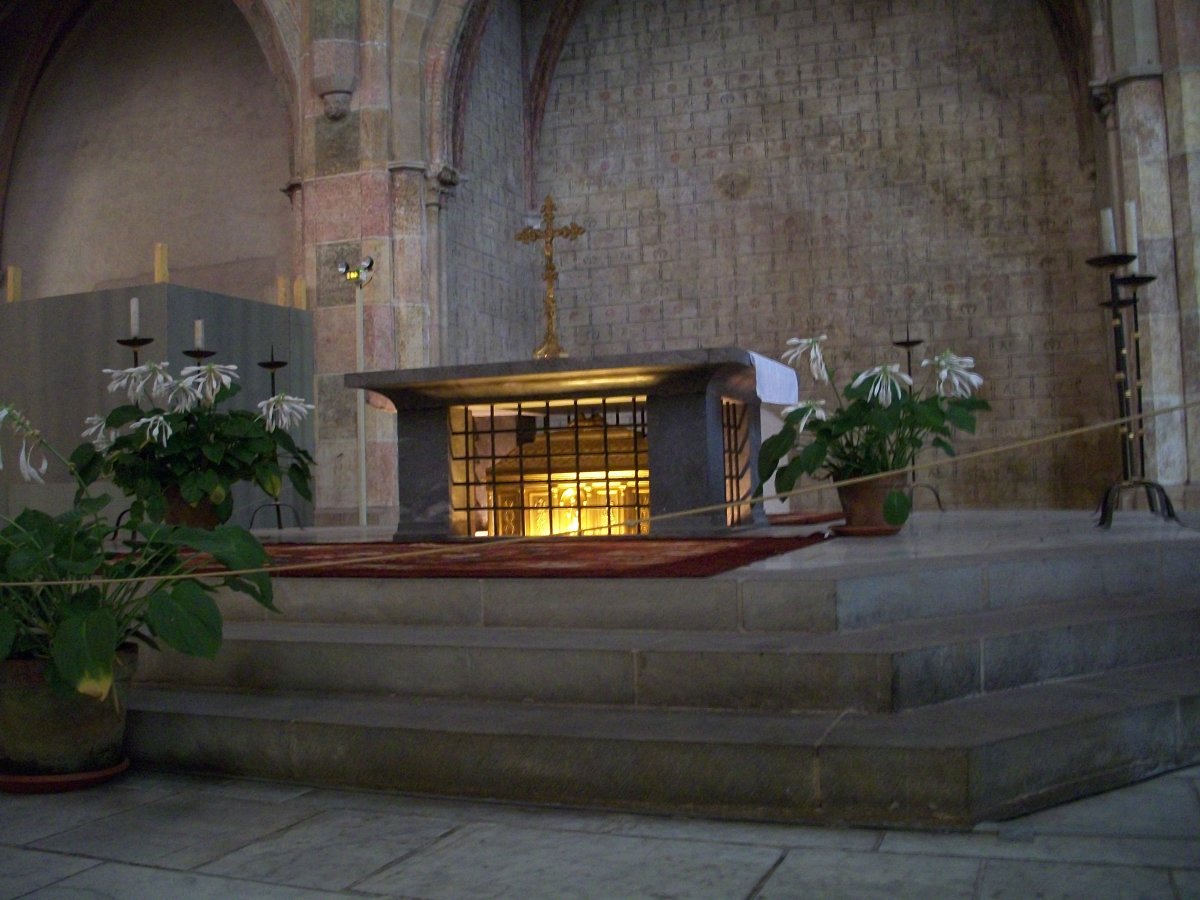
The main claim to fame of this building known as the Church of the Jacobins is the tomb of St Thomas Aquinas, whose remains are entombed in a golden reliquary beside the altar

3

Dating back to 1230, the Church of the Jacobins traces its origins to a small community of monastic preachers originally founded by St Dominic at Toulouse

4

Thomas showed great scholarly promise at a tender age and was enrolled by his father first at Cassino and later at the recently established studium generale (Medieval University) at Naples

5

It is here that Thomas was introduced to the thought of Aristotle and to the Dominican Order which had been established a few years earlier in 1215

02Plan Your Visit
Getting There
Eglise des Jacobins, Rue Lakanal, 31000 Toulouse, France

In the centre of Toulouse, a 5-minute walk from Place du Capitole. Metro: Capitole Station (Line A), 5 minutes. From Toulouse Matabiau station: 20-minute walk or 10 minutes by Metro.

Open in Google Maps →
CET (UTC+1:00)
--:--:--

The Jacobins church is an extraordinary building even outside of its reliquary significance. The palm column alone justifies the visit. The acoustics are remarkable. Evening concerts are regularly held here.

Opening Hours
Church9:00 AM - 7:00 PM daily; closed during special events
03Must See

What to seek out, and why it matters

I
Inside the church

The Palm Column

The single central column from which 22 ribs spread in a palm pattern to support the entire vaulted ceiling of the apse — the palm of the Jacobins — is one of the most beautiful structural innovations in medieval architecture. No photograph conveys what it is to stand beneath it and look up at the ribs spreading above. It is geometry as theology: unity at the centre, diversity radiating outward.

II
Beneath the palm column

The Reliquary of St Thomas Aquinas

The golden reliquary containing the relics of Thomas Aquinas — placed beneath the palm column — is the destination of the pilgrimage. Praying at the relics of the greatest theologian of the medieval Church, in the finest Gothic church of the Languedoc, in the city that his order called home, is one of the most intellectually and spiritually rich pilgrimage experiences in France.

III
Inside and outside

The Southern Gothic Architecture

The Church of the Jacobins is a masterpiece of southern French Gothic — the brick construction, the alternating course of red brick and white stone, the soaring height, and the twin nave created by the central row of columns. The exterior view from the cloisters is magnificent. The building is an argument for the compatibility of beauty and faith.

IV
Adjacent to the church

The Cloisters

The Jacobins cloisters — the medieval Dominican monastery complex adjacent to the church — provide a quiet enclosure for meditation. Walking the cloister is the monastic walk: the covered walkway, the open garden at the centre, the sound of the fountain, the architecture of community. Aquinas walked such cloisters in Paris and Naples.

V
Context of the visit

The Intellectual Pilgrimage

A pilgrimage to the tomb of Thomas Aquinas is a pilgrimage to the question of faith and reason. Aquinas spent his life arguing that faith and reason are not enemies but partners: that the natural light of reason and the supernatural light of faith both come from God and cannot therefore be ultimately contradictory. The tomb is the resting place of the man who made this argument most comprehensively.

04Masses & Events
Feast of St Thomas AquinasJanuary 28

The Doctor's feast — academic pilgrimage occasion

Regular VisitsDaily 9:00 AM - 7:00 PM

The church is open daily

Concerts and EventsYear-round

The acoustics make this a major concert venue

5Reflection & Prayer

Thomas Aquinas was so large and silent as a student that his classmates called him the dumb ox. Albert the Great said: the dumb ox will bellow so loud that his bellowing will fill the world. The Summa Theologiae has 3,125 articles addressing 10,000 objections. It is not finished — Aquinas put it down three months before he died, after a mystical experience in which he said that compared to what he had seen, everything he had written seemed like straw. The greatest theological synthesis in Christian history ends with its author saying: this is straw. What remained unwritten was greater.

Proverbs 8:22-23

The Lord brought me forth as the first of his works, before his deeds of old; I was formed long ages ago, at the very beginning, when the world came to be.

Read in full on Bible Gateway →
A Pilgrim's Prayer

Wisdom: the first of God's works, the beginning of the beginning. Thomas spent his life pursuing wisdom — not as something he could possess but as something that possesses its possessors. He filled volumes. He said at the end it was straw. Let me pursue wisdom with the same relentlessness, and hold what I find with the same humility: never mistaking what I have understood for what remains to be understood. Amen.

06More

Standing majestically in the heart of Toulouse, France, is a huge Gothic structure of brick and stone. The main claim to fame of this building, known as the Church of the Jacobins, is the tomb of St Thomas Aquinas, whose remains are entombed in a golden reliquary beside the altar.

The Church of the Jacobins

One of its striking features are the huge palm-tree columns that support the main nave’s ceiling. These are complemented by impressive stained-glass windows that tower alongside. Dating back to 1230, the Church of the Jacobins traces its origins to a small community of monastic preachers originally founded by St Dominic at Toulouse. It has weathered many storms in its complicated history, which spans almost eight centuries.

A series of historical twists and turns starting from the French Revolution led to the eventual de-consecration of the church. Although the church is no longer in active use, a part of it has been converted into a museum. A landmark event in its history was the takeover by Napoleon, who used it as an armoury, besides having the walls whitewashed to cover its beautiful medieval frescoes. Appalled at the destruction, outraged citizens of Toulouse managed to convince the army to move to other barracks.

A series of restorations conducted over the last 150 years have seen this beautiful structure regain much of its former glory. Today it stands in quiet solitude, having borne witness to tumultuous events like the banishment of its Dominican founders in the wake of the French Revolution, the takeover by Napoleon, and the destruction brought about by two world wars.

Who Was Thomas Aquinas?

But who exactly is Thomas Aquinas, and what is it about him that lends such great significance to the Church of the Jacobins? A Doctor of the Church and arguably its most influential theologian, St Thomas Aquinas was a Dominican friar whose works have had a far-reaching and profound impact on Western thought. Ranked alongside the four great Latin fathers of the Church — St Ambrose, St Augustine of Hippo, St Jerome of Stridon and Pope St Gregory the Great — St Thomas Aquinas has been described as “one of the dozen greatest philosophers of the western world”.

Early Life

St Thomas was born in 1225 to an aristocratic Italian family. His father, Landulf of Aquino, was a man of means and power and served as a knight under the Holy Roman Emperor Frederick II. Being the nephew of Sinibald, Abbot of the Monte Cassino Benedictine monastery, it was expected of Thomas to follow his uncle into the order. Thomas showed great scholarly promise at a tender age and was enrolled by his father first at Cassino and later at the recently established studium generale (medieval university) at Naples. It is here that Thomas was introduced to the thought of Aristotle and to the Dominican Order, which had been established a few years earlier in 1215. The former was to exercise great influence on his thinking and the books he authored, while the latter shaped the nature of his calling into religious life.

The decision of Thomas to join the Dominican Order was not looked upon kindly by his family. They attempted to dissuade him by means of abduction and then confinement in the family castle for nearly a year. The undeterred Thomas was firm in his resolve, and eventually the family accepted the path that he had chosen for himself.

The Dumb Ox

Thomas was sent to Paris to enrol in the University of Paris, where he learnt the Arts. It was here that Thomas came into contact with Albertus Magnus, a Dominican scholar who mentored him. Quiet by nature and reticent in speech, Thomas invited ridicule from his fellow students, who thought him slow. It was Albertus who pronounced with great insight: “You call him the dumb ox, but in his teaching he will one day produce such a bellowing that it will be heard throughout the world.” St Thomas Aquinas was to resoundingly prove this prophecy correct, as he went on to master his subjects and author great works on theology and philosophy, which to this day remain the cornerstone of the teachings of the Roman Catholic Church.

Faith and Reason

St Thomas was the first theologian to marry the philosophy of Aristotle to the principles of Christianity. He held that reason was to be found in God, and that the existence of God was not contrary to logic and science.

The Summa Theologica

Notable among his works is the Summa Theologica, which is the most referred-to work of theology not just in the Roman Catholic Church, but also in the Eastern Catholic Churches as well as in mainstream Protestant denominations. It is, however, an unfinished work, as St Thomas Aquinas abandoned writing the third part soon after two mystical experiences that he is traditionally held to have undergone. He is said to have cryptically remarked to his secretary and fellow Dominican, Reginald of Piperno: “Mihi videtur ut palea”, or “All that I have written seems like straw compared to what has now been revealed to me.”

St Thomas died on 7 March 1274, weeks before he was to present his work at the Second Council of Lyon, to which he had been summoned by Pope Gregory X.

Doctor of the Church

In 1567, St Thomas Aquinas was proclaimed a Doctor of the Church by Pope Pius V. In the encyclical Aeterni Patris, issued by Pope Leo XIII on 4 August 1879, the theology of Thomas Aquinas was accorded central place in the doctrine of the Church. The following year he was declared patron of all Catholic educational establishments.

Visiting

Toulouse is one of the most important cities of France and has an international airport. Conveniently connected by train to major French cities, it is 133 km away from Lourdes and is a popular stop for pilgrims en route to this important Catholic destination in France.
Saints Associated With This Site
More from France
Creation Museum, Kentucky
2800 Bullittsburg Church Rd, Petersburg, KY 41080
Divine Mercy Shrine, Krakow, Poland
Poznańska 183, 05-850 Ożarów Mazowiecki, Poland
Our Lady of Guadalupe
Mexico City
Our Lady of Aparecida
Aparecida