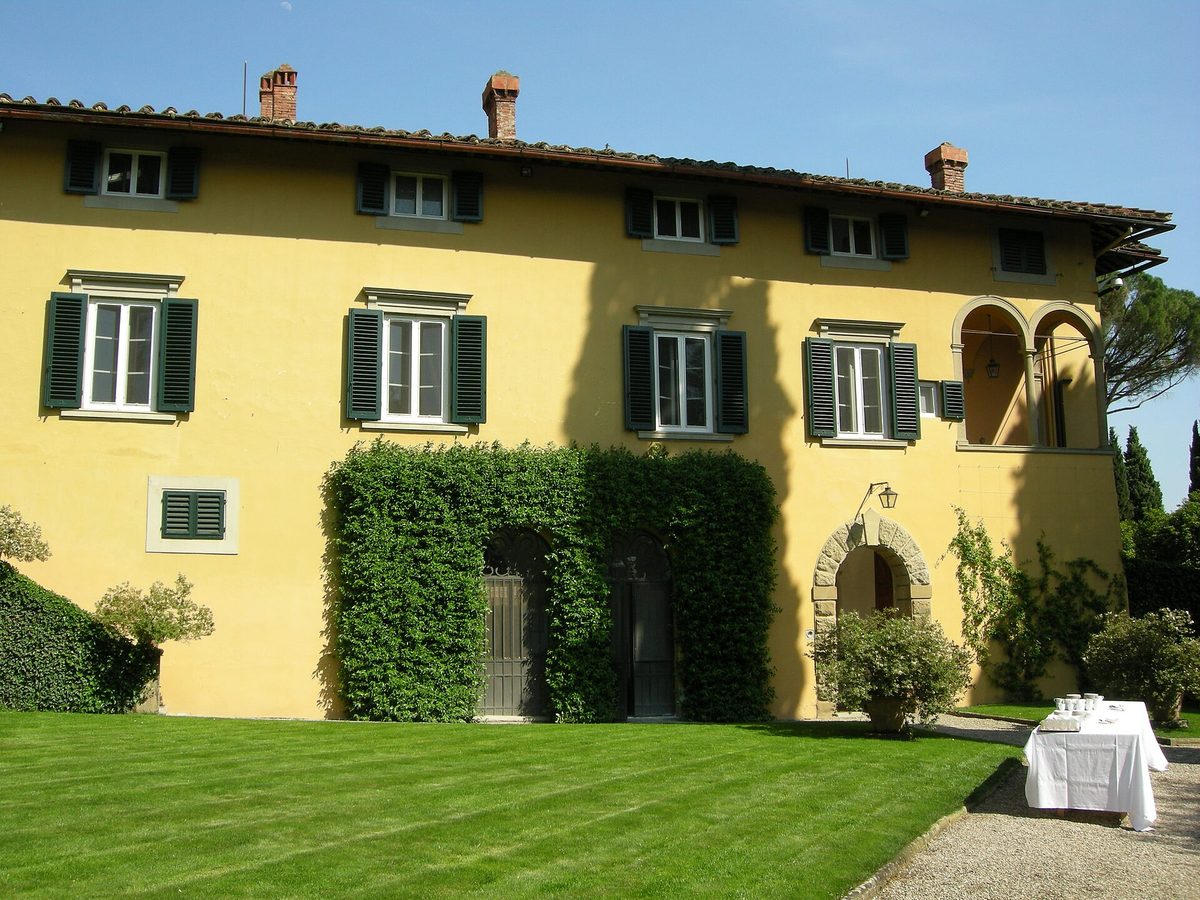
Bernard Berenson was the most influential connoisseur of Italian Renaissance painting in the twentieth century — perhaps the most influential such figure in history. Born in Butrimonys, Lithuania, in 1865, the son of Jewish immigrants who brought him to Boston as a child, Berenson educated himself in art history at Harvard and then at Oxford and Berlin before settling permanently in Florence in the 1890s. His early publications — The Venetian Painters of the Renaissance (1894), The Florentine Painters of the Renaissance (1896), The Central Italian Painters of the Renaissance (1897) and The North Italian Painters of the Renaissance (1907) — established the scholarly framework within which Italian Renaissance painting was understood and collected for the entire first half of the twentieth century. His concept of 'tactile values' — the quality in a painting that makes the viewer's hand want to reach toward it, the illusion of sculptural presence achieved through the painter's manipulation of light and tone — gave collectors and museum directors a vocabulary for discussing the qualities that made great painting great, and his attribution opinions, expressed in these books and in private correspondence, governed the market for Italian Old Masters for half a century. Villa I Tatti, which Berenson purchased in 1900 and expanded and restored over the following decades with the help of the garden designer Cecil Pinsent, is the physical embodiment of this connoisseurship. The house stands on a hillside in Settignano, a village above Florence known for its tradition of stone carving, with views across the cypress-dotted slopes toward the city and the distant Arno valley. Berenson filled it over sixty years with the objects that most expressed his vision of the Italian Renaissance: early paintings, drawings, photographs (the Fototeca, his systematic photographic archive of Italian art, was a pioneering scholarly tool), books and manuscripts that together constituted a private scholarly environment of extraordinary refinement. His collection of early Italian religious panels — gold-ground Madonnas, devotional diptychs, narrative scenes from the Passion and the lives of the saints — reflects both his scholarly expertise and his deeply personal response to the beauty of these small, luminously painted objects. Berenson bequeathed Villa I Tatti to Harvard University in 1960, and it now operates as the Harvard University Center for Italian Renaissance Studies, hosting approximately fifteen to twenty Fellows per year who pursue advanced research in all aspects of Italian Renaissance culture. Access to the villa and its collections is restricted to scholars, but the gardens and the library are periodically open to the wider academic community, and the scholarly publications of the Center have an international readership.
Bernard Berenson's collection of gold-ground Tuscan and Venetian panels represents the material evidence for the scholarly arguments that defined the Italian Renaissance canon.
The Fototeca — Berenson's systematic photographic archive of Italian art, now comprising hundreds of thousands of images — was the first major visual database in art historical scholarship.
Cecil Pinsent's gardens, with their box-hedged parterres and terrace views of Florence, are among the finest examples of the Anglo-Florentine garden style.
Berenson bequeathed the villa to Harvard University in 1960; it now hosts the most prestigious fellowship programme in Italian Renaissance studies.
Access is restricted to academic researchers, preserving the atmosphere of the scholarly private home Berenson created over sixty years of continuous residence.
Bernard Berenson: Connoisseur and Controversialist
Berenson's career was brilliant, contested and morally complicated in ways that have attracted biographical attention for more than a century after his death. His early publications established him as the pre-eminent authority on Italian Renaissance painting, and his attributed works commanded premium prices in the booming Gilded Age market for Old Masters. His relationship with the dealer Joseph Duveen — who paid Berenson a percentage of the price of every work he certified for Duveen's American millionaire clients — gave his scholarship a commercial dimension that modern standards of art historical ethics would regard as a conflict of interest. The arrangement was widely known and widely criticised even in his own time, and some of his attributions were later revised, but the scholarly framework he created remained the foundation of the field. He converted to Christianity — specifically to Roman Catholicism — in 1891, and the devotional dimension of his response to Italian religious art was genuine and personal, not merely aesthetic.
The Collection of Early Italian Panels
The paintings Berenson kept for himself at I Tatti are not the showiest works in his career — he had handled and certified works of much greater celebrity and monetary value — but they are among the most personally meaningful. The collection of gold-ground Tuscan and Venetian panels focuses on the period he had studied most deeply: the thirteenth and fourteenth centuries, the age of Cimabue, Duccio and the young Giotto, when the conventions of Byzantine icon-making were being gradually inflected by the naturalistic observation that would culminate in Masaccio and Fra Angelico. These small objects — Madonnas, crucifixes, diptychs depicting scenes of the Passion — are the material evidence for the scholarly arguments that had made Berenson famous. To see them in the rooms where he lived and worked is to understand the deep continuity between his life and his scholarship.
The Fototeca Berenson
Among Berenson's most important scholarly contributions was the Fototeca — his systematic photographic archive of Italian art, which he began building in the 1890s and which eventually comprised hundreds of thousands of photographs of paintings, sculptures and architectural details from museums, churches, private collections and archaeological sites across Italy and beyond. The Fototeca, now held by the Harvard Center at I Tatti and augmented by subsequent curatorial additions, was the first major photographic archive in art historical scholarship, and it anticipated by decades the visual databases that are now standard tools of the discipline. Berenson used the photographs to compare attributions, track the movement of individual hands across multiple works, and build the systematic catalogues of individual artists that constituted the central scholarly achievement of his career.
Cecil Pinsent and the Gardens
The garden at Villa I Tatti was designed by the British architect Cecil Pinsent, who worked at I Tatti from 1909 onward and created one of the finest examples of the Anglo-Florentine garden style in the hills above the city. The formal garden, closest to the house, consists of box-hedged parterres, stone pools and lemon trees in terracotta pots, arranged on a central axis that extends the perspective of the main reception room outward into the landscape. Below the formal garden, a series of terraced olive groves and woodland paths descends toward the valley, with views of Florence and of the surrounding countryside that Berenson considered among the finest in Tuscany. The garden reflects Berenson's conviction — shared with his contemporaries Henry James and Edith Wharton — that the Italian garden was one of the supreme achievements of the Renaissance civilisation he had devoted his life to studying.
The Harvard Center Today
The Harvard University Center for Italian Renaissance Studies at Villa I Tatti accepts approximately eighteen to twenty Fellows per year for residencies of between three months and one year, with preference given to scholars at postdoctoral level or above who are working on projects related to Italy between 1300 and 1600. The Center's library of approximately 130,000 volumes on Italian Renaissance history, art history, literature and culture is one of the most comprehensive specialist libraries in the field. Public lectures and symposia are held throughout the academic year and are open to the wider scholarly community. The Fototeca and the manuscript collection are available to researchers by appointment.
Visiting
Villa I Tatti is not open to the general public; access is restricted to academic visitors associated with the Harvard Center and to scholars with specific research needs. The library and Fototeca are available to qualified researchers by appointment. The gardens are occasionally opened for special events and for participants in the Center's public lecture series. Visitors to Florence who wish to see Berenson's early Italian panels in a museum context should visit the Uffizi, the Bargello and the Museo di San Marco, where works of the same period and tradition are displayed to the public.