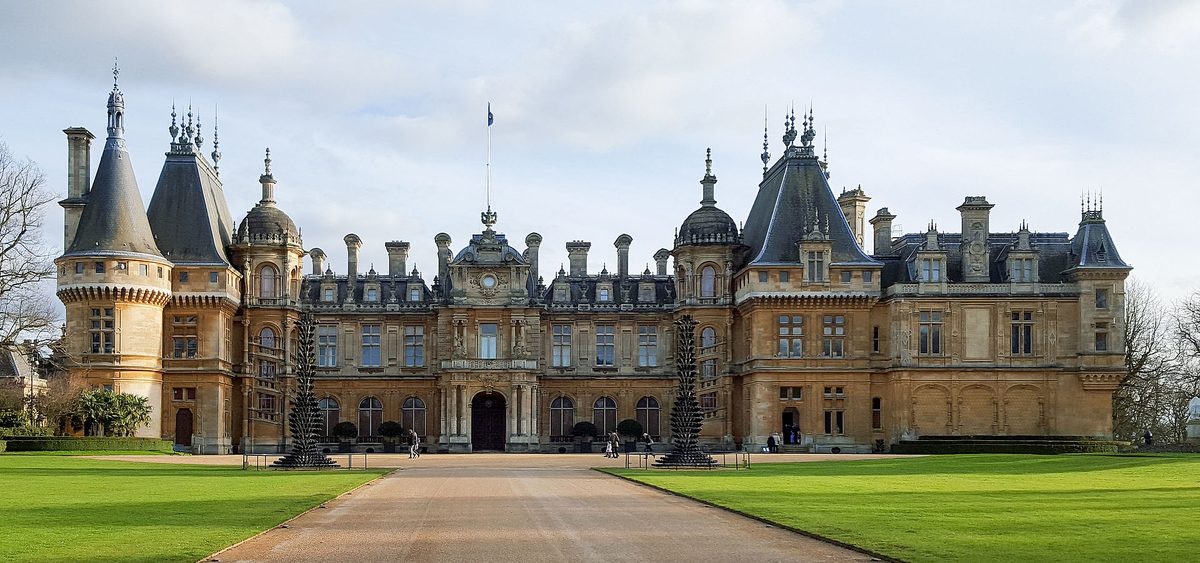
Waddesdon Manor, rising from the Buckinghamshire countryside like a transplanted Loire valley château, is among the most theatrical expressions of Rothschild taste and wealth in Britain. Baron Ferdinand de Rothschild commissioned the French architect Hippolyte Alexandre Gabriel Walter Destailleur to design it in the French Renaissance style, and the house was built between 1874 and 1889 on a hilltop that required careful landscaping and the laying of a special tramway to haul construction materials. The result is a building of extraordinary confidence — turrets, dormers and carved stonework proliferating against the English sky — that houses one of the most important private art collections ever assembled outside a national museum. The Rothschild family's engagement with Christian art is long and nuanced. As Jewish bankers who moved in the highest European court circles, the Rothschilds collected Old Masters with the same systematic intensity they brought to financial markets, acquiring works that bore no particular religious resonance for themselves but carried the highest aesthetic prestige. Among the Christian art in the Waddesdon collection are works by Sandro Botticelli, whose graceful, melancholy Madonnas represent the finest flowering of Florentine Quattrocento religious painting. Nicolas Poussin, the French Baroque master who spent most of his career in Rome and whose austere, classically ordered compositions meditated on biblical and mythological subjects with philosophical rigour, is also represented. The broader collection includes Flemish and Dutch religious genre scenes, French court paintings with devotional subjects, and a magnificent library of illuminated manuscripts and early printed books that touch on sacred texts. Beyond what remains at Waddesdon, the Rothschild family's extraordinary generosity to public institutions has shaped Christian art holdings worldwide. The family's gifts to the Louvre over several generations amount to hundreds of major works, including medieval religious ivories, enamels and panel paintings of the first rank. Waddesdon itself was bequeathed to the National Trust in 1957 by James de Rothschild, along with a substantial endowment, and continues to be managed by the Rothschild Foundation, which maintains both the building and the collection to museum standards.
Built by Baron Ferdinand de Rothschild in the French Renaissance style, Waddesdon is among the finest Victorian country houses in England.
The collection includes Old Master religious works by Botticelli, Poussin and Flemish masters, displayed alongside the finest French decorative arts in private hands.
The Rothschild family's gifts to the Louvre over several generations constitute one of the great acts of private Christian art philanthropy in European history.
Bequeathed to the National Trust in 1957 with a substantial endowment, Waddesdon is now managed by the Rothschild Foundation.
The house and garden are open to the public for much of the year, offering an unparalleled encounter with Rothschild taste and Old Master religious painting.
Baron Ferdinand and the Building of Waddesdon
Ferdinand de Rothschild was born in Paris in 1839, the son of Anselm von Rothschild of the Vienna branch of the family. He moved to England after his marriage in 1865, became a British subject, and was elected to Parliament as the MP for Aylesbury in 1885. He was a collector of intense cultivation and specific tastes — his focus was on the decorative arts of eighteenth-century France, and he assembled at Waddesdon the finest collection of Sèvres porcelain, Savonnerie carpets and Louis XV and XVI furniture outside the Versailles collections. The paintings at Waddesdon were chosen to complement this decorative programme: Flemish and Dutch masters, English portraiture, and Old Master religious works that provided intellectual and aesthetic ballast to the rooms of furniture and porcelain.
Botticelli and the Florentine Tradition
Sandro Botticelli's presence in the Waddesdon collection connects the manor to the most refined current of early Renaissance religious painting. Botticelli was the favoured painter of the Medici circle in late-fifteenth-century Florence, and his images of the Madonna and Child — the gold-ground panels that move effortlessly between Byzantine formality and humanist tenderness — represent the moment when Christian devotional art achieved a perfect equilibrium between spiritual authority and human beauty. The Rothschilds recognised in Botticelli the same quality of refined intelligence that characterised their own collecting sensibility: an art that rewards close attention and reveals its depths slowly.
The Rothschild Gifts to the Louvre
The family's donations to the Louvre constitute one of the most significant acts of private cultural philanthropy in European history. Over the course of the nineteenth and twentieth centuries, successive generations of the French branch of the family gave the Louvre hundreds of works spanning medieval enamels and ivories, Renaissance bronzes and medals, and Old Master paintings — many of them with explicitly Christian subjects. The Rothschild bequest rooms in the Louvre's Decorative Arts wing represent the accumulated generosity of a dynasty that, despite holding no personal religious connection to these Christian objects, recognised their supreme importance to the cultural heritage of Europe.
Nicolas Poussin and the Meditative Tradition
Nicolas Poussin's biblical compositions belong to a tradition of learned, contemplative religious painting that appealed particularly to collectors of intellectual seriousness. Poussin spent most of his career in Rome, surrounded by the monuments of antiquity and the collections of the great Roman noble families, and he developed a style of painting in which classical architecture and drapery provide the setting for meditations on Old and New Testament subjects — the Flight into Egypt, the Holy Family, the Annunciation — that are simultaneously narrative, devotional and philosophical. His presence at Waddesdon reflects the Rothschilds' engagement with the French academic tradition at its most distinguished.
Waddesdon Today
Waddesdon Manor is managed by the Rothschild Foundation under a lease from the National Trust. The house is open to visitors for much of the year, with the collection displayed in the principal rooms much as Baron Ferdinand arranged it. The house is also known for its spectacular garden, its aviary, and its annual Christmas exhibition. A Wine Cellars building in the grounds houses a permanent exhibition on the Rothschild wine estates. The manor's collection database is available online, allowing scholars and visitors to explore works in depth before visiting.
Visiting
Waddesdon Manor is located near the village of Waddesdon in Buckinghamshire, approximately 60 miles northwest of London and easily reached by car or by train to Aylesbury followed by a bus connection. The house is open Wednesday to Sunday from March to December, with admission charges for the house and garden. The grounds are open more widely. Booking is recommended during peak periods. The shop and restaurant operate on extended hours.