
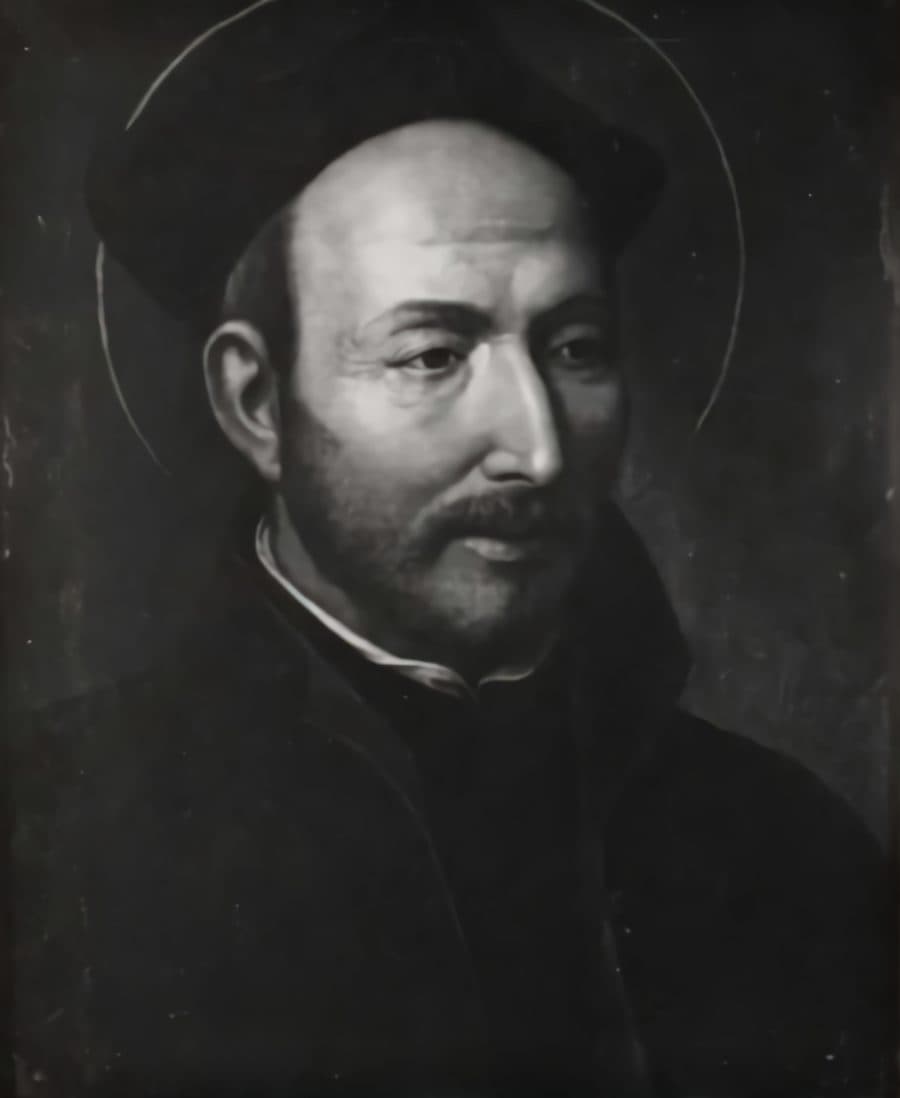
The Life
Inigo Lopez de Loyola was born in 1491 at the castle of Loyola in the Basque Country, the youngest of thirteen children of a minor noble family. He was trained as a soldier and courtier, serving in the army of the Duke of Najera. In 1521, at the siege of Pamplona, a cannonball shattered his right leg and seriously wounded his left. He was taken to Loyola to recuperate — expecting to return to military life after recovery.
During the long months of convalescence he had only two books to read: a life of Christ and a collection of saints' lives. He noticed that when he imagined returning to court life and chivalric adventure, the consolation quickly passed and left him empty; when he imagined imitating the saints, the consolation was lasting and deepened. This observation — the difference in quality between the two types of spiritual movement — became the foundation of Ignatian discernment: the method of distinguishing authentic from inauthentic spiritual movements that is still the most widely practiced approach to spiritual direction in the Catholic world.
He went on pilgrimage to Montserrat, made a general confession, left his sword at the altar of the Black Madonna, and spent nearly a year in Manresa — the town below Montserrat — in intense prayer, penance, and the interior experiences that formed the basis of the Spiritual Exercises. He then made a pilgrimage to Jerusalem, studied in Barcelona, Alcala, Salamanca, and finally Paris, where he gathered the small group of companions — including Francis Xavier and Peter Faber — who became the founding members of the Society of Jesus.
The Society of Jesus, founded by Ignatius and confirmed by Pope Paul III in 1540, was the most effective Catholic response to the Protestant Reformation. It was organized on a semi-military model, with special obedience to the pope, no fixed offices to sing (unlike the traditional monastic orders), maximum mobility, and a specific charism of education and mission. Within decades the Jesuits had founded hundreds of colleges across Europe and were active in India, Japan, Brazil, and China.
The Cannonball at Pamplona — the wound that saved him
At the siege of Pamplona in 1521, Ignatius commanded the small Spanish garrison in a hopeless defense against the French. He was struck by a cannonball that shattered his right leg and wounded his left. As he lay wounded, the fortress capitulated. He was taken to Loyola to recover — where the two books available and the observation of his different interior responses to different imaginations began the process that ended with the Society of Jesus. The cannonball was, as he later understood it, God's intervention to stop a career that was going nowhere in particular and redirect it. The Observation at Loyola — the foundation of discernment The observation Ignatius made during his convalescence is the founding insight of Ignatian spirituality: that different kinds of spiritual movement have different qualities. Imagining court life and chivalric adventure produced consolation that quickly flattened out and left him empty and dry. Imagining imitating the saints produced consolation that was lasting, deepened over time, and left him peaceful. This difference — the quality of the spiritual movement, its duration and direction — is the basis of discernment of spirits: the Ignatian method for distinguishing authentic from inauthentic spiritual movements. Manresa — the Spiritual Exercises are born After leaving his sword at Montserrat's altar, Ignatius spent nearly a year in the town of Manresa, living in a cave by the river Cardoner, in intense prayer and sometimes extreme penitential practices. He experienced both deep consolation and terrible desolation. The interior experiences of Manresa — the mystical experience by the river Cardoner that he described as leaving him a different man — formed the basis of the Spiritual Exercises: the four-week retreat programme that is still the most influential tool of discernment and conversion in the Catholic world. The Society of Jesus — the Jesuit mission The Society of Jesus, founded in 1540, was specifically designed for mission: maximum mobility, minimum institutional attachment, maximum educational effectiveness. Within decades the Jesuits were founding colleges across Europe (the Ratio Studiorum — the Jesuit curriculum — defined European education for centuries), running missions in India (Francis Xavier), Japan, China (Matteo Ricci), Brazil, and Paraguay. The Jesuits were the most effective Catholic response to the Protestant Reformation — not by defeating Protestantism but by renewing Catholic culture, education, and mission from within.
Walk in Their Footsteps
Pilgrimage sites connected to St Ignatius of Loyola
Ask St Ignatius of Loyola to Intercede
Bring these intentions to this saint in prayer:
A cannonball stopped Ignatius. Without the shattered leg, without the long months of convalescence, without the two books and the observation of his interior responses, there is no discernment of spirits, no Spiritual Exercises, no Society of Jesus. God works through interruptions. The wound that ends one life begins another. The question Ignatius teaches us to ask is not What do I want? but What is the quality of what I am experiencing? What lasts? What deepens? What leaves me at peace?
“And the peace of God, which transcends all understanding, will guard your hearts and your minds in Christ Jesus.”
Saint Ignatius, master of discernment — teach me to notice. I live so fast that I do not observe the quality of my own interior movements. Slow me down. Let me notice what lasts and deepens, and what flatters and leaves me empty. Help me distinguish between the two spirits that compete for my attention. And in the discernment, may I find the peace that transcends understanding. Ad maiorem Dei gloriam. Amen.