
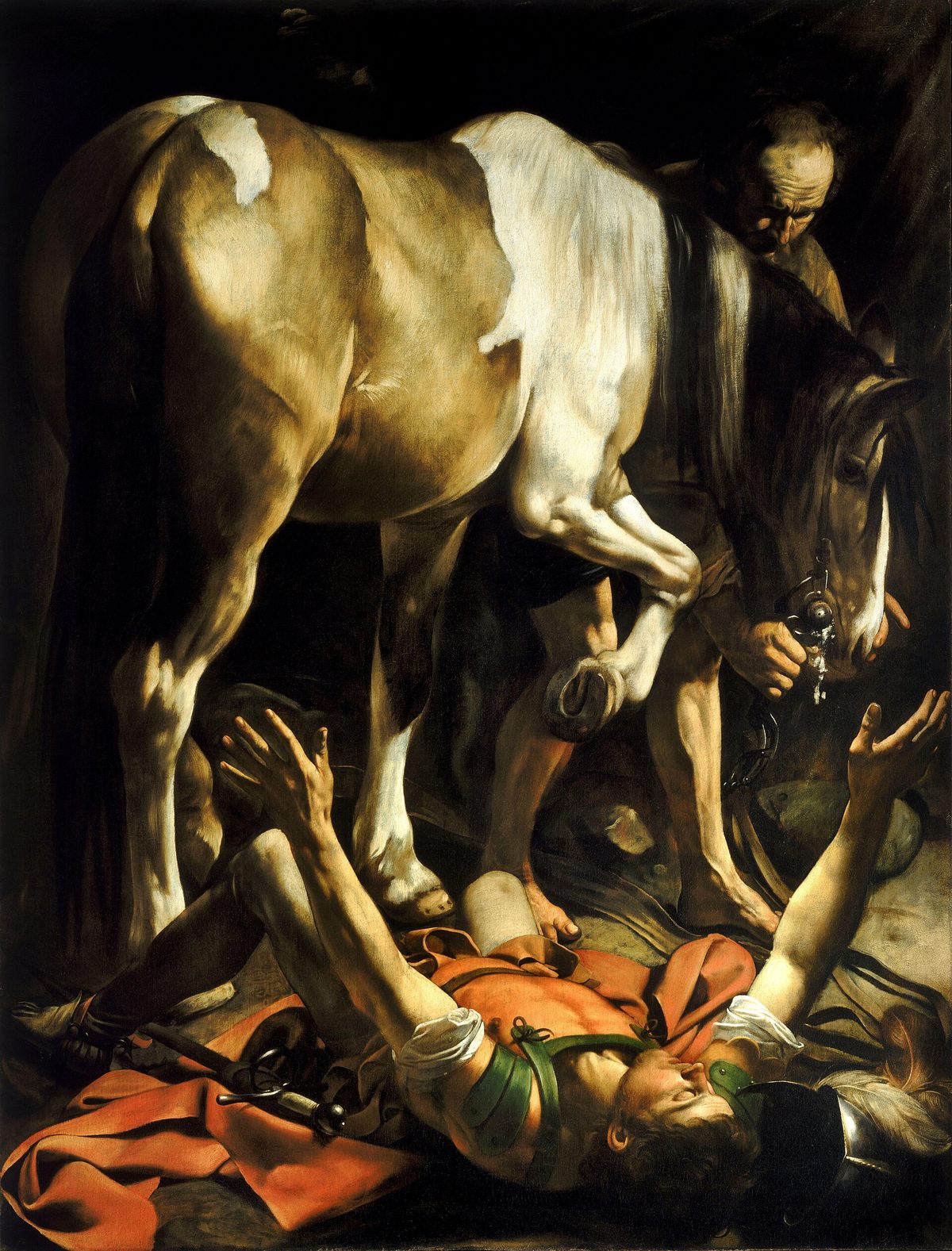
Conversion of St Paul (Conversion on the Way to Damascus)
Conversion of St Paul — full composition
Caravaggio, Public domain, via Wikimedia Commons
Caravaggio's Conversion of St Paul in the Cerasi Chapel of Santa Maria del Popolo is one of the most radical reinterpretations of a biblical narrative in the history of painting. Instead of the conventional dramatic scene — Paul thrown from his horse in a blaze of heavenly light, surrounded by fleeing soldiers — Caravaggio depicts an almost intimate moment: Paul lying on his back with arms spread wide, eyes closed, apparently unconscious, while his horse looms enormously over him and a groom holds the animal's bridle.
There is no dramatic light from heaven; there is only the natural light of the stable. The horse is the largest figure in the painting. The miracle is almost invisible — this is what divine transformation looks like from the outside.
The Cerasi Chapel commission (1600-1601) gave Caravaggio the opportunity to hang his Conversion and Crucifixion of Peter on either side of a Carracci altarpiece — a juxtaposition that was probably deliberate, contrasting two approaches to religious painting. Caravaggio's first version of the Conversion (also surviving, in Palazzo Odescalchi, Rome) is more conventionally dramatic, with Christ appearing in the sky and greater activity among the soldiers.
The second version — the one now in the chapel — is far more radical in its reduction. Caravaggio removes all conventionally miraculous elements and presents the event as it might have appeared to an observer with no knowledge of what was happening internally to Paul.
The compositional structure is simple: Paul's body on the diagonal (a pose of absolute passivity), the horse's body rising above him (enormous, dominating, indifferent), the groom's body closing the left side (a working man, unaware of what has occurred). No soldiers, no heavenly apparition, no dramatic gesture.
Paul's arms are spread in a posture that deliberately echoes crucifixion — he is being transformed, as Christ was transformed, through helplessness. The horse's rear leg, the stable ground, the quality of Paul's red cloak catching the light — Caravaggio's descriptive genius is total. The divine event is interior; the painting shows only the exterior.
When standing before this work, look carefully: Conversion of St Paul — full composition. Give it time — what seems decorative often carries the central meaning.
When standing before this work, look carefully: The horse dominating the composition. Give it time — what seems decorative often carries the central meaning.
When standing before this work, look carefully: Paul's arms spread — the cruciform posture. Give it time — what seems decorative often carries the central meaning.
When standing before this work, look carefully: The Cerasi Chapel — Caravaggio and Carracci together. Give it time — what seems decorative often carries the central meaning.
The Cerasi Chapel is the second chapel on the left in Santa Maria del Popolo, near the Piazza del Popolo. It contains both Caravaggio paintings (Conversion and Crucifixion of Peter) plus the Carracci altarpiece, and is one of the most remarkable small chapels in Rome. Bright light is needed to see the paintings, which are in a dark lateral position; a coin-operated light is available.