
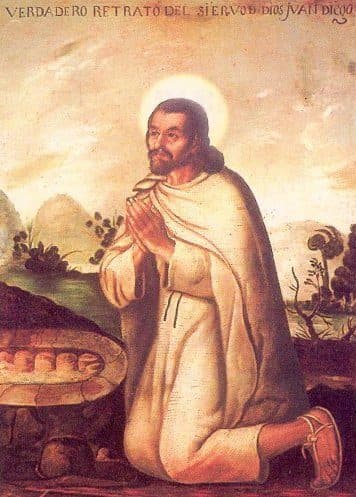
The Life
Juan Diego Cuauhtlatoatzin was born around 1474 in Cuauhtitlan, in what is now Mexico, a member of the Chichimec people. He was baptised as an adult, probably in 1524, after the Spanish conquest and the evangelisation of Mexico by Franciscan missionaries. He was a man of about 57, a poor peasant and weaver, a widower, when the events of December 1531 occurred that made him the first indigenous saint of the Americas.
On the morning of December 9, 1531, he was walking across the hill of Tepeyac to attend Mass when he heard singing and then saw a brilliant light, from which a young woman appeared and addressed him in his native Nahuatl. She identified herself as the Virgin Mary and asked him to go to Bishop Juan de Zumarraga and ask him to build a church on that hill. Juan Diego went to the bishop. The bishop was polite but did not believe him and asked for a sign.
The Lady appeared to him again and told him to return. The bishop's response was more skeptical. She appeared a third time and told him to return again with a sign. Juan Diego's uncle was dying; he tried to avoid passing Tepeyac on his way to fetch a priest for the dying man, going around the hill instead. The Lady appeared to him anyway and told him his uncle had been cured. She told him to go to the top of the hill and gather the flowers he would find there — roses, flowering in December on a barren hilltop. He gathered them in his tilma (cloak). He brought them to the bishop; when he opened his tilma to release the roses, the image of the Virgin of Guadalupe was found imprinted on the cloth.
The tilma — a rough-woven ayate of cactus fiber — has survived for nearly 500 years and is now encased in the Basilica of Guadalupe in Mexico City. Scientific examinations have been unable to determine the technique by which the image was produced. Juan Diego was beatified in 1990 and canonised by John Paul II in 2002. He is the first indigenous person from the Americas to be canonised.
I Am Only a Poor Man — his own self-description
Juan Diego's response to the Lady's request was consistent and characteristic: he told her he was unsuitable. He was a poor man, a humble peasant; there were better people to carry the message. The Lady insisted on him specifically: it is necessary that you yourself go and ask that my wish be carried out through your intercession. The choice of the unsuitable messenger is a constant in biblical and hagiographic tradition — Moses, Gideon, Jeremiah — and Juan Diego fits the pattern exactly. God does not choose the qualified; he qualifies the chosen. The Bishop Who Did Not Believe — and the sign Bishop Juan de Zumarraga's scepticism was entirely reasonable. A poor indigenous man with no standing was claiming visions of the Virgin Mary. The bishop listened, but needed evidence. The request for a sign — and the Lady's provision of roses in December on a barren hilltop, carried in the tilma — is the structure of all the great Marian apparitions: the institutional Church asks for evidence, the apparition provides it. The bishop, when the image appeared on the tilma, fell to his knees. The Tilma and the Image of Guadalupe The image of Our Lady of Guadalupe imprinted on Juan Diego's tilma is one of the most studied and debated objects in the history of Marian apparitions. The tilma, made of ayate (cactus fiber), should have deteriorated within 20 years; it has survived nearly 500. No paint, brush strokes, or underpainting have been found on the portion containing the image. The eyes of the figure, examined under microscopy, appear to contain reflected images consistent with the scene at the bishop's residence when the tilma was opened. The image is now enshrined in the Basilica of Guadalupe in Mexico City. The Healing of Juan Bernardino Juan Diego's dying uncle, Juan Bernardino, was healed by the Lady on the same morning that she directed Juan Diego to gather the roses. Juan Diego had tried to avoid Tepeyac precisely because he was worried about his uncle and was going to fetch a priest. The Lady appeared to him anyway and told him: Is it not I, your mother, who is here? What else do you need? Your uncle is already cured. The miraculous healing of Juan Bernardino — confirmed by the bishop — was one of the evidential elements that persuaded the Church authorities to accept Juan Diego's account.
Walk in Their Footsteps
Pilgrimage sites connected to St Juan Diego Cuauhtlatoatzin
Ask St Juan Diego Cuauhtlatoatzin to Intercede
Bring these intentions to this saint in prayer:
Juan Diego told the Lady he was unsuitable. She told him to go anyway. He went. The bishop did not believe him. She told him to go again. He went. The bishop still did not believe him. She gave him the roses and the image. The bishop fell to his knees. The unsuitable messenger, sent three times, carrying roses in December, became the vessel of the most widespread Marian devotion in the Western world. The tilma survived 500 years. Juan Diego is the first indigenous person from the Americas to be canonised. He was only a poor man.
“But God chose the foolish things of the world to shame the wise; God chose the weak things of the world to shame the strong.”
Juan Diego, unlikely messenger — I too feel unworthy of the message I have been given. I have told God there are better people for this. Tell me what the Lady told you: it is necessary that you yourself go. Walk with me across my Tepeyac today. Give me the roses in December. Let me open my tilma at the feet of whoever needs to see the image. Amen.