
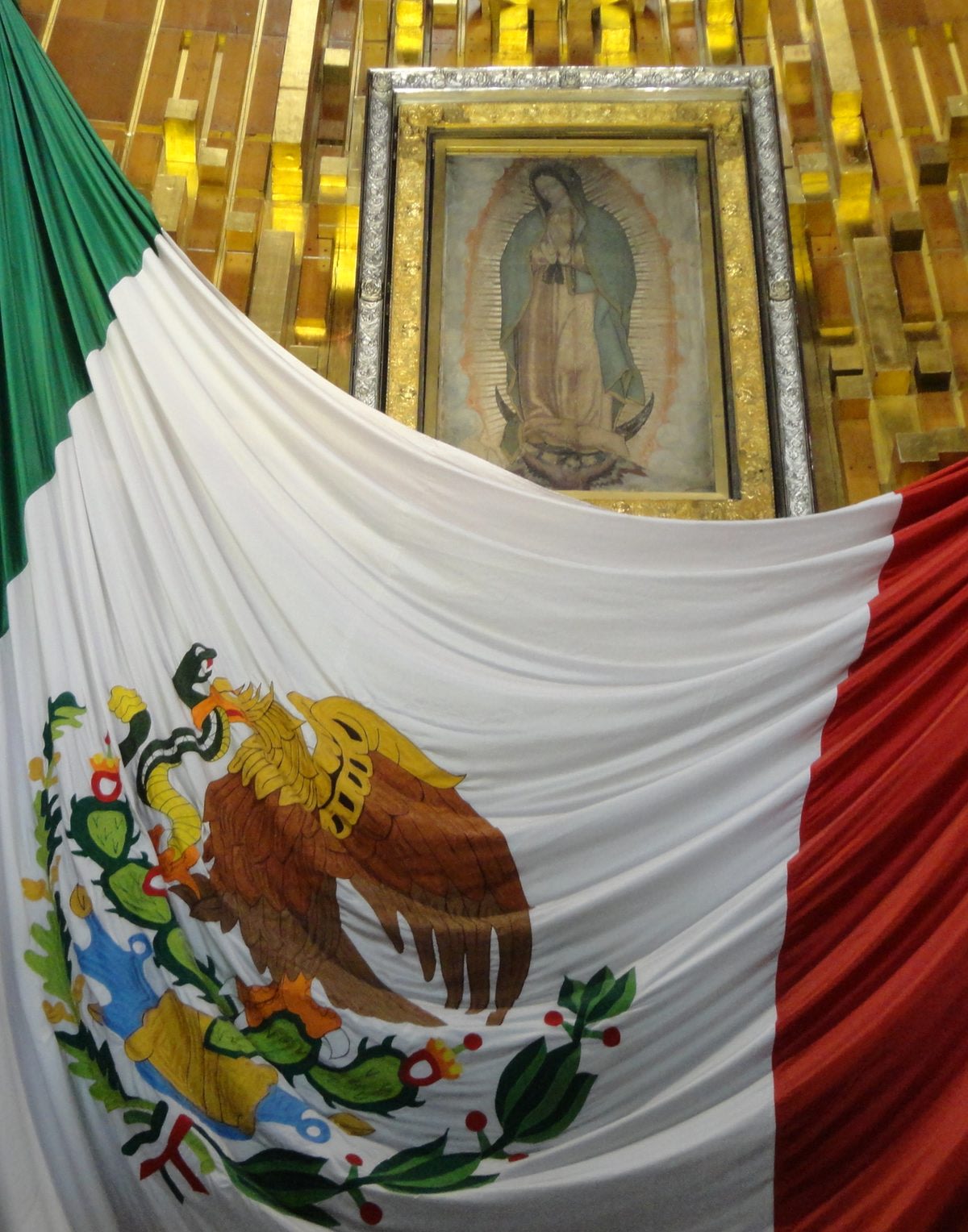
The Image of Our Lady of Guadalupe (the Tilma)
The Tilma — Our Lady of Guadalupe, 1531
Public domain, via Wikimedia Commons
The Image of Our Lady of Guadalupe is the most visited Marian shrine image in the world and the central religious object of Mexican Catholicism — a full-length image of the Virgin Mary on a tilma (cloak) of cactus fiber, preserved in the Basilica of Our Lady of Guadalupe at the foot of Tepeyac Hill in Mexico City. According to the tradition recorded in the Nican Mopohua (1556), the image was miraculously imprinted on the cloak of the indigenous convert Juan Diego following four apparitions of the Virgin in December 1531.
The image shows a dark-skinned Virgin in a rose-colored robe with a blue-green mantle covered in gold stars, standing on a crescent moon supported by an angel — an iconographic synthesis of indigenous Aztec cosmic symbolism and Christian Marian imagery. The image has been subjected to extensive scientific examination, particularly by NASA scientists in 1979, who reported anomalies in the painting technique (including an absence of underdrawing, a lack of brushstrokes, and apparent stars in the mantle corresponding to the winter solstice sky of 1531) that remain contested.
The basilica at Guadalupe has been the site of the most important annual pilgrimage in the Western Hemisphere since the 16th century. The feast of Our Lady of Guadalupe (December 12) draws millions of pilgrims to the site, many arriving on their knees for the final approach.
The image is credited with the mass conversion of indigenous Mexicans to Christianity in the generation following the Conquest — an estimated 8-9 million baptisms in a decade. The current basilica (designed by Pedro Ramirez Vazquez, opened 1976) can accommodate approximately 10,000 worshippers inside and 100,000 in the plaza; the tilma is displayed behind bulletproof glass at the back of the sanctuary.
The tilma is displayed approximately 15 metres from the nearest viewing point in the basilica — a moving walkway passes below it for close observation. The image itself is approximately 1.7 metres tall; the fabric is a coarse cactus fiber weave visible to the naked eye.
The face of the Virgin — with dark skin, indigenous features, and downcast eyes — is the central focus of devotion. A television screen near the image allows magnified examination. Look also at the crescent moon at the Virgin's feet (a Aztec symbol of the moon goddess Coyolxauhqui, vanquished here by the Christian Virgin) and the angel at the base — the only figure in the image with wings.
When standing before this work, look carefully: The Tilma — Our Lady of Guadalupe, 1531. Give it time — what seems decorative often carries the central meaning.
When standing before this work, look carefully: Basilica interior with tilma on display. Give it time — what seems decorative often carries the central meaning.
When standing before this work, look carefully: The face of the Virgin — indigenous features, downcast eyes. Give it time — what seems decorative often carries the central meaning.
When standing before this work, look carefully: New Basilica of Our Lady of Guadalupe exterior. Give it time — what seems decorative often carries the central meaning.
Basilica of Our Lady of Guadalupe, Tepeyac Hill, Villa de Guadalupe, Mexico City. Open daily from very early morning.
Free admission. The site receives up to 20 million pilgrims per year — December 12 is extremely crowded; arrive before dawn for the best experience.