
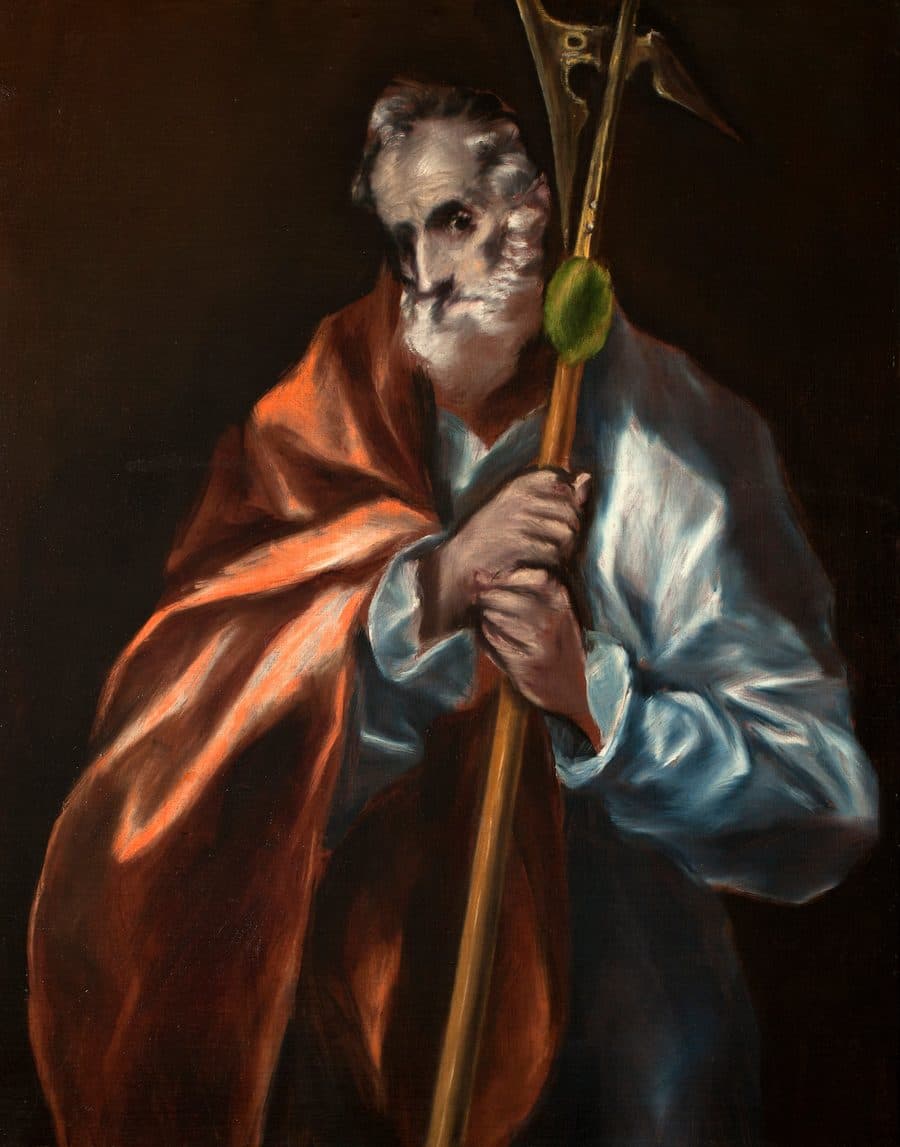
The Life
Jude Thaddeus is one of the twelve apostles and the most universally popular saint for desperate causes — the one you turn to when every other option has been exhausted and all hope has apparently failed. He is distinguished from Judas Iscariot by his other name (Thaddeus) and appears only twice in the Gospels, once in the lists of the twelve and once in John 14:22 with a question that reveals his character: Lord, how is it that you will manifest yourself to us, and not to the world? It is the question of someone paying careful attention and genuinely puzzled by the apparent inconsistency between the private revelation of the Last Supper and the public mission of the Kingdom. He gets a careful answer from Jesus.
He is also the author of the Epistle of Jude — a short, fierce letter warning against false teachers who have corrupted the Christian community with licentiousness, comparing them to the angels who fell, to Sodom and Gomorrah, to Cain, to Balaam, to the rebellion of Korah. The letter contains one of the most beautiful doxologies in the New Testament: To him who is able to keep you from stumbling and to present you before his glorious presence without fault and with great joy — to the only God our Saviour be glory, majesty, power, and authority, through Jesus Christ our Lord, before all ages, now and forevermore! Amen.
The theological reason for Jude's particular patronage of desperate cases is uncertain — tradition suggests that because his name was so close to Judas Iscariot's, he was largely ignored by the faithful for centuries and thus developed a special sympathy for those similarly overlooked or desperate, accumulating spiritual credit (as it were) by being available when others were busy. A more generous interpretation: those who have been brought to the edge of despair know that ordinary intercession will not help; they need an apostle who has his own history with the impossible and who is available because of long neglect.
The Question at the Last Supper
At the Last Supper, Jesus has told the disciples that he will manifest himself to those who love him and keep his commandments, but not to the world. Jude Thaddeus raises his hand: Lord, how is it that you will reveal yourself to us and not to the world? It is a good question — the question of someone who has been paying attention and who is genuinely puzzled by the distinction Jesus is making between the inner circle and the world outside. Jesus answers at length, explaining the indwelling of the Spirit and the intimacy of love. Jude asked the question that got the answer. This is his one documented theological contribution, and it is significant. The Epistle of Jude — burning words The letter of Jude, the shortest epistle in the New Testament, is a document of fierce prophetic urgency: I felt compelled to write and urge you to contend for the faith that was once for all entrusted to God's holy people. The contention Jude calls for is against people within the community who are corrupting it from within. His comparisons are extreme — the fallen angels, Sodom and Gomorrah, Cain, Balaam. His purpose is to call the community back to its foundations before the corruption becomes complete. The fierceness of the letter is not anger for its own sake; it is the urgency of someone who sees the house on fire. The Devotion of the Desperate The devotion to St Jude as patron of impossible causes has a modern history that begins in the 1920s, when the Claretian Fathers at the National Shrine of St Jude in Chicago began publicising Jude's patronage of hopeless cases. They received testimonials by the thousands. The National Catholic Reporter regularly carries testimonials from those whose desperate causes were answered after praying to Jude. The devotion has spread across the world and is particularly intense in Latin America, where Jude shrines are among the most visited Catholic sites, and in the Philippines. He is the saint of last resort, and the line outside his shrines is long. The Doxology at the End of His Letter The letter of Jude ends with one of the most magnificent doxologies in Scripture: To him who is able to keep you from stumbling and to present you before his glorious presence without fault and with great joy — to the only God our Saviour be glory, majesty, power, and authority, through Jesus Christ our Lord, before all ages, now and forevermore. The man who is the patron of hopeless cases ends his letter with an expression of absolute confidence in God's power to present the desperate and the stumbling before God's glorious presence, not with shame but with great joy. That is the foundation of the Jude devotion.
Walk in Their Footsteps
Pilgrimage sites connected to St Jude Thaddeus
Ask St Jude Thaddeus to Intercede
Bring these intentions to this saint in prayer:
Jude was the apostle nobody prayed to — too close in name to the traitor, perhaps; too obscure in the Gospels, certainly. And so he accumulated, as it were, centuries of availability. When people finally started praying to him in large numbers, in the 20th century, they found him ready. There is a lesson here about the obscure and overlooked: they are often the most available, the most attentive, the most ready to respond, precisely because they have not been overwhelmed by the crowd.
“To him who is able to keep you from stumbling and to present you before his glorious presence without fault and with great joy — to the only God our Saviour be glory, majesty, power and authority, through Jesus Christ our Lord, before all ages, now and forevermore! Amen.”
St Jude, apostle of hopeless causes — I am here. I come at the end, when everything else has been tried and nothing has worked. You know what I am carrying — this situation that seems to have no solution, this need that cannot be met by any ordinary means. Intercede for me with the one who is able to keep us from stumbling and to present us before his glorious presence with great joy. I am trusting you with the impossible. Amen.