
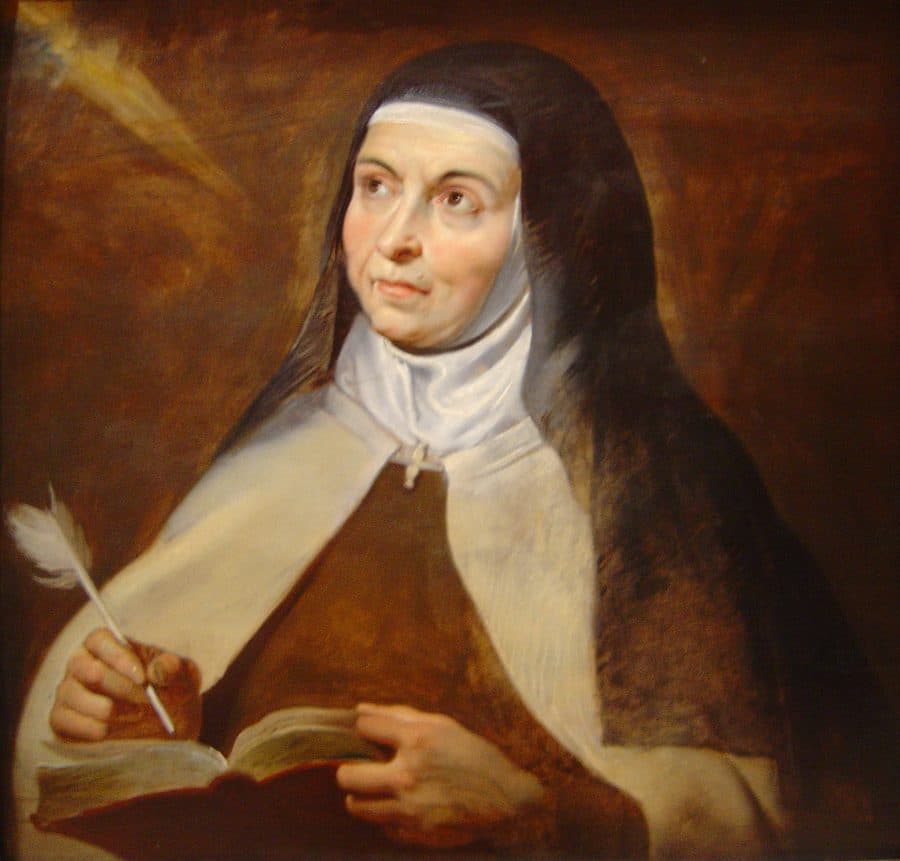
The Life
Teresa of Avila was born in 1515 in Avila, Castile, the daughter of a converso family (her paternal grandfather was a Jewish convert to Christianity who had been investigated by the Inquisition). She entered the Carmelite Convent of the Incarnation at Avila at age 20 and remained a religious for the rest of her life — but a religious life that was dramatically interrupted, reformed, and transformed by a second conversion in her early 40s that led to the greatest reform of religious life in the Spanish Counter-Reformation and the production of some of the most important mystical texts in the Christian tradition.
For approximately twenty years after entering religious life, Teresa lived a mediocre and distracted spiritual life by her own account — she was popular in the convent, enjoyed visitors and conversation, and was inconsistent in prayer. Around 1554, at age 39, she experienced a second conversion before an image of the suffering Christ and began the intensive interior life that produced her mystical experiences and her writing. She had visions, locutions, and the experience of levitation (she reportedly asked the other nuns to hold her down during prayer). She experienced the Prayer of Quiet and the Prayer of Union that she describes in The Interior Castle and The Life.
In 1562 she founded the first of the reformed Discalced Carmelite convents — St Joseph's in Avila — with only thirteen sisters, minimal income, and maximum contemplative discipline. The reform encountered fierce opposition from the unreformed Carmelites, the city of Avila, and various ecclesiastical authorities. Teresa persisted, founding seventeen more reformed convents across Spain — traveling in a mule cart, negotiating with landlords, managing finances, writing letters, and producing her major works simultaneously. She worked with John of the Cross in reforming the male branch of the Carmelite order.
Her major writings — The Life (her autobiography), The Way of Perfection, and The Interior Castle — are among the most important works of Christian mysticism. The Interior Castle is the masterwork: a description of the soul as a castle of crystal with seven dwelling places, the innermost being the place of union with God. It remains one of the most sophisticated and accessible maps of the interior life in the entire Christian mystical tradition. She was declared a Doctor of the Church by Paul VI in 1970 — the first woman to receive this title.
The Second Conversion at 39
Teresa's second conversion — before an image of the ecce homo Christ at age 39 — ended two decades of spiritual mediocrity and opened the period of her greatest spiritual intensity and productivity. She writes in her autobiography: I could not endure it any longer and burst into tears and threw myself on my knees before him. The conversion of the woman who had been a popular, socially comfortable nun into the reformer of an entire religious order, the author of the Interior Castle, and the first female Doctor of the Church began with tears before an image of the suffering Christ. The Interior Castle — mapping the soul The Interior Castle (El Castillo Interior, 1577) is Teresa's masterwork — a description of the human soul as a castle of crystal or diamond with seven concentric dwelling places, the innermost being the place of divine union. The seven mansions correspond to stages of prayer and interior development, from the outermost (where the soul is barely conscious of its inner life) to the innermost (where the soul is united with God in spiritual marriage). The image of the castle is one of the most powerful and comprehensive maps of the interior life in the mystical tradition. Founding the Convents — reform in a mule cart Between 1562 and her death in 1582, Teresa founded seventeen reformed Discalced Carmelite convents across Spain. She negotiated with landlords, managed finances, handled ecclesiastical opposition, dealt with unhappy friars, and wrote letters by the hundreds — all while producing her major mystical works. The work of reform was done in mule carts across the roads of Castile and Andalusia, in the heat of summer and the cold of winter, by a woman who suffered from severe headaches, heart trouble, and periodic ill health. The practicality of the great mystic is as remarkable as the mysticism. Let Nothing Trouble You — the final motto The prayer most associated with Teresa, found written in her breviary after her death, is the Nada te turbe: Let nothing trouble you, let nothing frighten you. All things pass; God does not change. Patience achieves everything. Whoever has God lacks for nothing. God alone suffices. This is not a consoling platitude; it is the distillation of decades of interior experience. Teresa had been troubled and frightened by many things. She arrived at this nada through the seven mansions, not around them.
Walk in Their Footsteps
Pilgrimage sites connected to St Teresa of Avila
Ask St Teresa of Avila to Intercede
Bring these intentions to this saint in prayer:
Teresa was 39 when she had her second conversion. She had twenty years of religious life behind her and apparently little to show for it. The second conversion led to the seven mansions, the seventeen convents, the mule carts across Castile, and the Interior Castle. God uses late starters. Teresa would say: it is never too late. The interior castle is always there, even if you have not entered it yet. The outermost mansions are already within you.
“Let nothing trouble you, let nothing frighten you. All things pass; God does not change. Patience achieves everything. Whoever has God lacks for nothing. God alone suffices.”
Teresa, Doctor of the Interior Castle — lead me in. I am standing in the outermost courtyard, distracted and noisy and barely aware that there is a castle at all. Show me the gate. Tell me the way through the seven mansions. And when I arrive, at the innermost room where you say the soul meets God face to face — may I recognise what I have been walking toward. Nada te turbe. Amen.