
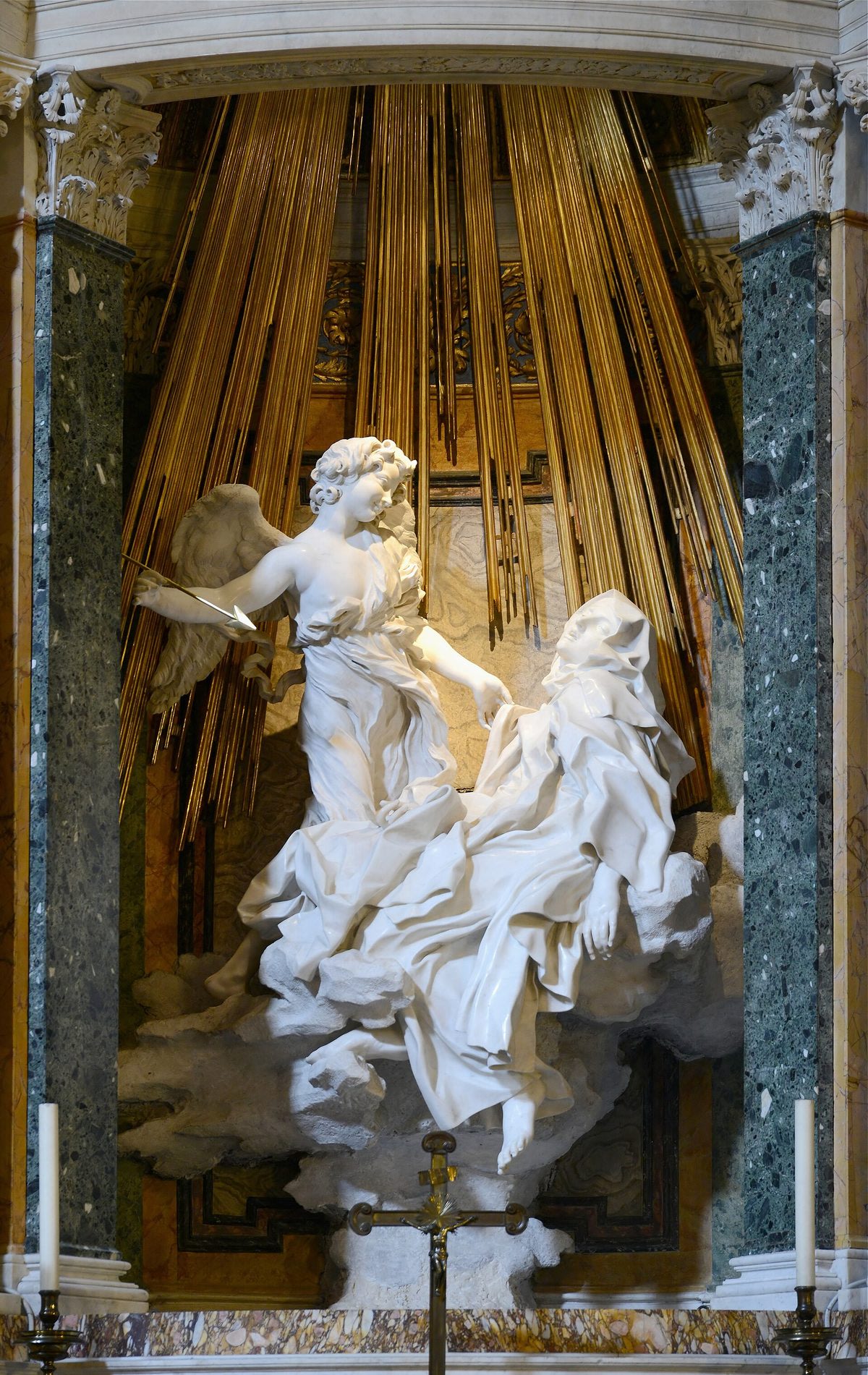
Ecstasy of Saint Teresa
Ecstasy of St Teresa — full group in the niche
Gian Lorenzo Bernini, Public domain, via Wikimedia Commons
The Ecstasy of St Teresa is considered Bernini's greatest single work — a sculptural and architectural complex in which the entire Cornaro Chapel becomes a theatrical stage for the mystical encounter of St Teresa of Avila with an angel who pierces her heart with a golden arrow. The sculpture occupies a concave marble niche above the altar, lit from above by hidden windows whose light falls on the gilded bronze rays framing the two figures.
Teresa — in a state of spiritual ecstasy that she herself described in her autobiography — reclines on clouds, her face slack with overwhelm, her body apparently weightless. The angel above her raises the golden arrow, smiling. On either side of the chapel, members of the Cornaro family (in marble relief boxes like theatre balconies) observe the scene.
The Cornaro Chapel commission came from Cardinal Federico Cornaro in 1647. Bernini conceived it as a unified Gesamtkunstwerk — an early instance of what the 20th century would call 'total art': the architecture, sculpture, painting (the ceiling fresco), lighting, and decorative programme are all designed as a single experience.
Teresa's own account of the experience in her Life (1562) was Bernini's source: 'I saw in his hand a long golden spear... He seemed to be plunging it into my heart... The pain was so great that I screamed aloud; but simultaneously I felt such infinite sweetness that I wished the pain to last for ever.' Bernini's translation of this text into marble is so precise it is essentially sculptural theology.
The two figures are the emotional centre, but the architecture of experience matters equally. Stand in the doorway and notice how the entire chapel — its marble floor, the coloured pilasters, the family boxes on the side walls, the fresco above — is oriented toward the lit niche. Teresa's drapery is carved in heavy, agitated folds that communicate physical disruption; her face is perhaps the most ecstatic in all sculpture.
The angel's smile is enigmatic — neither cruel nor entirely kind. The gilded bronze rays around the figures represent divine light. Looking up at the family boxes, the Cornaro members are depicted in conversation, as if at the theatre — some watching, some absorbed in discussion — which adds a subtly ironic social dimension to the devotional spectacle below.
When standing before this work, look carefully: Ecstasy of St Teresa — full group in the niche. Give it time — what seems decorative often carries the central meaning.
When standing before this work, look carefully: Teresa's face — the expression of ecstasy. Give it time — what seems decorative often carries the central meaning.
When standing before this work, look carefully: The Cornaro Chapel — complete architectural theatre. Give it time — what seems decorative often carries the central meaning.
When standing before this work, look carefully: The angel with the golden arrow. Give it time — what seems decorative often carries the central meaning.
Santa Maria della Vittoria is a five-minute walk from the Termini station. The Cornaro Chapel is the fourth chapel on the left side of the church. The church is often quiet; unlike many of Rome's famous monuments, this one rewards long, slow attention.