
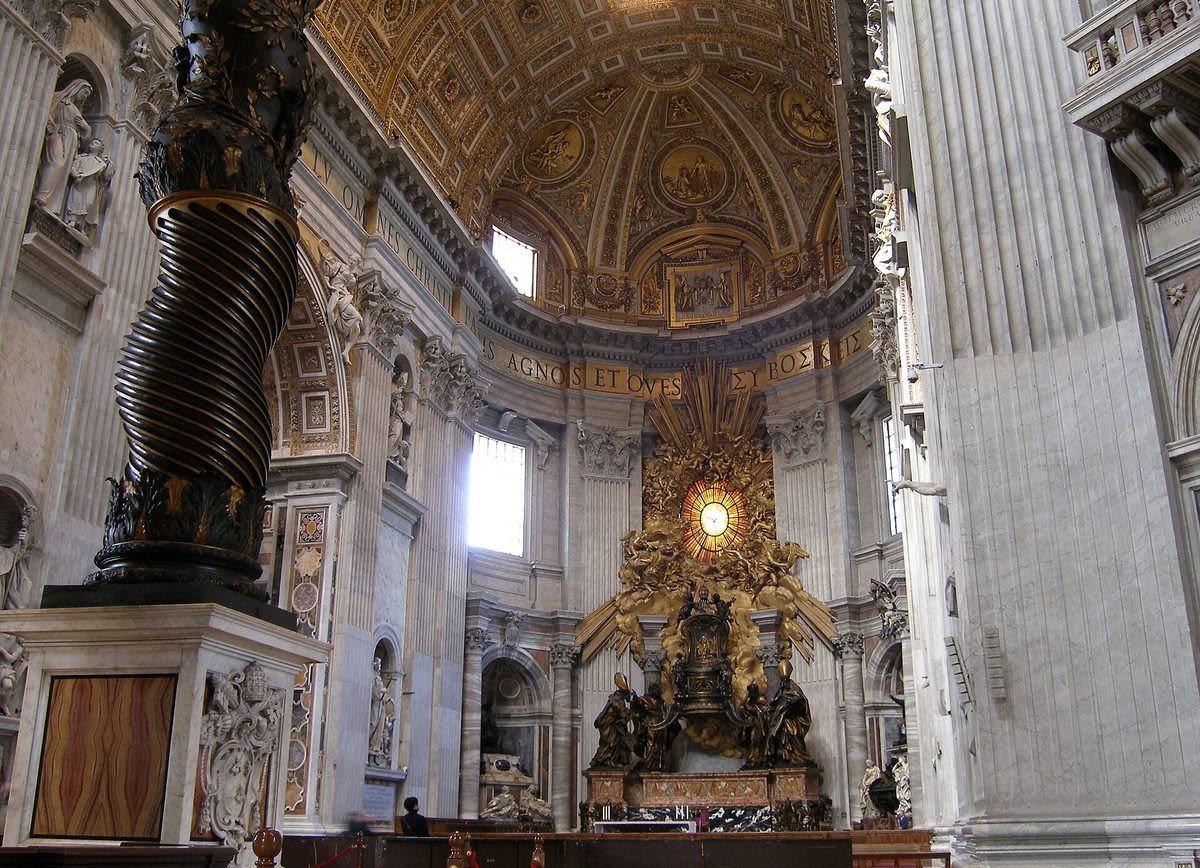
Cathedra Petri (Chair of St Peter)
Cathedra Petri — full view of the apse monument
Gian Lorenzo Bernini, Public domain, via Wikimedia Commons
The Cathedra Petri is the apse monument of St Peter's Basilica — a gilded bronze reliquary throne floating on clouds of gilded bronze supported by the four Doctors of the Church (Ambrose, Augustine, Athanasius, and John Chrysostom) and topped by a golden glory of bronze rays and angels surrounding a stained-glass window in the form of the dove of the Holy Spirit. It was created by Bernini to enshrine the ancient wooden chair (cathedra) traditionally said to have belonged to St Peter himself. The monument is the theatrical conclusion of the basilica's long axial journey: the visitor who walks from the entrance, past the Baldachin, arrives at the apse wall and sees this explosion of golden light and bronze energy.
Bernini received the commission from Pope Alexander VII in 1656; the work was unveiled in 1666. The cathedra itself (the wooden chair, now known to be an 875 AD gift from Charles the Bald to Pope John VIII and therefore not Peter's actual chair) is enclosed within the bronze reliquary seat.
Bernini's great formal challenge was giving the reliquary a theatrical setting that would dominate the apse — the far end of the largest church in Christendom. His solution — suspending the bronze chair on the shoulders of the four Doctors, with a golden radiance behind and the dove illuminated from within — creates a perpetual light show whose intensity changes with the time of day. At evening light, the window glows orange-gold against the bronze, and the dove seems to vibrate.
The four Doctors of the Church support the chair in two pairs: the Latin Doctors (Ambrose and Augustine) at the front, the Greek Doctors (Athanasius and John Chrysostom) at the back — an ecumenical gesture of East-West unity. The oak chair of Peter (now the medieval throne) is visible through the transparent bronze lattice of the seat.
The dove window is approximately 1.5 metres wide; its light fills the apse regardless of external conditions through clever directional positioning. The radiance of bronze rays and fifty-six angels around the window is one of the most exuberant baroque compositions in existence. Look for the putti playing in the clouds around the throne base.
When standing before this work, look carefully: Cathedra Petri — full view of the apse monument. Give it time — what seems decorative often carries the central meaning.
When standing before this work, look carefully: The dove of the Holy Spirit in stained glass. Give it time — what seems decorative often carries the central meaning.
When standing before this work, look carefully: The four Doctors of the Church supporting the throne. Give it time — what seems decorative often carries the central meaning.
When standing before this work, look carefully: The apse of St Peter's — the theatrical conclusion. Give it time — what seems decorative often carries the central meaning.
At the far end of the apse in St Peter's Basilica; visible from the crossing but best seen from close up, which requires walking the length of the basilica. Relatively few visitors walk all the way to the apse; the monument rewards the short journey from the Baldachin.