
The Life
Catherine Benincasa was born in 1347 in Siena, the 23rd of 25 children of a dyer named Giacomo. She began having visions as a young child and at age 7 vowed her virginity to Christ. Her family tried to marry her off; she cut off her hair to make herself unattractive, was assigned all the household's most menial work as punishment, and eventually prevailed. She joined the Dominican Third Order (tertiaries — not enclosed religious, but laywomen living in the world under a Dominican rule) and spent three years in a cell in her family home, leaving only for Mass, in intense interior prayer and penance.
Then she emerged from the cell and launched one of the most extraordinary public careers of the medieval Church. She nursed those with the most repulsive diseases in Siena's hospitals, including plague victims and those with cancer of the face, accompanying them at the execution scaffold. She gathered a vast circle of followers — disciples, correspondents, political figures — and conducted extensive correspondence with the greatest figures of Europe. She wrote 381 letters that survive, many dictated because she could not write.
She intervened in the politics of her time with extraordinary boldness. She wrote to Pope Gregory XI — then living at Avignon under French influence, where the papacy had been resident since 1309 — calling him babbo mio (my daddy), urging him to return to Rome, and eventually helping persuade him to make the return in 1377. She wrote to political leaders across Italy and Europe with a directness that would have been remarkable from any figure and is astonishing from a young woman with no formal authority. She called out cowardice by name, gave specific instructions, and held powerful people accountable.
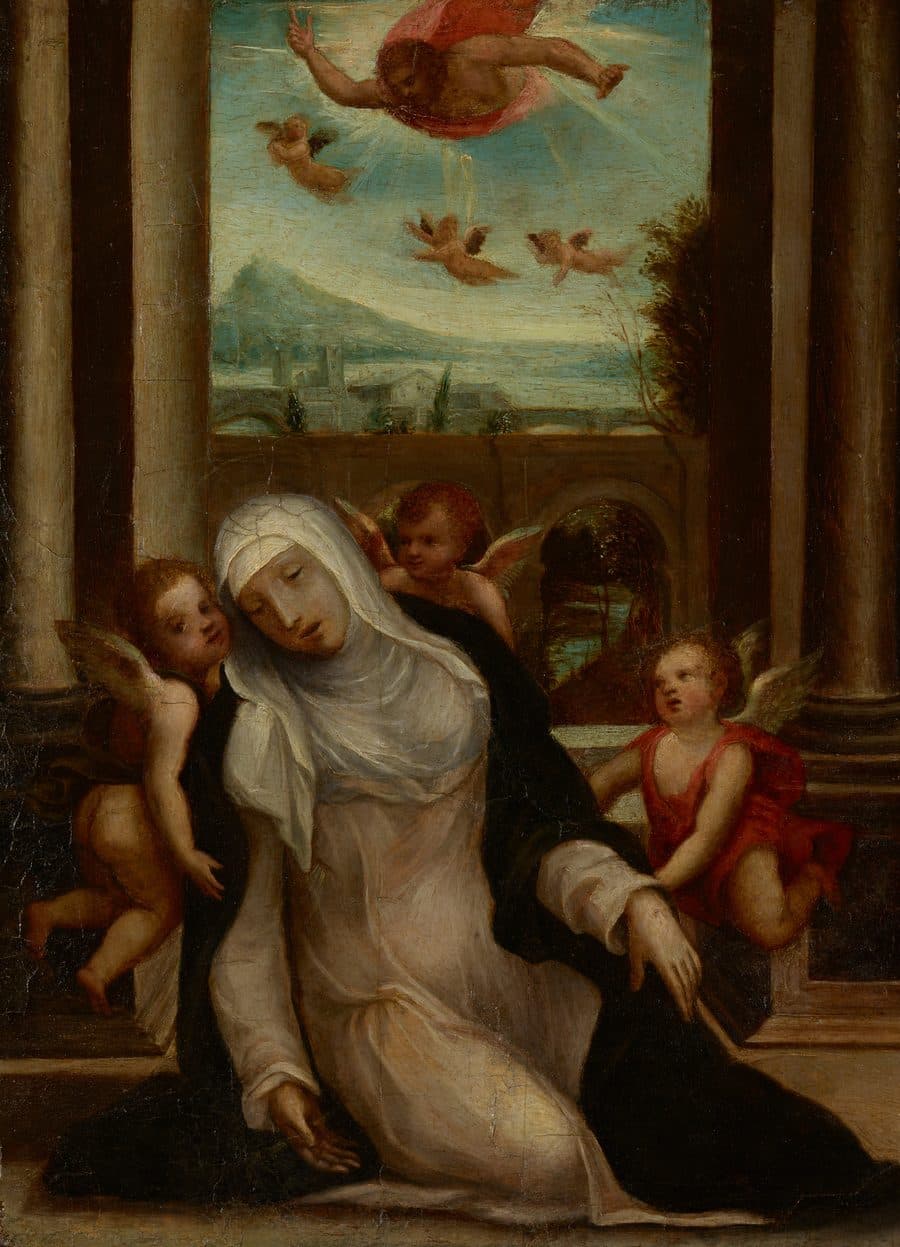
Her theological masterwork is the Dialogue of Divine Providence — a prolonged mystical dialogue between the soul and God, dictated during a period of ecstasy. She received the stigmata (which she asked to remain invisible during her lifetime, so they appeared only after her death). She died in Rome in 1380, at age 33, possibly as the result of a voluntary eating restriction she understood as a form of asceticism. She was declared a Doctor of the Church by Paul VI in 1970, alongside Teresa of Avila.
Three Years in the Cell
The three years Catherine spent in the cell in her family home — leaving only for Mass, in intense prayer, fasting, and penance — form the interior foundation of her extraordinary public career. She describes undergoing spiritual combat in the cell, experiencing both intense consolations and terrifying demonic attacks. She emerged from the cell at a divine command to go out and serve the world. The pattern is exact: the interior work first, then the exterior mission. The cell was not retreat from the world but preparation for it. Nursing the Worst — radical charity Catherine's practical charity was as radical as her mystical life. She specialised in the patients others would not touch: those with the most repulsive diseases, plague victims, those with facial cancer. She is recorded as forcing herself to drink the drainage from a cancer patient's wound in order to overcome her physical revulsion — an act of deliberate self-mastery that reflects the intense physicality of her spirituality. The same person who wrote to popes and kings also washed the bodies of plague victims and accompanied the condemned to the scaffold. Calling the Pope Home Catherine's letters to Pope Gregory XI at Avignon are among the most remarkable documents in medieval political history. She calls him babbo mio (my daddy) and addresses him as the Vicar of Christ with a familiarity that is simultaneously tender and demanding. She urges him to be courageous, stop listening to the counselors who are keeping him in France, and return the papacy to Rome. He did return in 1377 — whether because of her letters or other political factors is debated. She wrote to kings, cardinals, and city rulers with the same directness. She had no institutional authority whatever. She had God and a quill. The Dialogue and the Stigmata Catherine's major theological work, the Dialogue of Divine Providence, was dictated during a period of ecstasy — her secretaries wrote as she spoke. The text is a prolonged dialogue between the soul (Catherine) and God, structured around the image of the Bridge (Christ) over the river of worldly life. She received the stigmata in the last years of her life, but asked that they remain invisible; they appeared only after her death. She died in Rome in 1380, at age 33, having said: I have sinned, Lord, have mercy on me.
Walk in Their Footsteps
Pilgrimage sites connected to St Catherine of Siena
Ask St Catherine of Siena to Intercede
Bring these intentions to this saint in prayer:
Catherine had no authority: no office, no title, no institutional standing. She wrote to the pope as babbo mio and told him to stop being a coward. He came home. The authority she had was the authority of someone who had spent three years in a cell with God and emerged knowing what she knew. The courage to speak is proportionate to the depth of the interior life. The cell produces the letter. The three years of prayer produce the call to Gregory. Be who God meant you to be and you will set the world on fire.
“But the Lord said to me, Do not say, I am too young. You must go to everyone I send you to and say whatever I command you. Do not be afraid of them, for I am with you.”
Catherine, who called the pope babbo mio — give me your holy audacity. I have things to say to powerful people that I am afraid to say. I have letters I have not sent. I have truths I have softened or suppressed because of who would receive them. Give me your pen, your cell, and your conviction that God is with you when you speak the truth. Set me on fire. Amen.