
Grotto of the Nativity and Mosaics
The 14-pointed star — site of the Nativity
Public domain, via Wikimedia Commons
The Church of the Nativity in Bethlehem is built over the grotto traditionally identified as the birthplace of Jesus Christ — the oldest continuously operating church in Christianity, built originally by the Emperor Constantine in 326-333 AD and rebuilt by the Emperor Justinian in 527-565 AD. The grotto beneath the church is a natural cave approximately 12.2 by 3.5 metres; a 14-pointed silver star in the marble floor marks the traditional spot of the Nativity with the Latin inscription: 'Hic de Virgine Maria Jesus Christus natus est' ('Here Jesus Christ was born of the Virgin Mary').
Around the star, olive oil lamps from the Greek Orthodox, Roman Catholic (Franciscan), and Armenian communities burn continuously. The church contains surviving 6th-century mosaic floors (the oldest in the building), Byzantine mosaics (fragments) in the nave, and Crusader mosaic fragments in the transepts.
The Church of the Nativity is shared by three Christian communities: Greek Orthodox (who control the main church and grotto), Roman Catholic/Franciscan (who control the adjacent St Catherine's Church and have rights in the grotto), and Armenian Apostolic (who share rights in the church). The building's history of division, conflict, and shared custody among the communities has been complex and sometimes contentious — the 'status quo' governing rights and spaces in the building was established in the 19th century.
The church was inscribed as a UNESCO World Heritage Site in 2012 (the first Palestinian site on the list). A major restoration project (2013-2019) cleaned and stabilised the Crusader mosaics and restored the roof.
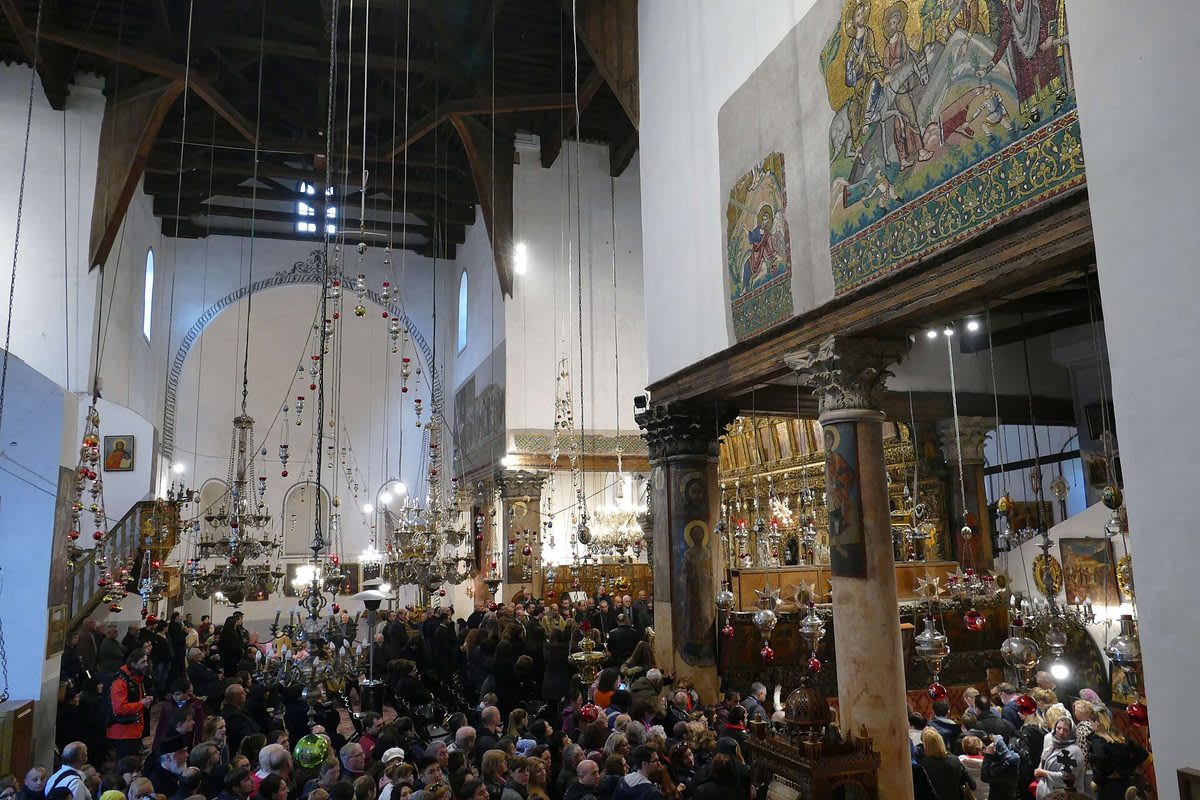
Enter the church through the 'Door of Humility' — a doorway reduced in height in the medieval period (to prevent horses being ridden inside; also to require visitors to bow). The nave retains its Justinianic columns and mosaic floor (largely covered); the walls show fragments of Crusader mosaics (restored 2019) including the Tree of Jesse.
Descend into the grotto by the stairs on either side of the choir: the star is immediately visible. The grotto is small, dimly lit by olive oil lamps, and often crowded with pilgrims from every nation — the experience is powerful precisely because of the specificity of the site.
When standing before this work, look carefully: The 14-pointed star — site of the Nativity. Give it time — what seems decorative often carries the central meaning.
When standing before this work, look carefully: Church of the Nativity exterior, Bethlehem. Give it time — what seems decorative often carries the central meaning.
When standing before this work, look carefully: The grotto interior — lamps around the star. Give it time — what seems decorative often carries the central meaning.
When standing before this work, look carefully: The nave — Justinianic columns and mosaic fragments. Give it time — what seems decorative often carries the central meaning.
Church of the Nativity, Manger Square, Bethlehem. Open daily; access via Israeli checkpoints or from Palestinian-controlled areas.
Modest dress required. The grotto queue can be long; arrive early.