
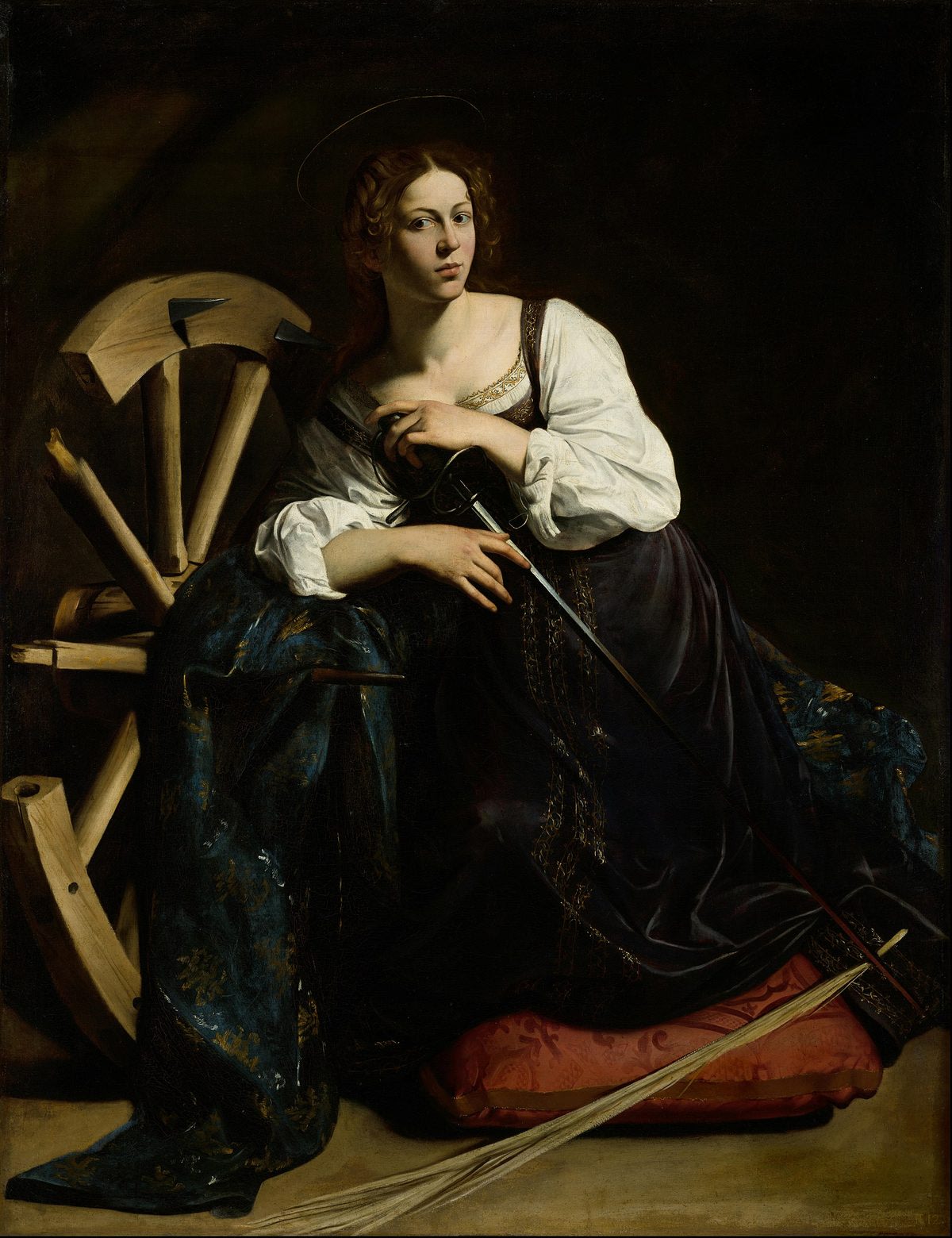
Saint Catherine of Alexandria
Saint Catherine of Alexandria — Caravaggio, c.1597
Caravaggio, Public domain, via Wikimedia Commons
Caravaggio's Saint Catherine of Alexandria in the Thyssen-Bornemisza Museum is among his finest single-figure paintings — a half-length portrait of the martyr Catherine with the instruments of her martyrdom (the spiked wheel, the sword, and the palm of martyrdom) against a dark background. The model is almost certainly Fillide Melandroni, a Roman courtesan who appears in several of Caravaggio's early paintings; her face has the specific individuality of a portrait rather than the idealization of a devotional type. The Catherine is one of a group of paintings Caravaggio made for Cardinal Francesco Maria del Monte in the late 1590s, in which he depicted female martyrs and penitents with a documentary naturalism unprecedented in Italian religious painting.
Caravaggio's Saint Catherine demonstrates his consistent technique for devotional single figures: the figure is lit from a single raking light source (upper left), the background is uniformly dark, and the physical evidence of the martyr's identity (her attributes) is depicted with the same documentary precision as her face and clothing. The broken spiked wheel (which miraculously shattered when she was placed on it) is a heavy wooden and metal object that Catherine rests her hand on; the sword (with which she was actually beheaded) lies across her lap. The physical quality of these objects — the splinters of the broken wheel, the cold steel of the blade — creates a tension between the beauty of the figure and the violence her story implies.
The figure's pose is simultaneously devotional (she is contemplating her martyrdom) and documentary (she is identified by her attributes). Fillide Melandroni's face — strong-featured, slightly challenging, direct — gives the image a psychological complexity unusual in devotional portraiture.
Catherine does not look upward toward heaven or inward in spiritual absorption; she looks at the viewer with a quality of measured attention. Look at the quality of the white collar and the satin of her yellow-ochre dress — fabric painting at the level of van Eyck.
When standing before this work, look carefully: Saint Catherine of Alexandria — Caravaggio, c.1597. Give it time — what seems decorative often carries the central meaning.
When standing before this work, look carefully: Catherine's face — Fillide Melandroni. Give it time — what seems decorative often carries the central meaning.
When standing before this work, look carefully: The broken wheel — the martyr's instrument. Give it time — what seems decorative often carries the central meaning.
When standing before this work, look carefully: Museo Thyssen-Bornemisza, Madrid. Give it time — what seems decorative often carries the central meaning.
Museo Thyssen-Bornemisza, Paseo del Prado 8, Madrid. Room 12 (Italian Baroque). The Thyssen is adjacent to the Prado; a combined ticket visit of the two museums covers the most important collections in Madrid.