
St Peter's Baldachin
The Baldachin — full view from the nave
Bernini's Baldachin is the largest bronze structure in the world — a canopied ciborium (liturgical shelter) standing 29 metres tall above the tomb of St Peter and the papal altar of St Peter's Basilica. Commissioned by Pope Urban VIII and cast partly from bronze stripped from the Pantheon (for which Pasquino's famous satirical comment was that the barbarians did not do what Barberini [Urban VIII's family name] did), the Baldachin marks the exact crossing of the basilica — the architectural and symbolic centre of Catholic Christendom.
Its four twisted Solomonic columns support a canopy of cast-bronze drapery, and the whole structure is crowned by four angels and a golden orb. It is simultaneously architecture, sculpture, and theatrical spectacle.
Gian Lorenzo Bernini (1598–1680) was the dominant artistic personality of Roman Baroque and the most versatile sculptor since Michelangelo. He took the commission in 1623, when he was 25, under the patronage of Urban VIII (Maffeo Barberini), who had been his patron since before the pontificate.
The Baldachin occupied Bernini for eleven years and employed a large workshop. The twisted columns deliberately echo the Solomonic columns (relics of Solomon's Temple supposedly brought to Rome by Titus) then housed in the old St Peter's and now distributed in the Confessione piers of the new basilica. The bronze was partly obtained from the Pantheon portico — a decision that caused outrage and the satirical epigram quoted above.
Stand at the nave entrance to the basilica and look toward the altar: the Baldachin sits at the exact centre of Michelangelo's dome, which rises above it. The effect is of a continuous vertical axis from the tomb of Peter below the floor, through the bronze columns, to the lantern of the dome above.
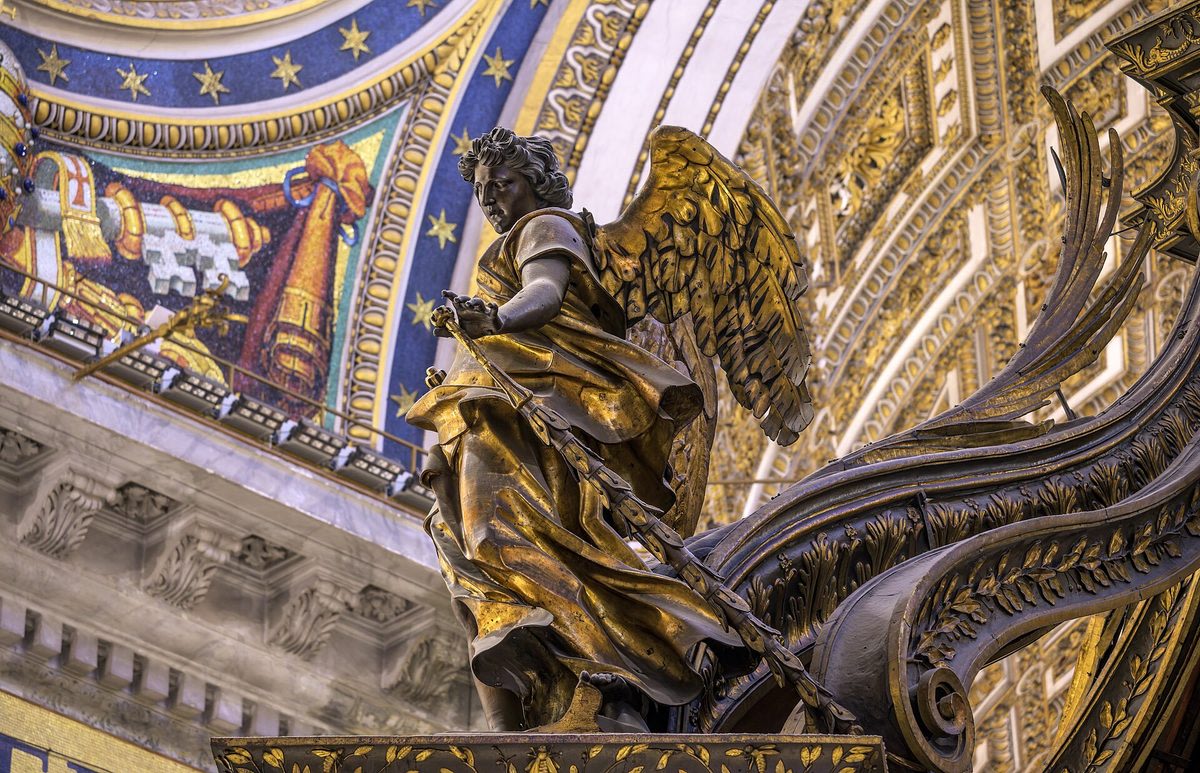
The four twisted columns are each cast with the Barberini bees (Urban VIII's heraldic device) and laurel branches; the bronze drapery at the top suggests the canopy being raised by angels. The four great bronze angels at the base are among the most powerful sculptural figures Bernini ever made. At night, when the basilica is lit from below, the Baldachin reads as a luminous bronze forest.
When standing before this work, look carefully: The Baldachin — full view from the nave. Give it time — what seems decorative often carries the central meaning.
When standing before this work, look carefully: Twisted Solomonic column detail with Barberini bees. Give it time — what seems decorative often carries the central meaning.
When standing before this work, look carefully: The Baldachin with Michelangelo's dome above. Give it time — what seems decorative often carries the central meaning.
When standing before this work, look carefully: One of the four bronze angels. Give it time — what seems decorative often carries the central meaning.
St Peter's Basilica is entered freely from St Peter's Square. The Baldachin can be seen from anywhere in the central nave but is best understood from close proximity — walk to the crossing and look up through the Baldachin at the dome directly above. The papal altar beneath it can only be used by the Pope himself.