
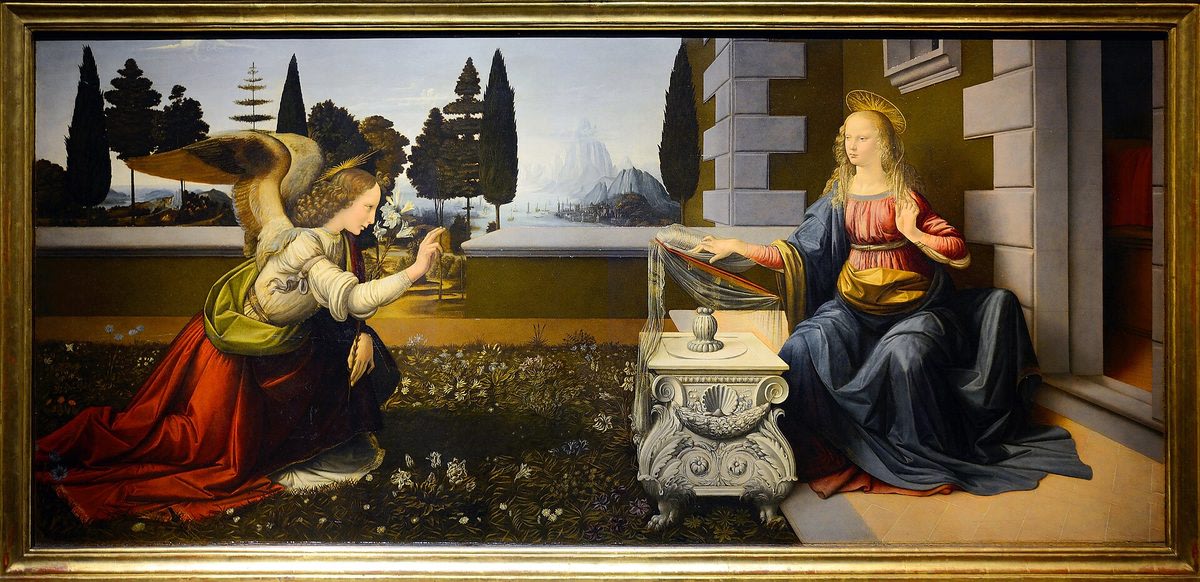
The Annunciation
The angel Gabriel — detail of the wing and lily
Leonardo da Vinci, Public domain, via Wikimedia Commons
Leonardo's Annunciation — painted when he was still in Verrocchio's workshop, aged approximately 20 — is one of the earliest works attributable to him and already shows his singular approach to light, atmosphere, and naturalistic observation. The angel Gabriel arrives from the left, kneeling in a garden of precise botanical detail, to announce to the Virgin that she will bear the Son of God.
Mary, seated at a lectern reading, raises her right hand in a response whose meaning — surprise, acceptance, or a gesture of affirmation — is deliberately ambiguous. The painting is exceptional for its atmospheric depth (the landscape behind recedes into a pale blue haze), its botanical realism, and the extraordinary lily the angel holds.
The Annunciation was probably painted c.1472-1475, when Leonardo was still a garzone in Andrea del Verrocchio's workshop in Florence. Attribution to Leonardo was not universal — the painting was for many years attributed to Domenico Ghirlandaio — until detailed stylistic and technical analysis confirmed it as his.
The right arm of the Virgin is technically imperfect (too long relative to the body) — a curious error from a painter otherwise obsessive about anatomical accuracy, perhaps indicating that the figure was repainted or revised during execution. The lectern on which Mary rests her book is richly carved in a classical style also found in other works from the Verrocchio shop.
Two main areas reward sustained attention. First, the angel's wing: Leonardo based it on a close study of actual bird wings, with feathers overlapping in naturalistic gradation rather than the conventional heraldic arrangement.
Second, the landscape in the background: the trees, water, and mountains recede into an aerial perspective — the sfumato haziness that would define Leonardo's mature style — astonishingly advanced for a young painter in 1472. The lily the angel holds is painted with botanical precision. The garden wall behind the figures creates a spatial separation between the sacred encounter and the wider world — the hortus conclusus (enclosed garden) of medieval Marian symbolism.
When standing before this work, look carefully: The angel Gabriel — detail of the wing and lily. Give it time — what seems decorative often carries the central meaning.
When standing before this work, look carefully: The Annunciation — full composition. Give it time — what seems decorative often carries the central meaning.
When standing before this work, look carefully: Mary's response — the ambiguous raised hand. Give it time — what seems decorative often carries the central meaning.
When standing before this work, look carefully: The landscape background with aerial perspective. Give it time — what seems decorative often carries the central meaning.
The Uffizi Gallery in Florence requires pre-booked timed entry (uffizi.it). The Annunciation is in Room 35 (the Leonardo room) along with Leonardo's unfinished Adoration of the Magi. Allow time to read the two works together — the Annunciation showing Leonardo's polished early manner, the Adoration his later investigation into the underdrawing itself as the primary artistic act.