
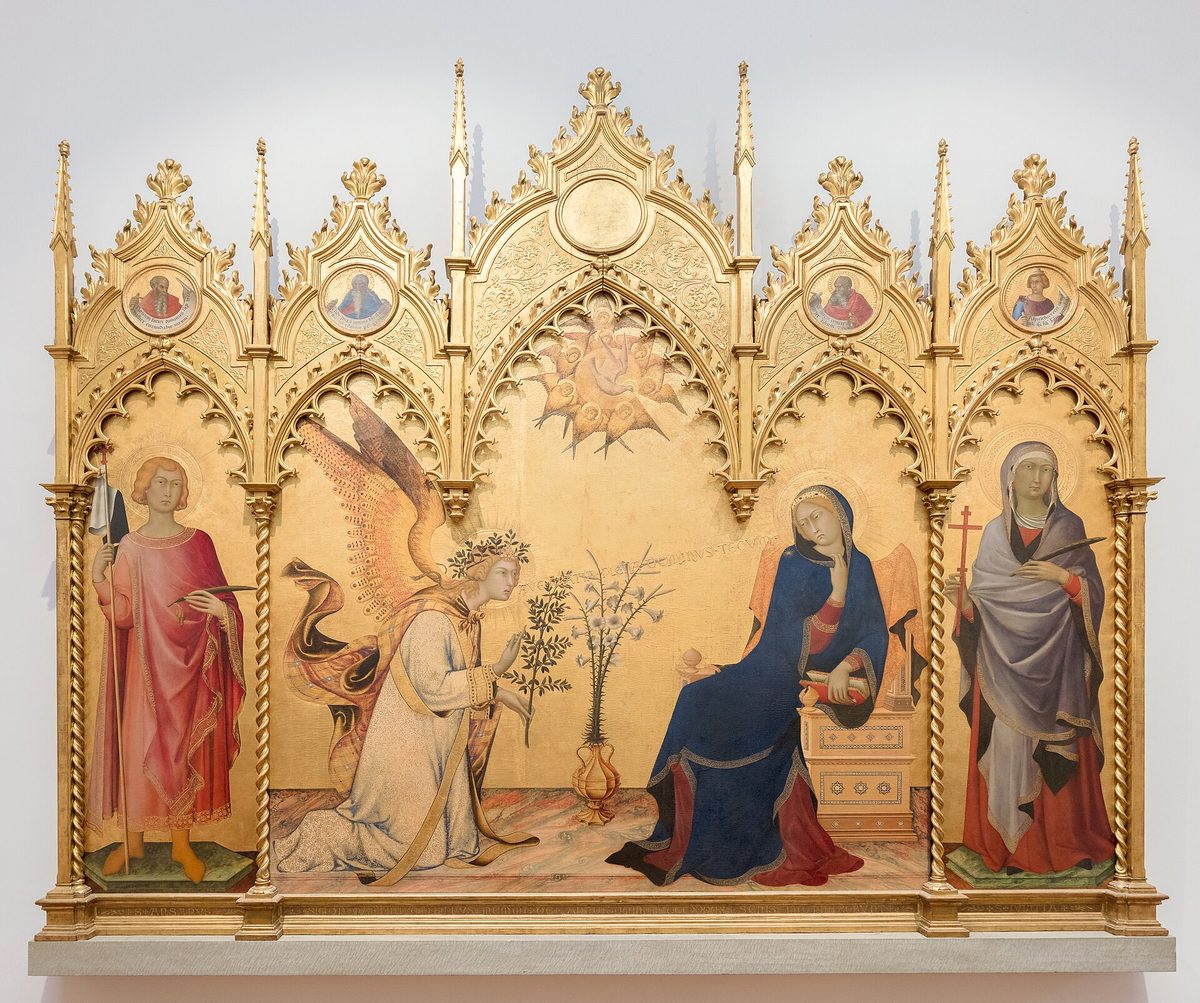
The Annunciation
Annunciation — Simone Martini, 1333
Simone Martini, Public domain, via Wikimedia Commons
Simone Martini's Annunciation altarpiece (painted with his brother-in-law Lippo Memmi in 1333) is the supreme example of Sienese Gothic panel painting and one of the most beautiful altarpieces in the history of Christian art. The central panel shows the Archangel Gabriel (entering from the left, his wings still in motion, an olive branch in his hand) delivering the Annunciation to the Virgin, who recoils with a gesture of agitated modesty.
The gold ground, the sinuous Gothic line of the figures, the intricate gold tooling of the halos and the Virgin's robe, and the spring flowers scattered on the tiled floor make this one of the most elegant compositions in medieval Italian painting. The inscription of Gabriel's words — 'AVE GRATIA PLENA DOMINUS TECUM' — floats in gold letters between the two figures, as if the words themselves are visible in the space. The lateral panels (the work of Lippo Memmi) show St Ansanus and St Julia or St Margaret.
Simone Martini (c.1284-1344) was the greatest painter of the generation after Duccio and the master who defined the International Gothic style in Italian painting. He worked primarily in Siena, Naples (for King Robert of Anjou), and Avignon (where he moved in 1336 and died in 1344).
His Avignon years brought him into contact with the poet Petrarch — a famous friendship that produced a portrait of Petrarch's beloved Laura, now lost. The 1333 Annunciation was painted for the Siena Cathedral; it entered the Uffizi in the 18th century. The sinuous elegance of Martini's line and his mastery of gold tooling techniques made him the most internationally influential Italian painter of his generation.
The central panel alone rewards extended study. Begin with Gabriel: his wings are not yet folded — they still carry the movement of his arrival, the feathers swept back by the speed of divine flight. His robe is embroidered in gold; he holds the olive branch of peace.
His face is a specific character study in concentrated reverence. Then look at the Virgin: she has been reading (the book is still in her hand, marked with her finger); she recoils from the sudden presence, pulling her robe around her. The gold letters of Gabriel's salutation float between them — they are not a caption but a physical presence in the space of the Annunciation.
When standing before this work, look carefully: Annunciation — Simone Martini, 1333. Give it time — what seems decorative often carries the central meaning.
When standing before this work, look carefully: Gabriel in motion — wings still swept back. Give it time — what seems decorative often carries the central meaning.
When standing before this work, look carefully: The Virgin recoiling — agitated modesty. Give it time — what seems decorative often carries the central meaning.
When standing before this work, look carefully: The gold inscription — 'AVE GRATIA PLENA' as visible words. Give it time — what seems decorative often carries the central meaning.
Uffizi Gallery, Piazzale degli Uffizi, Florence. The Simone Martini Annunciation is in Room 3 (Sienese Trecento). Advance booking essential.