
The Annunciation
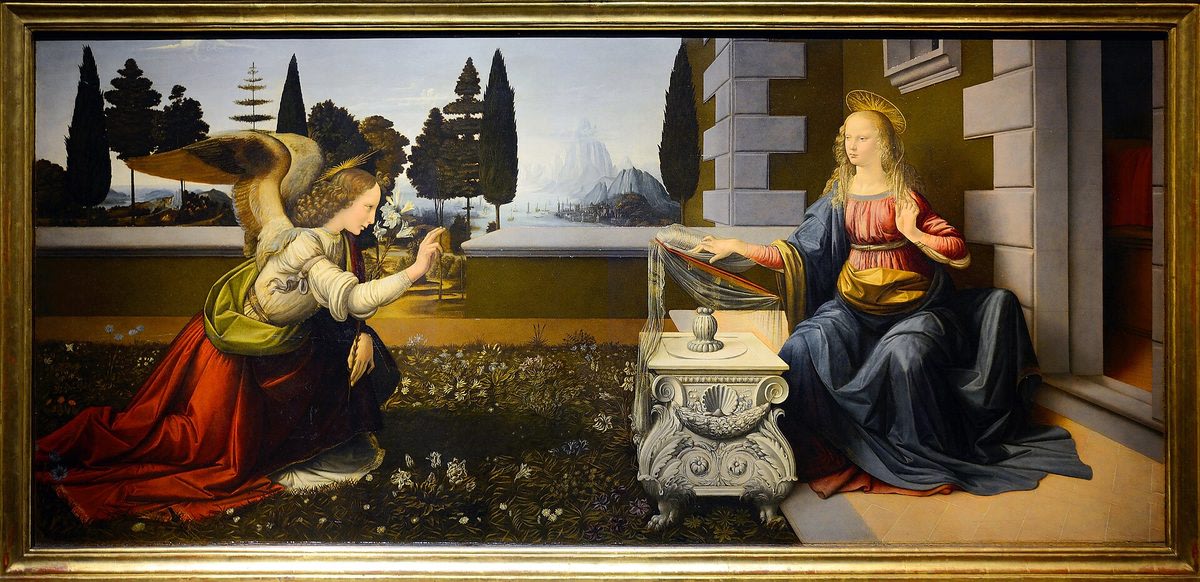
Annunciation — Leonardo da Vinci, c.1472-1475
Leonardo da Vinci, Public domain, via Wikimedia Commons
Leonardo's Annunciation in the Uffizi is generally accepted as his earliest surviving attributed work — painted around 1472-1475 when he was approximately 20 years old, possibly in collaboration with Verrocchio's workshop. The large panel (approximately 98 by 217 cm) shows the Archangel Gabriel kneeling in a garden, his wings spread, a lily in his hand, addressing the Virgin Mary who sits at a marble lectern.
The Florentine garden behind the figures recedes into a misty blue landscape in the distance — the earliest example of Leonardo's atmospheric perspective (sfumato) in a major work. Some passages of the painting show an earlier, more conventional hand (the marble lectern is borrowed from a Verrocchio workshop design); others — particularly the landscape, the drapery, and the angel's wings — demonstrate Leonardo's emerging mastery.
For Leonardo's full biographical context, see entry 15 (The Last Supper). The Annunciation is the starting point for Leonardo's career as an independent painter: working within the Verrocchio tradition but already asserting his own approach (the wings of Gabriel, repainted — the original wings, according to the best technical analysis, were painted over with more naturalistic feathered wings at a later stage) and his own visual programme (the landscape is already the characteristic Leonardo pale-blue dissolving distance). The marble lectern in the foreground has been connected to a lectern designed by Verrocchio for Piero de' Medici's tomb.
The compositional oddity of the painting — identified by many art historians — is the position of the Virgin's right arm: the arm appears to emerge from the wrong place on the body if the figure is viewed with the painting hanging as it currently is. This suggests the painting was originally intended to be seen from below and to the right (perhaps from the entrance to the chapel for which it was made), at an angle that corrects the perspective foreshortening. Leonardo's calculated the viewing angle into the composition.
When standing before this work, look carefully: Annunciation — Leonardo da Vinci, c.1472-1475. Give it time — what seems decorative often carries the central meaning.
When standing before this work, look carefully: Gabriel kneeling — naturalistic feathered wings. Give it time — what seems decorative often carries the central meaning.
When standing before this work, look carefully: The misty blue landscape — earliest sfumato. Give it time — what seems decorative often carries the central meaning.
When standing before this work, look carefully: The marble lectern — Verrocchio workshop design. Give it time — what seems decorative often carries the central meaning.
Uffizi Gallery, Room 35 (Leonardo), Florence. One of the most visited rooms in the museum; arrive early.