
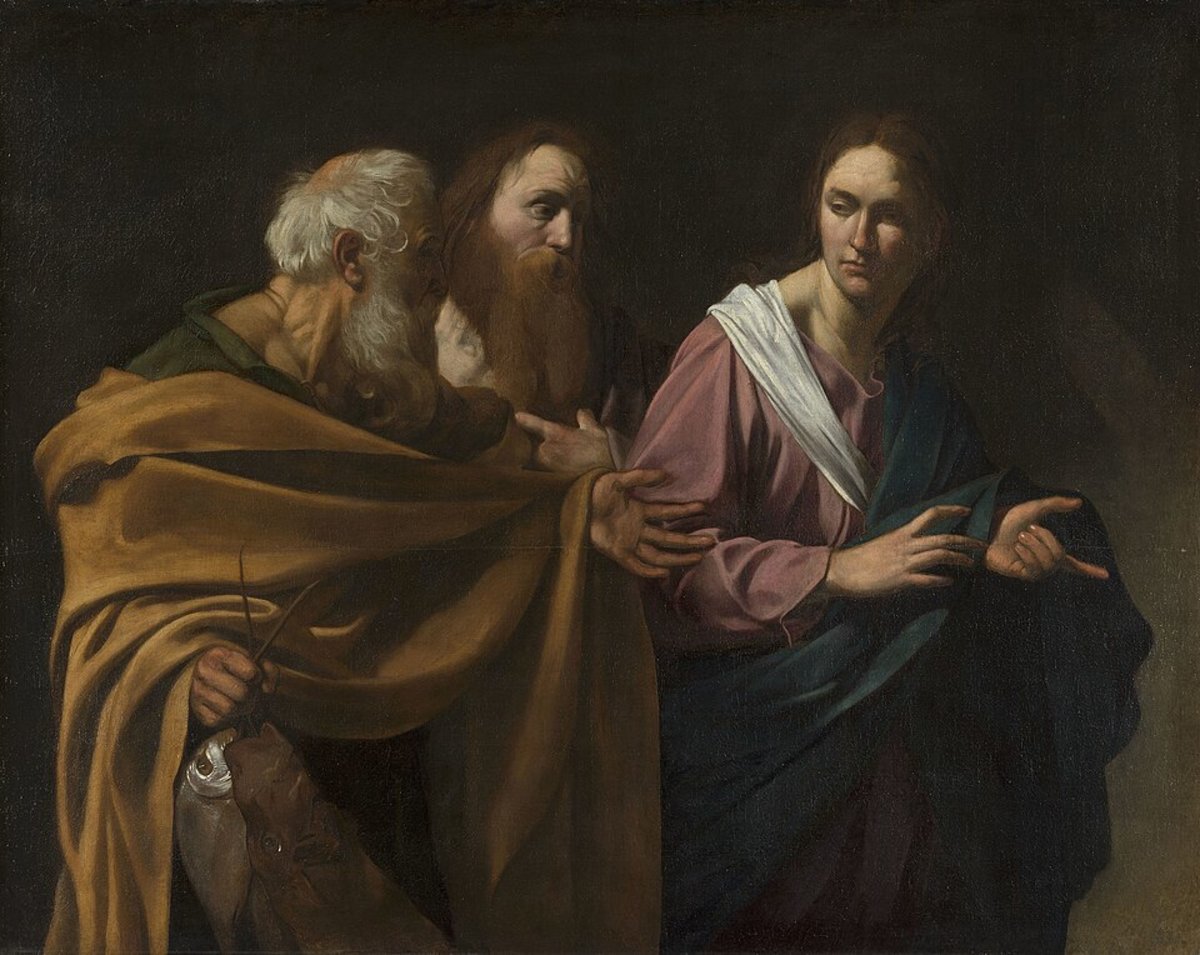
The Calling of Saints Peter and Andrew
Calling of Peter and Andrew — attributed Caravaggio, c.1603-1606
Caravaggio (attributed), Public domain, via Wikimedia Commons
The Calling of Saints Peter and Andrew is a canvas attributed to Caravaggio — the attribution has been disputed, accepted, and re-disputed over decades of scholarship. The painting shows Christ gesturing to Peter and Andrew on the shore of the Sea of Galilee, inviting them to follow him ('Follow me, and I will make you fishers of men').
The dramatic chiaroscuro, the figures' physical specificity, and the quality of the gesture suggest Caravaggio's hand in the most optimistic attributions; other scholars propose a close follower. The painting is in the Royal Collection at Hampton Court Palace. For Caravaggio's biographical context and main entry, see entry 39 (Calling of St Matthew, Rome).
The attribution question: the painting was attributed to Caravaggio by scholars including Denis Mahon in the 1990s, but the attribution has not achieved universal acceptance. If it is by Caravaggio, it would be from his late period (Naples or Sicily, c.1607-1609). The quality of the work — particularly the handling of the light on the water and the figures' hands — is consistent with Caravaggio at a late period or with a highly skilled follower.
Hampton Court Palace holds this painting in its State Apartments, accessible to visitors. The attribution question can be followed in the Royal Collection's own catalogue and in Caravaggio scholarship. For the definitive Caravaggio treatment of the apostle calling, see entry 39 (Calling of St Matthew).
When standing before this work, look carefully: Calling of Peter and Andrew — attributed Caravaggio, c.1603-1606. Give it time — what seems decorative often carries the central meaning.
When standing before this work, look carefully: Christ's calling gesture — dramatic chiaroscuro. Give it time — what seems decorative often carries the central meaning.
When standing before this work, look carefully: The fishermen responding — physical specificity. Give it time — what seems decorative often carries the central meaning.
When standing before this work, look carefully: Hampton Court Palace — Royal Collection. Give it time — what seems decorative often carries the central meaning.
Hampton Court Palace, East Molesey, Surrey, KT8 9AU. Open daily; admission fee. Reached by direct train from Waterloo station, approximately 35 minutes.