
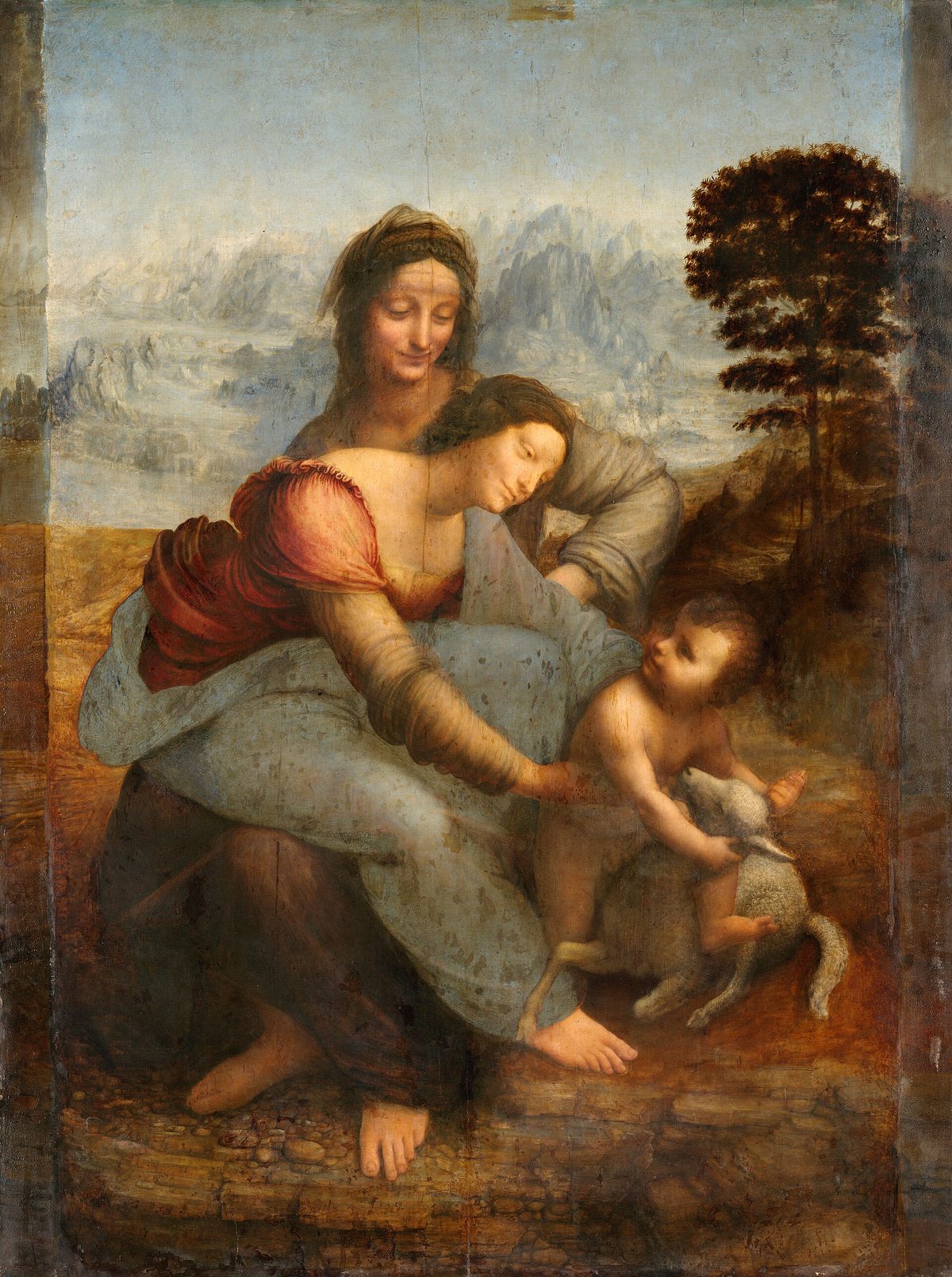
Virgin and Child with St Anne
Virgin and Child with St Anne — Leonardo, c.1503-1519
Leonardo da Vinci, Public domain, via Wikimedia Commons
Leonardo's Virgin and Child with St Anne is one of his most complex and most deeply pondered paintings — a work he apparently began around 1503 and refined until near his death. It shows St Anne (the Virgin's mother), the Virgin Mary, and the infant Christ in a rocky mountain landscape.
St Anne sits behind and slightly above Mary; Mary leans forward from St Anne's lap to reach the infant, who grasps a lamb (symbol of his sacrificial destiny); St Anne smiles with a knowing awareness that what she observes is the fulfilment of divine purpose. The pyramidal group of three generations — grandmother, mother, child — contains a theological argument: Mary tries to restrain the child from the lamb (his sacrificial fate); Anne allows it, understanding the necessity of the Redemption.
Leonardo made at least two major cartoons for this composition before the final painting. The Burlington House Cartoon (c.1499-1500, National Gallery, London) is an earlier version without the landscape and with different grouping; the Louvre cartoon (lost) and the Louvre painting itself represent the final development.
The painting is contemporary with the Mona Lisa and shares its sfumato technique: the figures are dissolved into the landscape, the transitions between tones are invisible, the faces are absorbed in psychological interiority. The landscape — blue-grey mountains receding into atmospheric haze — is among Leonardo's most meditative background inventions. Giorgio Vasari praised the painting's quality and noted Leonardo kept it with him.
The pyramidal group is the compositional key: three female/child generations arranged in a stable triangular form that achieves its stability through asymmetric dynamism — each figure leans in a different direction, creating a gently rotating energy around the central axis. Mary's face is turned toward the child; St Anne's face is turned toward Mary; the child faces forward.
Notice St Anne's smile: it is a knowing, slightly amused awareness — she sees the whole of salvation history in what she witnesses, and finds it both beautiful and inevitable. The lamb that Christ grasps is a specific symbol: the Agnus Dei, the Lamb of God who takes away the sins of the world (John 1:29).
When standing before this work, look carefully: Virgin and Child with St Anne — Leonardo, c.1503-1519. Give it time — what seems decorative often carries the central meaning.
When standing before this work, look carefully: St Anne's face — the knowing smile. Give it time — what seems decorative often carries the central meaning.
When standing before this work, look carefully: Christ grasping the lamb — the sacrificial symbol. Give it time — what seems decorative often carries the central meaning.
When standing before this work, look carefully: The Burlington House Cartoon — earlier version, National Gallery London. Give it time — what seems decorative often carries the central meaning.
Louvre Museum, Room 710, first floor (Salle des États adjacent). Less crowded than the Mona Lisa room, though in the same wing, and equally rewarding of sustained attention.