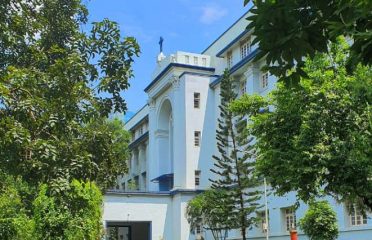
Archdioceasan Heritage Museum, Mumbai

Archdioceasan Heritage Museum, Mumbai

The Archdioceasan Heritage Museum has an unique collection of rare and antique church artifacts.

Type
Museum
Country
India
Location
Archdiocesan Heritage Museum, St Pius X College, Aarey Road
Scroll
01At a Glance

Tucked away in the leafy environs of Goregaon’s St Pius X College is the Archdioceasan Heritage Museum, one of only two of this kind in the country. What used to be the former gym of the Seminary has since 2011 been transformed into a treasure house hosting rare and antique Christian artefacts collected from churches in Bombay , Pune and Goa. At first glance it is immediately evident, that a lot of effort been expended to curate and catalogue pieces of church hardware of a bygone era. Aesthetically laid out and brightly lit, the museum transports you to another age and reveals the journey of Christianity in the region. Many of the exhibits have been unearthed from church attics, crypts and family altars where they lay silently, each with a story untold. It was a labour of love for the Museum to discover, repair and restore to their earlier beauty, objects which would otherwise have been lost to generations unborn. On display is an early copy of King James’ Bible, its leather binding foil stamped in gold with the twelve Stations of the Cross. Among the many manuscripts, religious objects and sculptures is a statue of St Paul which originally belonged to the parish church of Malad, a suburb of Bombay. In typical cross-cultural style the statue sports a beard more at home on the chin of a Hindu mendicant and is perched atop a lotus- again a symbol associated with divinity in Hinduism. The works of Angelo da Fonseca, who apprenticed under Nobel laureate Rabindranath Tagore are on display at the Heritage Museum. Spurned in his native Goa for having depicted the Virgin Mary in Indian attire, his paintings today occupy prime real estate in many of India’s Christian institutions. The Heritage Museum also has an enviable collection of metal work and religious themed embroidery. Some of the religious objects on exhibit date back to the 16th century, corresponding to the time when the Portuguese-led evangelisation of the region began. Although some of the churches of that period have either been destroyed or left to decay, it is to the credit of the Museum that some objects of veneration have been salvaged from these and placed for public viewing. The Archdiocesan Heritage Museum is a stop that selects itself on any itinerary of Mumbai , and would undoubtedly give the viewer a sense of having learnt something new.

1

At first glance it is immediately evident, that a lot of effort been expended to curate and catalogue pieces of church hardware of a bygone era

2

Among the many manuscripts, religious objects and sculptures is a statue of St Paul which originally belonged to the parish church of Malad, a suburb of Bombay

3

In typical cross-cultural style the statue sports a beard more at home on the chin of a Hindu mendicant and is perched atop a lotus- again a symbol associated with divinity in Hinduism

4

Some of the religious objects on exhibit date back to the 16th century, corresponding to the time when the Portuguese-led evangelisation of the region began

5

Tucked away in the leafy environs of Goregaon’s St Pius X College is the Archdioceasan Heritage Museum, one of only two of this kind in the country

02Plan Your Visit
Getting There
Archbishop's House, Wodehouse Road, Colaba, Mumbai 400039

In Colaba, on Wodehouse Road, a short walk from the Afghan Church and near the Navy Hospital. From Colaba Causeway it is a 10-minute walk. From CST or Churchgate by taxi: 20 minutes.

Open in Google Maps →
IST (UTC+5:30)
--:--:--

Prior appointment is recommended; call the Archdiocesan office to confirm visiting hours and museum access. Small entry fee may apply. Photography is permitted in designated areas.

Opening Hours
Museum10:00 AM - 5:00 PM Tue-Sun; closed Monday
03Must See

What to seek out, and why it matters

I
Museum galleries

The Portuguese-Period Sacred Vessels

The 16th and 17th-century chalices, patens, and monstrances from the Portuguese era are among the oldest Christian artefacts in India still preserved in institutional care. Their workmanship — a fusion of European Baroque and Indian goldsmithing traditions — is distinctive and beautiful.

II
Map gallery

The Historical Maps of Bombay

Early Portuguese and Dutch maps of the Bombay archipelago — showing the original islands before the land reclamation that created modern Mumbai — are among the most historically significant items in the collection. They document the settlement history of one of the world's great cities from the very beginning of its Christian history.

III
Corridor gallery

The Archbishop's Portrait Gallery

The portraits of all the Archbishops of Bombay, from the earliest period to Cardinal Gracias and beyond, constitute a visual survey of the Catholic leadership of the Archdiocese across five centuries. The changing dress, styles, and contexts of the portraits are a study in religious and social history.

IV
Grounds

The Archbishop's House Compound

The compound itself — with its Baroque-influenced residence, chapel, and gardens — is architecturally significant. The garden, with mature trees and a quiet atmosphere, is a remarkable oasis in the density of Colaba. The building complex is one of the most complete surviving examples of colonial Catholic institutional architecture in Mumbai.

V
Textile gallery

The Sacred Vestments Collection

Embroidered chasubles, copes, and dalmatics spanning five centuries — from Portuguese silk brocades of the 1600s to 20th-century Indian-made vestments — demonstrate the evolution of Catholic liturgical textile arts in India. The colour and craftsmanship of the earlier pieces is extraordinary.

04Masses & Events
Chapel ServicesMorning prayer in the Archbishop's House Chapel

Private chapel; occasional access for visitors

Heritage WalksOrganised on request

Group visits and guided tours available

5Reflection & Prayer

A chalice made in Lisbon in 1620 used to celebrate Mass on a Portuguese ship is now in a museum in Mumbai. It has crossed more oceans and witnessed more history than any of the people who touch it today. Objects outlast those who make them, those who use them, and often the institutions they serve. A museum is a way of saying: these things matter. The Archdiocesan Heritage Museum says this about the Catholic history of Mumbai.

Exodus 12:14

This is a day you are to commemorate; for the generations to come you shall celebrate it as a festival to the Lord.

Read in full on Bible Gateway →
A Pilgrim's Prayer

Lord of all history, I stand before objects that have survived shipwrecks, wars, independence movements, and five centuries of human change. Let me receive from them what they offer — a sense that the faith I hold today was held by others before me, carried across oceans, maintained in heat and monsoon and difficulty, and passed on. Let me be worthy of the tradition I have inherited. Amen.

06More

Tucked away in the leafy environs of Goregaon’s St Pius X College is the Archdiocesan Heritage Museum, one of only two of its kind in the country. What used to be the former gym of the Seminary has, since 2011, been transformed into a treasure house hosting rare and antique Christian artefacts collected from churches in Bombay, Pune and Goa. At first glance it is immediately evident that a lot of effort has been expended to curate and catalogue pieces of church hardware of a bygone era.

Aesthetically laid out and brightly lit, the museum transports you to another age and reveals the journey of Christianity in the region. Many of the exhibits have been unearthed from church attics, crypts and family altars where they lay silently, each with a story untold. It was a labour of love for the museum to discover, repair and restore to their earlier beauty objects which would otherwise have been lost to generations unborn.

The Collection

On display is an early copy of King James’ Bible, its leather binding foil-stamped in gold with the twelve Stations of the Cross. Among the many manuscripts, religious objects and sculptures is a statue of St Paul which originally belonged to the parish church of Malad, a suburb of Bombay. In typical cross-cultural style, the statue sports a beard more at home on the chin of a Hindu mendicant and is perched atop a lotus — again a symbol associated with divinity in Hinduism.

The works of Angelo da Fonseca, who apprenticed under Nobel laureate Rabindranath Tagore, are on display at the Heritage Museum. Spurned in his native Goa for having depicted the Virgin Mary in Indian attire, his paintings today occupy prime real estate in many of India’s Christian institutions. The Heritage Museum also has an enviable collection of metalwork and religious-themed embroidery.

Visiting

Some of the religious objects on exhibit date back to the 16th century, corresponding to the time when the Portuguese-led evangelisation of the region began. Although some of the churches of that period have either been destroyed or left to decay, it is to the credit of the museum that some objects of veneration have been salvaged from these and placed for public viewing. The Archdiocesan Heritage Museum is a stop that selects itself on any itinerary of Mumbai, and would undoubtedly give the viewer a sense of having learnt something new.

Saints Associated With This Site
More from India
Church of St John the Evangelist (Afghan Church), Mumbai
Shahid Bhagat Singh Road, Navy Nagar, Colaba
All Saints Cathedral, Allahabad
Sarojini Naidu Marg, Civil Lines, Prayagraj (Allahabad)
Basilica of Bom Jesus, Goa
Basilica of Bom Jesus, Old Goa Road, Bainguinim
Basilica of Our Lady of Good Health, Vailankanni