Basilica della Santa Casa (Holy House of Loreto)

Basilica della Santa Casa (Holy House of Loreto)

The Basilica of the Holy House of Loreto houses one of the most extraordinary objects in Catholic devotion:...

Type
Basilica
Country
Italy
Location
Loreto
Scroll
01At a Glance

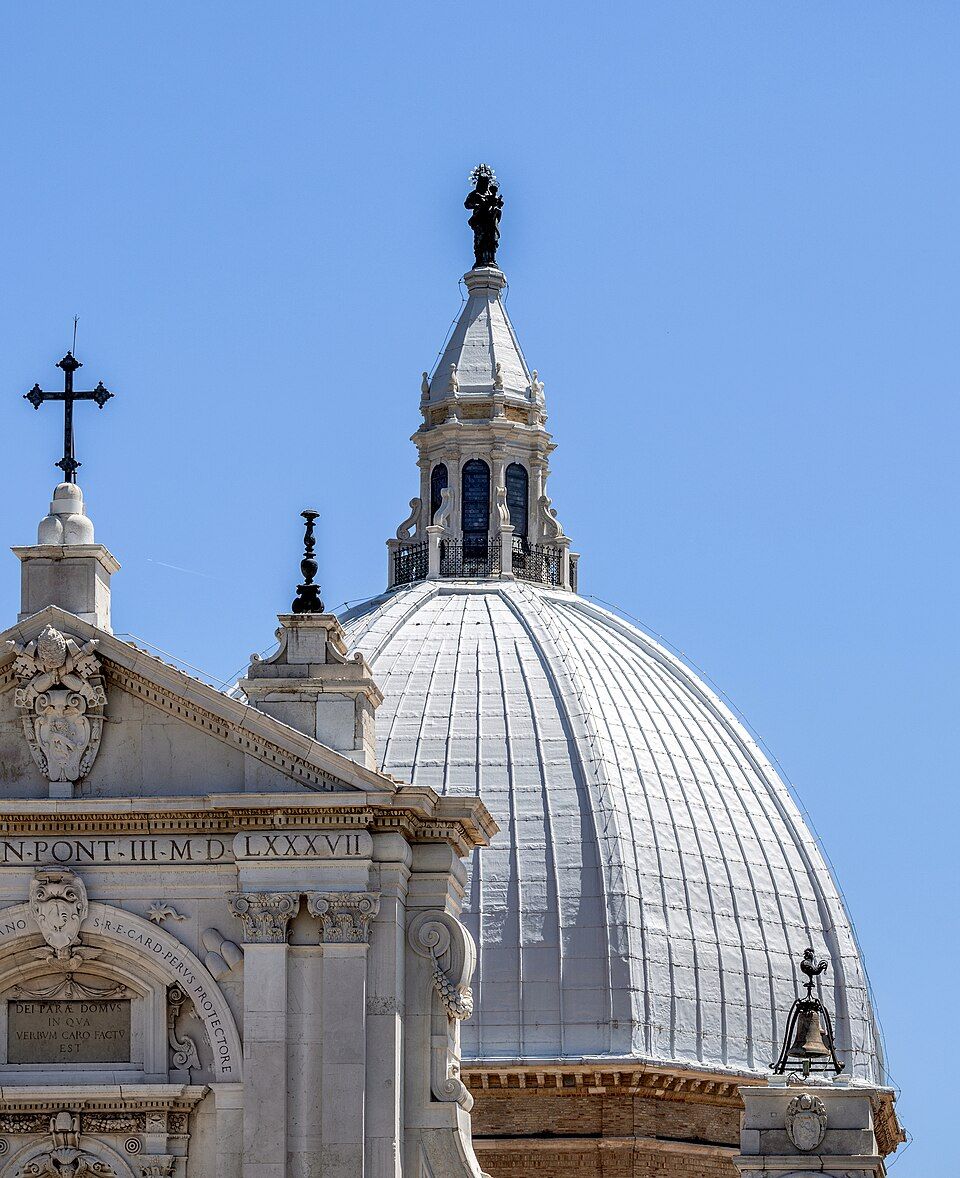
The Basilica of the Holy House of Loreto houses one of the most extraordinary objects in Catholic devotion: the Santa Casa — the Holy House of Nazareth, believed to be the actual dwelling where the Virgin Mary was born and raised, where the Annunciation took place, and where the Holy Family lived. According to tradition, the house was transported by angels from Nazareth to Loreto in 1294, after a period in Dalmatia. The basilica that encases it receives approximately four million pilgrims per year. Historical and archaeological research suggests that the stonework of the house is consistent with 1st-century Palestinian construction, and that stones matching those of the Holy House have been found at the site in Nazareth from which it is said to have come. The translation by angels is understood by many as symbolic or miraculous; the historical and archaeological questions are separate from the devotional reality, which has been uninterrupted for seven centuries. The Holy House stands entirely enclosed within a white marble casing designed by Bramante and completed by successive architects over 150 years. The marble casing is itself a masterpiece of Renaissance sculpture, with biblical scenes and prophets carved in relief. Inside, the small dark room — barely 4 metres by 9 metres — holds a replica of the black image of Our Lady of Loreto above its altar. Pilgrims enter in a constant stream and stand in what tradition holds is the room where the Annunciation occurred.

1

Houses what tradition holds is the actual home of the Virgin Mary from Nazareth —

2

transported to Loreto in 1294 Archaeological evidence suggests the house's stonework is consistent with 1st-century

3

Palestinian construction The marble casing designed by Bramante is a masterpiece of Renaissance sculpture December

4

10 — the Feast of the Translation — is the principal pilgrimage day Loreto gave

5

its title to the Litany of Loreto — among the most widely recited Marian prayers

02Plan Your Visit
Getting There
Piazza della Madonna, 60025 Loreto AN, Italy

Loreto is 25 km south of Ancona on the Adriatic coast. Direct trains from Ancona (20 minutes) and Rome (2.5h on Freccia or Intercity). The basilica is a 5-minute walk from Loreto station.

Open in Google Maps →
Rome Time (CET)
--:--:--

Holy House Open throughout basilica hours; queue required at busy times Entry is free. The queue to enter the Holy House can be 30-60 minutes on feast days. Confession is available in multiple languages throughout the day. The December 10 feast draws enormous crowds from all of Italy.

Opening Hours
Basilica6:30 AM - 7:00 PM
03Must See

What to seek out, and why it matters

I
Centre of the basilica The small Palestinian stone room

The Holy House (Santa Casa)

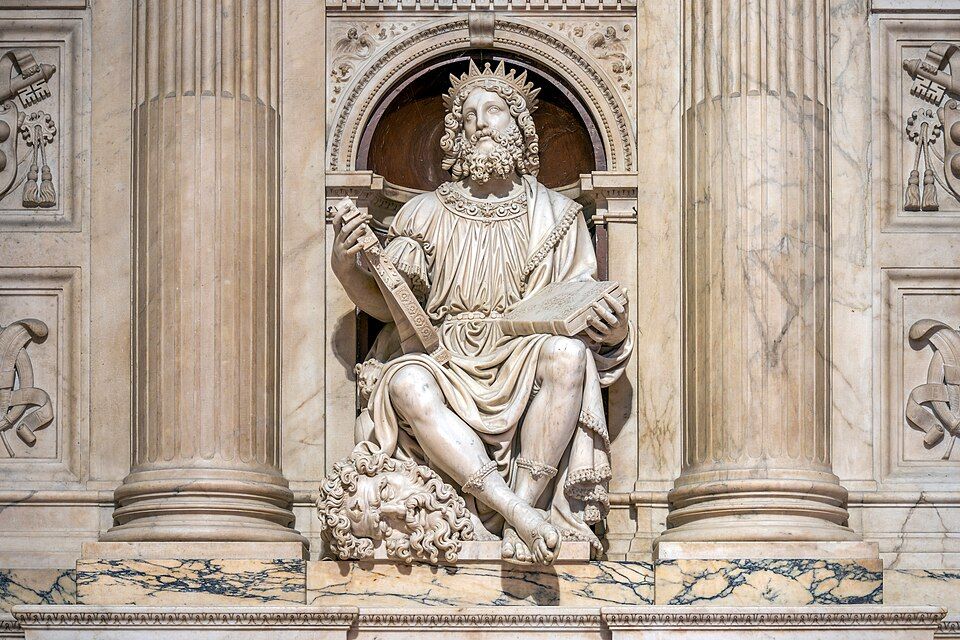
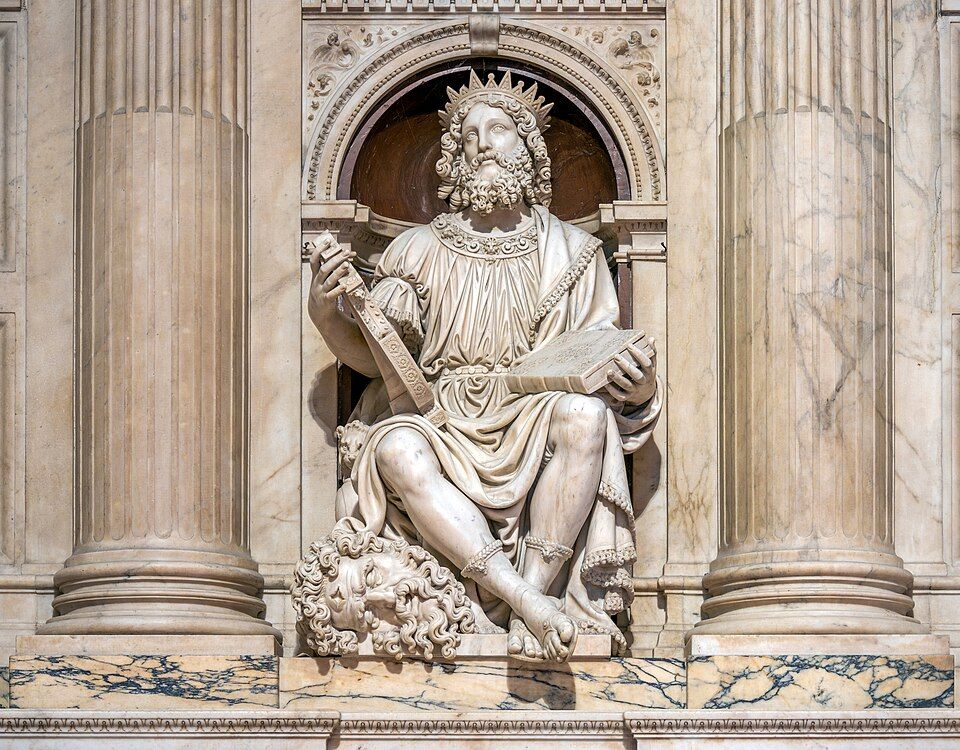
4 metres by 9 metres — is entered through one of three doors in the marble casing. Inside, the ceiling is blackened from centuries of candle smoke, the walls are the original dark basalt stone of Nazareth, and the replica image of Our Lady of Loreto stands above the altar. Standing in this room requires overcoming the crowds and the noise. When a quiet moment comes, what the pilgrims feel is the specific gravity of the specific claim: this is the room where God was announced to a young woman. The Marble Casing (Rivestimento) — Exterior of the Holy House, inside the basilica Bramante's marble casing, designed in 1509 and completed over 150 years, contains three tiers of sculptural reliefs — biblical scenes, prophets, and sibyls — in white Carrara marble. It is arguably the finest concentration of High Renaissance sculpture in a single decorative programme anywhere.
II

The Treasury and Sacristy

Accessible from the basilica The Loreto treasury contains the most important collection of ex-voto gifts in Italy: paintings, gold and silver objects, textiles, royal crowns, and gifts from popes, emperors, and kings spanning five centuries.

III
smaller, more modest

The ex-votos from ordinary pilgrims

are equally moving.

IV
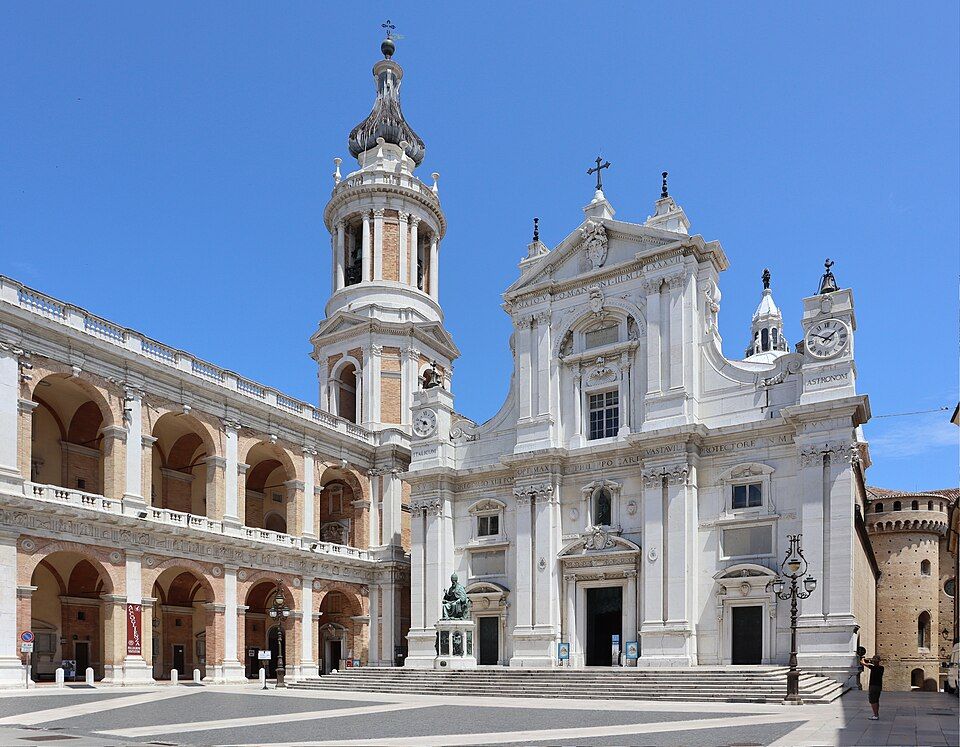
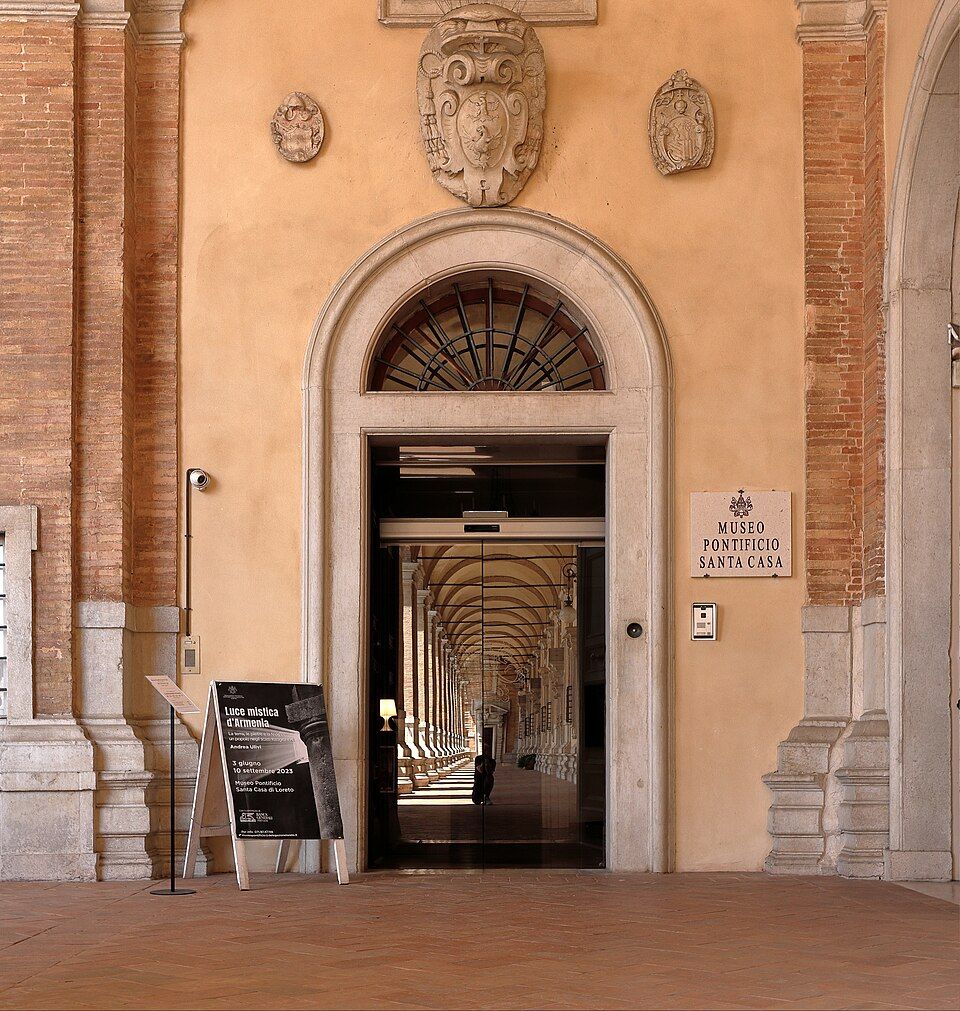
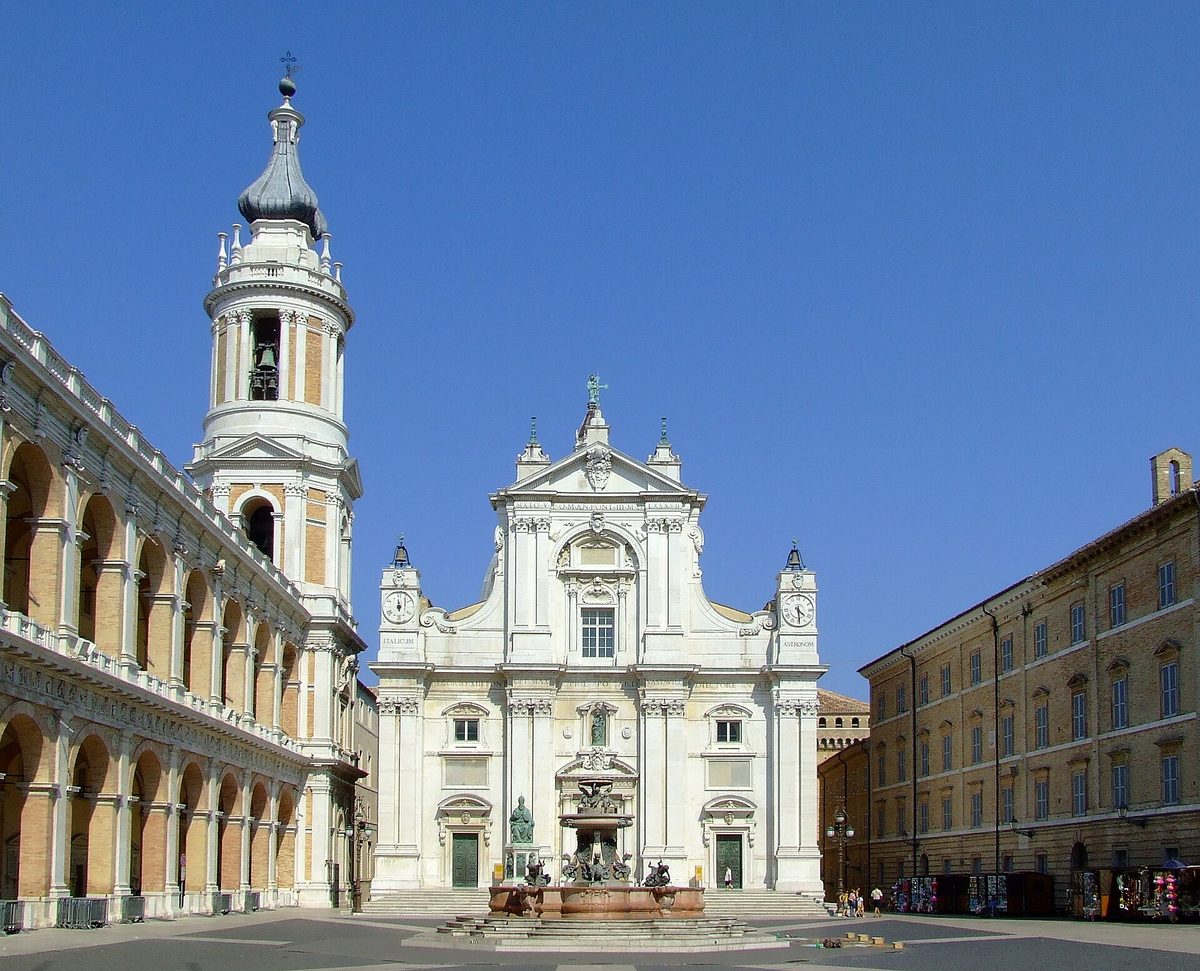
In front of the basilica [OUTDOOR] The large square, designed by Bramante and Sangallo, with a central fountain, is one of the finest Renaissance piazzas in Italy. The 16th-century Apostolic Palace alongside the basilica houses the Museo Antico. On feast days, the square fills with pilgrims and lights. The Campanile (Bell Tower)

The Piazza della Madonna

Exterior [OUTDOOR] The massive campanile, one of the finest in central Italy, towers above the piazza and can be seen from many kilometres away. Its bells have rung for pilgrims since the 16th century.

04Masses & Events
Daily MassMultiple from 7:00 AM in the basilica

Active pilgrimage schedule

Feast of the TranslationDecember 10

The principal feast; pilgrims from across

Italy Evening Rosary6:00 PM daily

In the basilica or at the Holy House

5Reflection & Prayer

The Annunciation happened in a room. Gabriel came into a specific house, in a specific town, to a specific young woman, and asked a specific question. She said yes. If the Holy House is genuine, then the room is still here. If it is a tradition rather than a literal fact, the tradition itself is the vessel of that yes — accumulated over seven centuries of pilgrimage. Either way: in this room or in its memory, the most important conversation in history took place.

Luke 1:38

I am the Lord's servant. May your word to me be fulfilled.

Read in full on Bible Gateway →
A Pilgrim's Prayer

Mary's God, who chose a house and a room and a young woman and spoke a question that changed everything — I stand in the room where the answer was given. Let something of her yes live in me. In whatever small Annunciation comes to me today — the call I am hesitating about, the change I am resisting — let me find the courage to say what she said: let it be so. Amen.

06More

The Basilica of the Holy House of Loreto houses one of the most extraordinary objects in Catholic devotion: the Santa Casa — the Holy House of Nazareth, believed to be the actual dwelling where the Virgin Mary was born and raised, where the Annunciation took place, and where the Holy Family lived. According to tradition, the house was transported by angels from Nazareth to Loreto in 1294, after a period in Dalmatia. The basilica that encases it receives approximately four million pilgrims per year.

History and Archaeology

Historical and archaeological research suggests that the stonework of the house is consistent with 1st-century Palestinian construction, and that stones matching those of the Holy House have been found at the site in Nazareth from which it is said to have come. The translation by angels is understood by many as symbolic or miraculous; the historical and archaeological questions are separate from the devotional reality, which has been uninterrupted for seven centuries.

The Santa Casa

The Holy House stands entirely enclosed within a white marble casing designed by Bramante and completed by successive architects over 150 years. The marble casing is itself a masterpiece of Renaissance sculpture, with biblical scenes and prophets carved in relief. Inside, the small dark room — barely 4 metres by 9 metres — holds a replica of the black image of Our Lady of Loreto above its altar. Pilgrims enter in a constant stream and stand in what tradition holds is the room where the Annunciation occurred.

Saints Associated With This Site
Part of this pilgrimage
10-day pilgrimage · Assisi to Loreto
Italy Shrines
View itinerary →
More from Italy
Pio Clementino Museum, Rome
VA, Cdad. del Vaticano, 00120
Sistine Chapel
Vatican City 00120
St Peter's Basilica
Vatican City
Vatican Museums
Vatican City