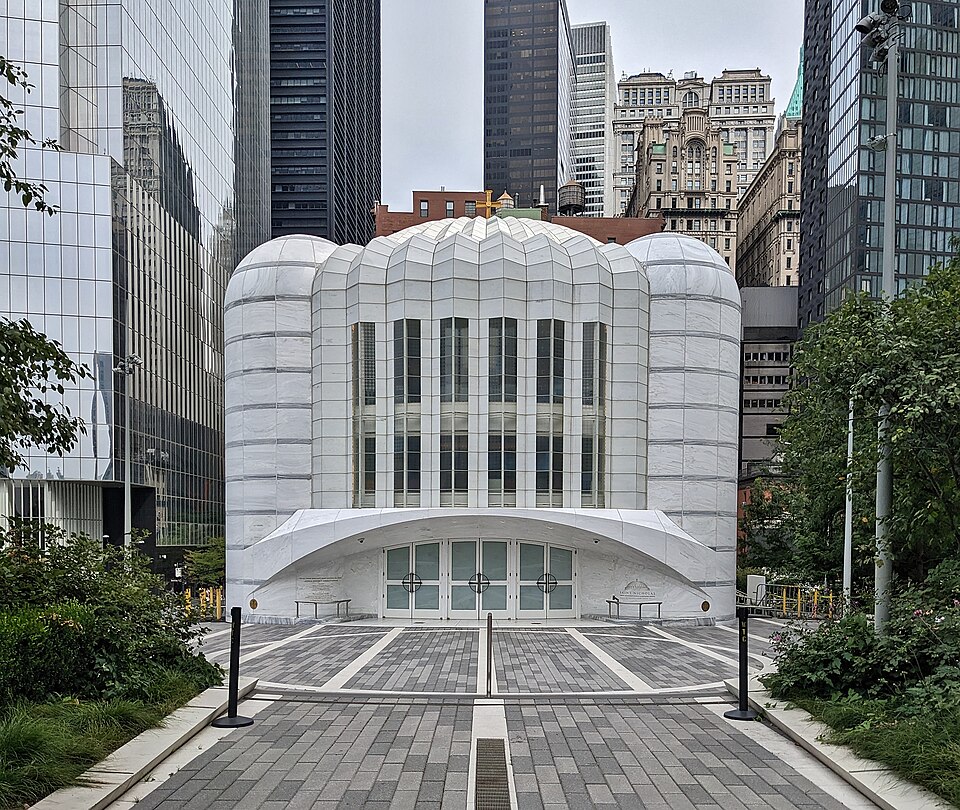
The Saint Nicholas Greek Orthodox National Shrine at the World Trade Center in Lower Manhattan is a building of extraordinary meaning — a place where architecture, memory, grief and resurrection converge in one of the most powerful pilgrimage sites in the contemporary world. The original Saint Nicholas Greek Orthodox Church, a small building at 155 Cedar Street, was the only house of worship destroyed in the attacks of 11 September 2001, crushed beneath the collapse of the South Tower. For twenty years the site remained empty while negotiations, political disputes and financial complications delayed rebuilding. When the shrine finally opened in 2022, it emerged not as a mere replacement for the old church but as something altogether grander: a national shrine, a monument to all who perished on that day, and an emblem of spiritual resilience in the face of history's violence. The new building was designed by Santiago Calatrava, the Spanish-Swiss architect whose soaring, light-filled structures have become landmarks in cities across the world. The design is inspired by the great Byzantine domed churches of the Eastern Mediterranean — Hagia Sophia in Istanbul, San Vitale in Ravenna, the Church of the Holy Sepulchre in Jerusalem — and takes the form of a luminous marble-clad cube surmounted by a shallow dome, elevated on slender columns so that it appears to float above the ground. The exterior is clad in Pentelic marble — the same stone used in the Parthenon — backlit by LED panels that make the building glow with a warm golden light visible from across the Hudson River after dark. Inside, the shrine is an environment of extraordinary beauty and stillness. The dome is decorated with Byzantine mosaics, the walls clad in warm stone, the liturgical furnishings crafted by skilled artisans working in the living tradition of Orthodox Christian art. It is simultaneously an active Greek Orthodox church — with the Divine Liturgy celebrated regularly — and a pan-Christian monument open to pilgrims of all traditions who come to pray, to remember, and to find in beauty and continuity a response to the violence of that September morning.
The only house of worship destroyed on 11 September 2001, rebuilt as a National Shrine and monument of spiritual resilience
Designed by Santiago Calatrava in the Byzantine tradition, clad in translucent Pentelic marble that glows golden at night
An active Greek Orthodox church celebrating the Divine Liturgy and open to pilgrims of all faiths
Dedicated to Saint Nicholas of Myra, venerated for seventeen centuries in both Eastern and Western Christianity
Located steps from the 9/11 Memorial pools, at one of the most historically charged sites in the United States
The Original Church and September 11
The original Saint Nicholas Greek Orthodox Church had stood at 155 Cedar Street since 1916, serving the Greek Orthodox community of Lower Manhattan. It was a modest building — small, unpretentious, sandwiched between commercial towers — but it held a large place in the devotional life of its congregation and in the affections of the neighbourhood. On the morning of 11 September 2001, as the South Tower of the World Trade Center collapsed, it was engulfed and destroyed. Of the hundreds of buildings damaged and destroyed that day, it was the only house of worship.
The symbolism was not lost on the Greek Orthodox Archdiocese of America, nor on the broader community of New Yorkers who felt in the destruction of this small church something more than merely physical loss. The church's patron, Saint Nicholas of Myra — the historic bishop of fourth-century Lycia whose legend gave rise to the figure of Santa Claus — is venerated in both Eastern and Western Christianity as a protector of the vulnerable, a defender of the innocent, and a bringer of unexpected gifts. His shrine's destruction, and its eventual rebuilding, has taken on overtones of parable.
Santiago Calatrava's Design
The commission for the new shrine was awarded to Santiago Calatrava, whose nearby Oculus transportation hub had already given the World Trade Center site one of its defining visual landmarks. Calatrava's design draws on the Byzantine tradition he studied during the development of the project. The building's footprint is a square of approximately 21 metres per side; the dome rises to approximately 16 metres above the floor. The exterior walls are 5.2 metres thick, clad in slabs of translucent Pentelic marble between stainless steel frames; at night, the backlighting makes the building appear to glow from within.
The interior is organised according to the traditional Byzantine model, with a narthex, nave and bema (sanctuary). The iconostasis — the screen of icons separating the sanctuary from the nave — was designed and executed by craftsmen working in the Byzantine artistic tradition, its gilded icons painted by iconographers trained in the classical manner. The dome mosaic, depicting the Pantocrator (Christ as ruler of the universe) surrounded by angels, follows the programme of great Byzantine domed churches.
A Place of Memory and Prayer
The shrine serves a double function unique among American churches: it is simultaneously an active Greek Orthodox parish, celebrating the Divine Liturgy and the full sacramental life of the Orthodox Church, and a memorial and pilgrimage site open to visitors of all faiths who come to pray for those who died on September 11. The Memorial Garden immediately adjacent to the shrine provides a space of quiet reflection, with views of the 9/11 Memorial pools and the Survivor Tree.
The choice to dedicate the national shrine to Saint Nicholas is deeply resonant: a bishop from Asia Minor who defended the poor and the innocent, venerated in both East and West for seventeen centuries, provides a figure of unity across the Christian traditions that the pilgrims who come from around the world represent.
Visiting
The shrine is open daily to visitors and pilgrims, with the Divine Liturgy celebrated on Sundays and feast days. No admission is charged, though donations are welcomed. The shrine is located at 130 Liberty Street in Lower Manhattan, steps from the 9/11 Memorial and Museum, and is accessible by subway from across New York City. The combination of architectural splendour, spiritual depth and historical significance makes it one of the most important new pilgrimage destinations in the United States.