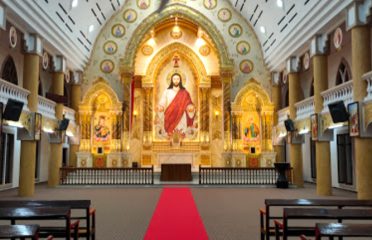
St Mary Queen of Peace Basilica, Trivandrum

St Mary Queen of Peace Basilica, Trivandrum

St Mary Queen of Peace Basilica is a famous Syro-Malankara Basilica located in the Palayam area of Trivandrum

Type
Basilica
Country
India
Scroll
01At a Glance

Standing prominently in the cantonment area of Trivandrum, the St Mary, Queen of Peace Basilica is the only Syro-Malankara Catholic Church to have been elevated to the status of a Catholic basilica. The history of St Mary’s church at Palayam would not be complete without the history of the Syro-Malankara Catholic Church. Employing the West Syriac Rite, it is one of the two Eastern Catholic Churches in India, the other being the Syro-Malabar Catholic Church which employs the East Syriac Rite in its liturgy. It is one of the oldest Eastern Catholic Churches, whose origins can be traced to the evangelical mission of St Thomas, the Apostle who arrived in India in 52 AD. Then known as the Saint Thomas Christians, the community was in communion with the Church of the East of Persia which employed the East Syriac Rite. With the advent of the Portuguese who founded a Latin Rite diocese at Cochin in 1558, the Saint Thomas Christians were gradually brought under the jurisdiction of the Portuguese padroado and into the Roman Catholic Church. The independence of the ancient Church of Malankara was rescinded, as the Portuguese did not accept the legitimacy of local Malabar traditions. At the Synod of Diamper held in 1599 under the presidency of the Portuguese Archbishop of Goa, Aleixo de Menezes, a number of such latinisations were adopted. They included changes in the Eucharistic liturgy, the use of Roman vestments, the requirement of clerical celibacy, the appointment of Portuguese bishops and finally the setting up of the Inquisition. After over 50 years of rule under the Latin Church, the majority of the Malabar Christians protested against Rome through the Coonan Cross Oath at Mattancherry to break off from the Catholic Church in 1653. Centuries later the reunion movement under the leadership of Geevarghese Ivanios split from the Malankara Church and entered into communion with the Catholic Church. The Syro-Malankara Catholic Church was thus established on 20 September 1930. To serve as its main cathedral, the Pompador cinema theatre in the Palayam area of Trivandrum was converted into a church. It was consecrated on 11 March 1933, the enthronement of Archbishop Mar Geevarghese Ivanios took place in this pro-cathedral on the same day. This was how the St Mary, Queen of Peace Basilica came into existence. Considering its historical significance, the Roman Catholic Church announced the designation of the St Mary’s church, Palayam as a Basilica on 10 November 2008.

1

Standing prominently in the cantonment area of Trivandrum, the St Mary, Queen of Peace Basilica is the only Syro-Malankara Catholic Church to have been elevated to the status of a Catholic basilica

2

It is one of the oldest Eastern Catholic Churches, whose origins can be traced to the evangelical mission of St Thomas, the Apostle who arrived in India in 52 AD

3

Then known as the Saint Thomas Christians, the community was in communion with the Church of the East of Persia which employed the East Syriac Rite

4

The Syro-Malankara Catholic Church was thus established on 20 September 1930

5

It was consecrated on 11 March 1933, the enthronement of Archbishop Mar Geevarghese Ivanios took place in this pro-cathedral on the same day

02Plan Your Visit
Getting There
St Mary Queen of Peace Basilica, Trivandrum (Thiruvananthapuram), Kerala 695001

In Trivandrum city. The exact location can be confirmed with the Diocese of Trivandrum. From Trivandrum Central railway station: auto or taxi, 10–15 minutes depending on location. From Trivandrum airport: 20 minutes.

Open in Google Maps →
IST (UTC+5:30)
--:--:--

Trivandrum is worth a full day or more: the Sri Padmanabhaswamy Temple, the Napier Museum, the Kovalam beach resort, and the basilica together constitute one of the richest city pilgrimage experiences in Kerala.

Opening Hours
Basilica6:00 AM - 8:00 PM daily
03Must See

What to seek out, and why it matters

I
Inside the basilica

Queen of Peace Devotion

The Queen of Peace title and image — Mary with her hands open in a gesture of offering peace, the Queen who gives what only God can give — is the theological centre of the basilica's life. The prayer intention that flows from this title is specific: peace. In a world and a personal life full of conflict, anxiety, hostility, and war, the Queen of Peace is asked to intercede for what she represents.

II
Through the liturgical year

The Marian Calendar of Kerala

The Marian feast cycle — the Annunciation, the Visitation, the Assumption, the Nativity of Mary, the Queenship of Mary — forms the rhythm of prayer at the basilica. Each feast offers a different aspect of Mary's life and identity as a lens for the pilgrim's own prayer.

III
City context

The Trivandrum Multi-Religious Landscape

Trivandrum is one of the most remarkable cities in India for the density and quality of its religious heritage: the Sri Padmanabhaswamy Temple (one of the wealthiest Hindu temples in the world), the Attukal Bhagavathy Temple (which holds the Guinness Record for the largest gathering of women in the world), and the Marian basilica all occupy the same city. The Marian Queen of Peace in the city of Lord Anantha is a powerful expression of Kerala's religious plurality.

IV
From outside

The Basilica Architecture

The basilica — in the contemporary Catholic church-building tradition of Kerala, with the scale and visibility that minor basilica status typically confers — is a prominent landmark in its part of the city. The approach, the facade, and the interior are worth attention as expressions of contemporary Kerala Catholic architectural identity.

V
Before the main image

The Peace Prayer

The prayer for peace — for families torn apart by conflict, for nations at war, for communities in hostility, for individuals at war with themselves — is the most universal prayer at the Queen of Peace basilica. Whatever the specific conflict or division in the pilgrim's life, the Queen of Peace is the person to whom it is brought.

04Masses & Events
Daily Mass6:30 AM and 6:30 PM

Regular daily Masses

Marian FeastsAssumption (Aug 15), Nativity of Mary (Sep 8)

Principal Marian celebrations

Novena MassesBefore major feasts

Nine-day preparation before principal feasts

5Reflection & Prayer

Peace is not the absence of conflict. It is what is possible in the middle of conflict — when someone in the room refuses to escalate, refuses to retaliate, refuses to mirror the anger being directed at them. Mary Queen of Peace is not the patron of peaceful situations. She is the patron of peace-making in situations that are not peaceful. The title was given to her in the aftermath of a world war. The prayer was not for a world without conflict. The prayer was for the grace to be peace-makers in the world that actually exists.

Matthew 5:9

Blessed are the peacemakers, for they will be called children of God.

Read in full on Bible Gateway →
A Pilgrim's Prayer

Queen of Peace, teach me to be a peacemaker — not a peacekeeper (which just suppresses conflict until it explodes) but a peacemaker (which addresses the root of the conflict and builds something new). Teach me to refuse escalation. Teach me to offer what I have not been offered. Teach me to be a child of God in the specific conflict that is in front of me today. Amen.

06More

Standing prominently in the cantonment area of Trivandrum, the St Mary, Queen of Peace Basilica is the only Syro-Malankara Catholic church to have been elevated to the status of a Catholic basilica.

The Syro-Malankara Catholic Church

The history of St Mary’s church at Palayam would not be complete without the history of the Syro-Malankara Catholic Church. Employing the West Syriac Rite, it is one of the two Eastern Catholic Churches in India, the other being the Syro-Malabar Catholic Church, which employs the East Syriac Rite in its liturgy. It is one of the oldest Eastern Catholic Churches, whose origins can be traced to the evangelical mission of St Thomas, the Apostle who arrived in India in 52 AD.

Then known as the Saint Thomas Christians, the community was in communion with the Church of the East of Persia, which employed the East Syriac Rite.

The Coming of the Portuguese

With the advent of the Portuguese, who founded a Latin Rite diocese at Cochin in 1558, the Saint Thomas Christians were gradually brought under the jurisdiction of the Portuguese padroado and into the Roman Catholic Church. The independence of the ancient Church of Malankara was rescinded, as the Portuguese did not accept the legitimacy of local Malabar traditions. At the Synod of Diamper, held in 1599 under the presidency of the Portuguese Archbishop of Goa, Aleixo de Menezes, a number of such latinisations were adopted. They included changes in the Eucharistic liturgy, the use of Roman vestments, the requirement of clerical celibacy, the appointment of Portuguese bishops, and finally the setting up of the Inquisition.

After over 50 years of rule under the Latin Church, the majority of the Malabar Christians protested against Rome through the Coonan Cross Oath at Mattancherry, breaking off from the Catholic Church in 1653.

The Reunion Movement

Centuries later, the reunion movement under the leadership of Geevarghese Ivanios split from the Malankara Church and entered into communion with the Catholic Church. The Syro-Malankara Catholic Church was thus established on 20 September 1930. To serve as its main cathedral, the Pompador cinema theatre in the Palayam area of Trivandrum was converted into a church. It was consecrated on 11 March 1933, and the enthronement of Archbishop Mar Geevarghese Ivanios took place in this pro-cathedral on the same day.

Basilica Status

This was how the St Mary, Queen of Peace Basilica came into existence. Considering its historical significance, the Roman Catholic Church announced the designation of St Mary’s church, Palayam, as a basilica on 10 November 2008.

More from India
Church of St John the Evangelist (Afghan Church), Mumbai
Shahid Bhagat Singh Road, Navy Nagar, Colaba
All Saints Cathedral, Allahabad
Sarojini Naidu Marg, Civil Lines, Prayagraj (Allahabad)
Archdioceasan Heritage Museum, Mumbai
Archdiocesan Heritage Museum, St Pius X College, Aarey Road
Basilica of Bom Jesus, Goa
Basilica of Bom Jesus, Old Goa Road, Bainguinim