
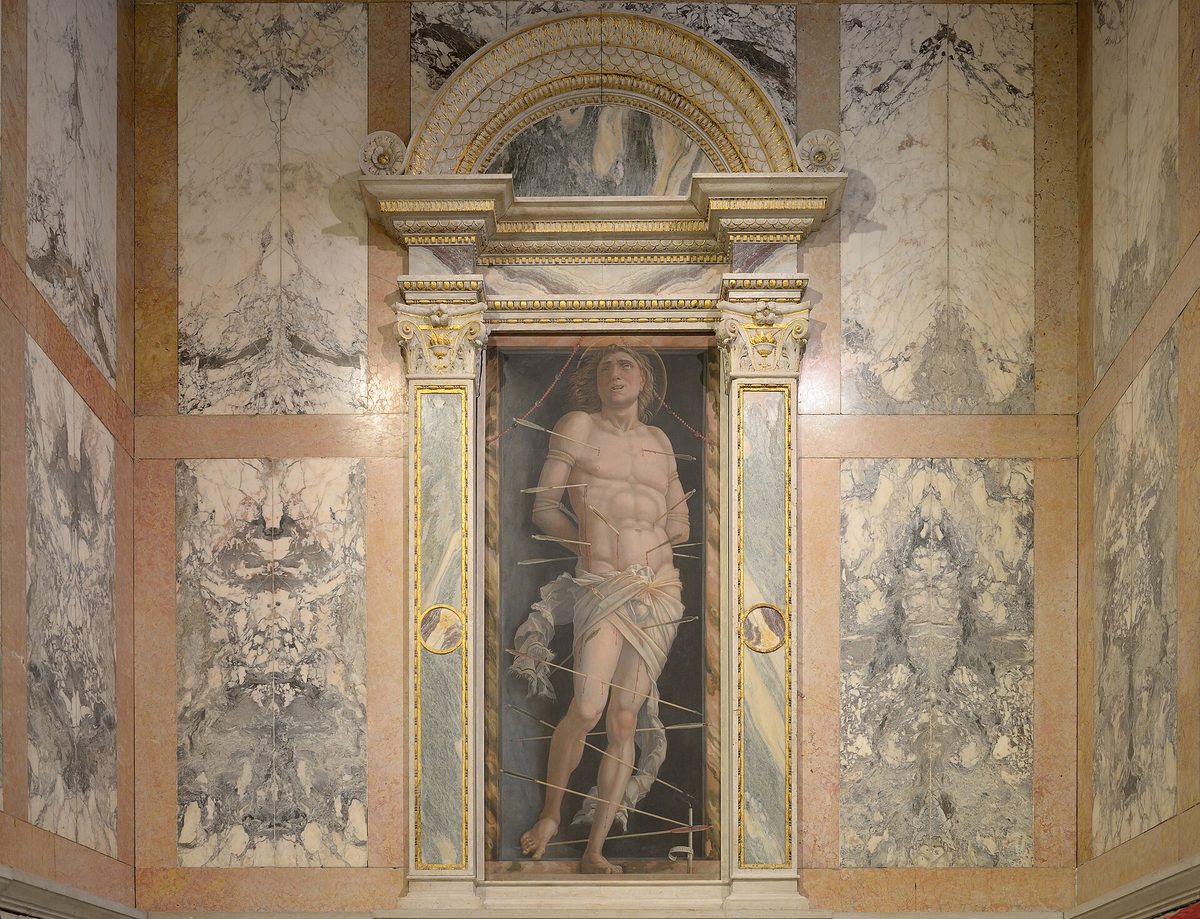
St Sebastian
St Sebastian — Mantegna, c.1480, Louvre
Andrea Mantegna, Public domain, via Wikimedia Commons
Andrea Mantegna's St Sebastian in the Louvre is the greatest of his three treatments of the subject (the others are in the Kunsthistorisches Museum, Vienna, and the Ca' d'Oro, Venice) — a large canvas (approximately 255 by 140 cm) showing Sebastian bound to a column, his body pierced by arrows, his face turned upward toward heaven with an expression of rapturous transcendence. The figure is set against a triumphal arch ruin in the Roman Campagna; other antique structures are visible in the distance.
The combination of antique architectural setting, precise anatomical observation, and extreme foreshortening (several of the arrows are seen end-on, embedded in the body) demonstrates Mantegna's characteristic programme of humanist archaeology and devotional intensity. A candle flame in the lower left corner bears the inscription 'NIHIL NISI DIVINUM STABILE EST CAETERA FUMUS' (Nothing but the divine is stable; the rest is smoke) — Mantegna's meditation on the ephemerality of antique civilisation.
Andrea Mantegna (c.1431-1506) was the court painter of the Gonzaga family of Mantua and the greatest Italian humanist painter — his work characterised by an obsessive engagement with classical Roman antiquity (he collected coins, sculptures, and inscriptions), an extreme precision of form (his figures have the hardness and specificity of carved stone), and a devotional intensity that combines classical severity with Franciscan tenderness. The three Sebastian paintings span his career (c.1458-1506) and document his changing approach to the subject: the earliest (Vienna) is more Gothic in spirit; the Louvre version is fully mature; the Ca' d'Oro version, painted very late, shows a looser, more emotionally raw treatment.
The candle in the lower left corner of the Louvre canvas is the key to the work's meaning: the flame, about to be extinguished, is the symbol of human vanity and transience — all the pagan civilisation visible in the ruins behind Sebastian will pass away; only the divine (Sebastian's faith, and by extension, Christian truth) is permanent. The inscription is in Latin; it is Mantegna's signature meditation on the relationship between classical antiquity and Christian faith.
When standing before this work, look carefully: St Sebastian — Mantegna, c.1480, Louvre. Give it time — what seems decorative often carries the central meaning.
When standing before this work, look carefully: The arrows — foreshortened, embedded in the body. Give it time — what seems decorative often carries the central meaning.
When standing before this work, look carefully: Candle and inscription — 'Nothing but the divine is stable'. Give it time — what seems decorative often carries the central meaning.
When standing before this work, look carefully: The antique ruins — Roman Campagna setting. Give it time — what seems decorative often carries the central meaning.
Musée du Louvre, Sully Wing, Paris. The Mantegna St Sebastian is in the Italian painting rooms of the Louvre's Sully Wing. See Louvre website for room assignments.