
The Immaculate Conception
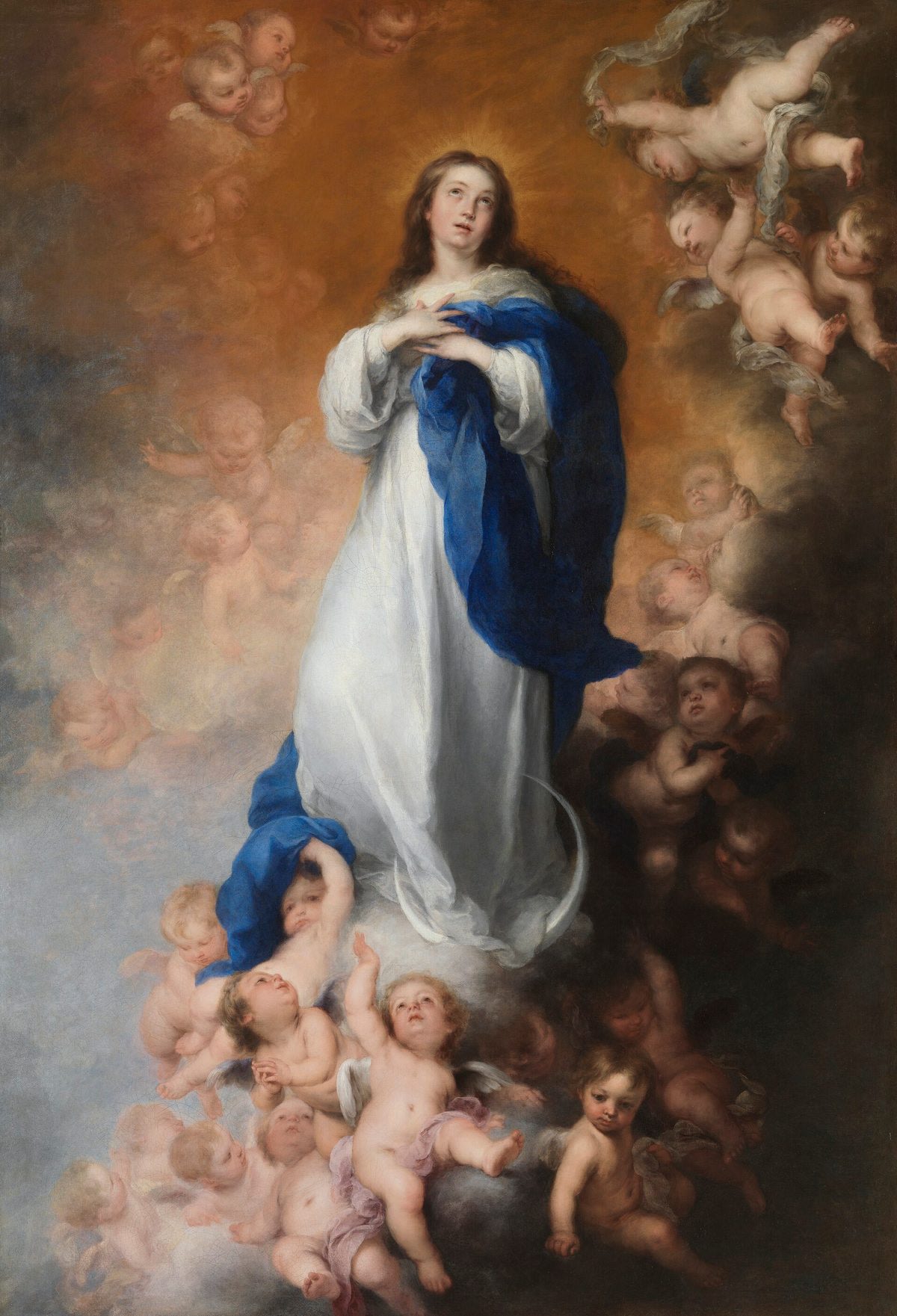
Immaculate Conception — Murillo, c.1678
Bartolomé Esteban Murillo, Public domain, via Wikimedia Commons
Murillo's Immaculate Conception in the Prado is the canonical version of one of the most characteristic subjects of Spanish Baroque painting — the Immaculada, or Immaculate Conception of the Virgin. The doctrine (that Mary was conceived without original sin) was a matter of intense Spanish theological debate in the 17th century, with Seville particularly devoted to its promotion.
Murillo's Mary is shown standing on the moon and clouds, clothed in white and blue, surrounded by putti, ascending toward a golden light above — the compositional conventions derive from Revelation 12:1 ('a woman clothed with the sun, with the moon under her feet and a crown of twelve stars on her head') combined with the Marian theology of the Immaculate Conception. Murillo painted this subject more than 20 times throughout his career; the Prado version is among his finest.
Bartolomé Esteban Murillo (1617-1682) was the dominant painter in Seville in the second half of the 17th century and the most popular Spanish Baroque painter in the 18th and 19th centuries (his reputation subsequently declined somewhat as taste shifted away from his atmospheric sweetness). His technical approach combined the Venetian warmth of colour with a Flemish softness of atmosphere: his canvases have a dreamy, luminous quality distinct from the austerity of Velázquez and the darkness of Zurbarán. The Immaculada subject allowed him to work in an elevated spiritual register — the figures are idealized, the colour celestially warm, the atmosphere between figure and background a continuous golden haze.
The composition is weightless: Mary stands on crescent moon and cloud without the conventional architectural support, her white gown and blue mantle flowing around her in the upward movement of ascension. The putti surrounding her are among Murillo's most celebrated motifs — small, cherubic, individuated figures in attitudes of worship and play.
Look at the quality of the Seville light that pervades the painting: warm, golden, slightly moist — Murillo's Andalusian atmosphere translated into celestial space. The Mary figure's upward gaze and her slightly parted lips convey a quality of spiritual transport that is Murillo's characteristic spiritual vocabulary.
When standing before this work, look carefully: Immaculate Conception — Murillo, c.1678. Give it time — what seems decorative often carries the central meaning.
When standing before this work, look carefully: The surrounding putti — Murillo's most celebrated motif. Give it time — what seems decorative often carries the central meaning.
When standing before this work, look carefully: Mary's face — spiritual transport. Give it time — what seems decorative often carries the central meaning.
When standing before this work, look carefully: Sevillian Baroque context. Give it time — what seems decorative often carries the central meaning.
Museo Nacional del Prado, Madrid. Room 17 (Murillo and Seville Baroque).