Basilica of Our Lady of Graces, Sardhana

Basilica of Our Lady of Graces, Sardhana

Modelled on the lines of St Peter's Basilica in Rome it is the only basilica in North India

Type
Basilica
Country
India
Location
Church Road, Sardhana, Meerut
Scroll
01At a Glance

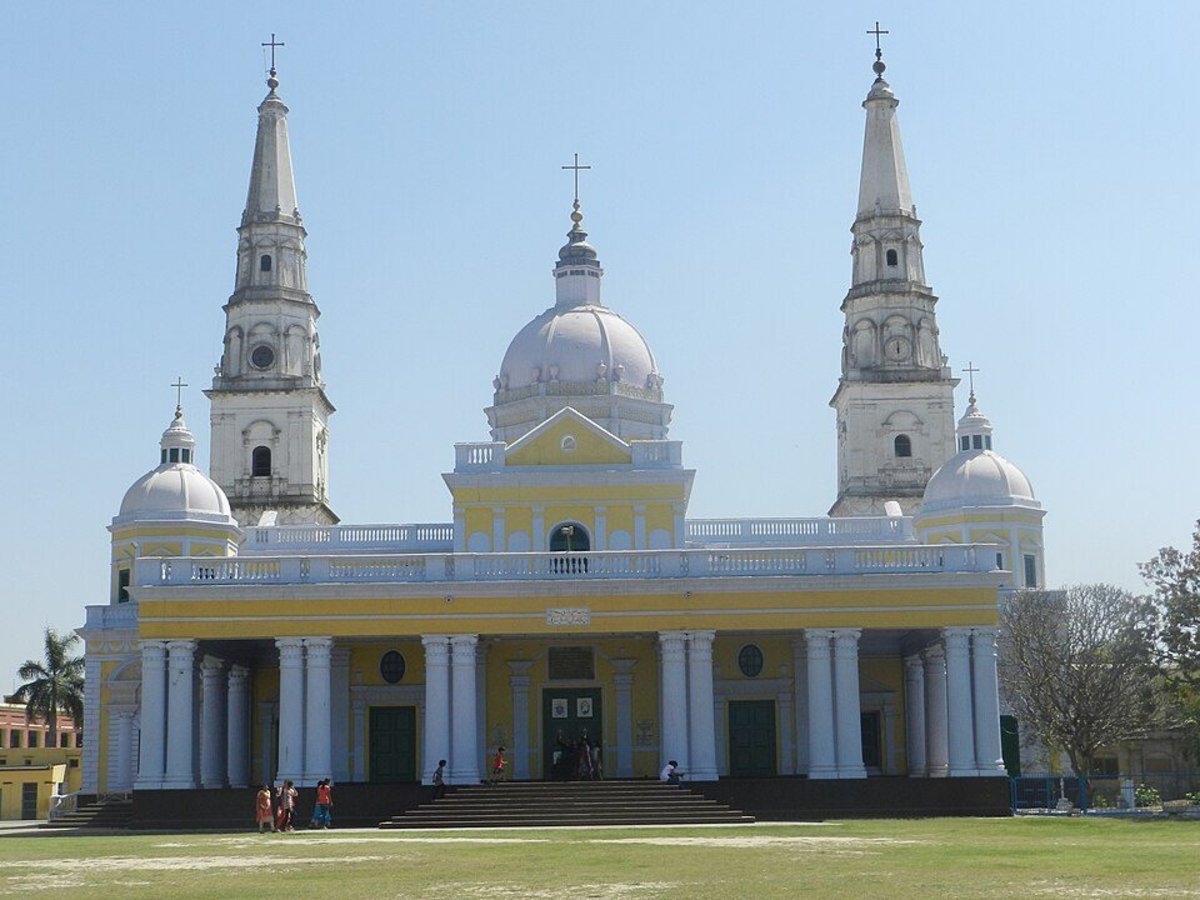
The history of the Basilica of Our Lady of Graces, popularly known as Sardhana church, is intertwined with that of Begum Samru, the ruler of Sardhana and builder of this church. Sardhana was a tiny principality, near Meerut in present day Uttar Pradesh. Begum Samru, who later adopted the name Joanna Nobilis, was a Kashmiri nautch girl. She married a European mercenary named Walter Reinhardt Sombre, who ruled Sardhana. When her husband died in 1778, Begum Samru ascended the throne. Sardhana is considered the only princely state in India, to have been ruled by a Catholic. On her conversion to Catholicism in 1781, Begum Samru raised what stands today as the only basilica in North India. Modelled on the lines of St Peter’s Basilica in Rome, Sardhana church incorporates distinct elements from Indian architecture. Its creator was Antonio Reghellini, an Italian architect who is responsible for many other structures of note in Sardhana. Estimated to have cost Rs 4 lakhs, a huge sum in that time, this majestic building is a stunning example of craftsmanship of the highest order. It took Reghellini 11 years to complete the church which boasts of an altar built in marble and inlaid with semi precious stones. Two spires and three Roman domes, a frontage of Greek styled columns, an octagonal set of stained glass above the altar; this is a marvel that brings history to life. Close by is the Begum’s tomb, depicting her seated on her throne, smoking a hookah with Europeans and Indians in attendance. Sculpted by Adamo Tadolini in Italy, it was transported to her kingdom where it rises majestically over the tomb. In elevating the church to a minor Basilica on 13 December 1961, Pope John XXIII bestowed upon it a great honour. It is not for nothing that the basilica is referred to as the ‘Church of Churches’, considering there are only 26 such in India.

1

The history of the Basilica of Our Lady of Graces, popularly known as Sardhana church, is intertwined with that of Begum Samru, the ruler of Sardhana and builder of this church

2

On her conversion to Catholicism in 1781, Begum Samru raised what stands today as the only basilica in North India

3

It took Reghellini 11 years to complete the church which boasts of an altar built in marble and inlaid with semi precious stones

4

Close by is the Begum’s tomb, depicting her seated on her throne, smoking a hookah with Europeans and Indians in attendance

5

Sculpted by Adamo Tadolini in Italy, it was transported to her kingdom where it rises majestically over the tomb

02Plan Your Visit
Getting There
Sardhana, Meerut District, Uttar Pradesh 250342

Sardhana is 14 km from Meerut city and 100 km from Delhi. From Meerut: regular buses and autos to Sardhana (45 min). From Delhi: bus to Meerut then onward to Sardhana. By car from Delhi: NH334, 2 hours.

Open in Google Maps →
IST (UTC+5:30)
--:--:--

The basilica is open all day. The feast day (June 9) and Christmas are the busiest times — hundreds of thousands of pilgrims arrive. Sardhana is a small town; accommodation is limited and pilgrims typically come for the day.

Opening Hours
Basilica6:00 AM - 8:00 PM daily
03Must See

What to seek out, and why it matters

I
From the entrance

The Basilica Facade and Dome

The Italian Baroque facade — with its colonnaded portico, twin towers, and central dome — appears with startling grandeur above the flat Meerut plain. Arriving by road, the basilica suddenly rises above the surrounding rooftops. It was designed by a European architect employed by Begum Samru and has the formal ambition of a Roman Baroque church transposed to northern India.

II
Crypt below the high altar

The Tomb of Begum Samru

Begum Samru is buried in the crypt directly beneath the high altar — the most honoured position in the church she built. Her life story — from dancing girl to Mughal court figure to independent ruler to Catholic patron — is one of the most extraordinary personal histories of 18th-century India. Pilgrims stop at her tomb on the way to the altar.

III
The apse

The High Altar and Statue of Our Lady

The marble high altar with the statue of Our Lady of Graces above it is the liturgical and devotional focus of the basilica. The statue is dressed in robes for feast days. The surrounding baroque decoration — columns, gilded details, painted ceiling — is the fullest expression of the Baroque aesthetic in north India.

IV
The nave

The Painted Interior Ceiling

The ceiling of the basilica nave is painted with religious scenes in the Italian tradition — a painted paradise above the heads of pilgrims. The paintings, executed in the 19th century, have been restored and remain the most complete example of Baroque ceiling painting in a north Indian church.

V
Basilica compound

The Courtyard and Approach

The basilica is approached through a large compound with gardens and colonnaded walkways. On feast days the courtyard fills with tens of thousands of pilgrims. The combination of the Italian Baroque building with the colour and density of a north Indian pilgrimage crowd is one of the most visually striking scenes in Indian Catholicism.

04Masses & Events
Daily Mass6:30 AM and 5:00 PM

Regular Mass schedule

Feast of Our Lady of GracesJune 9

The principal feast; enormous pilgrimage gathering

Christmas MassDecember 24-25

Major celebration drawing pilgrims from across UP

5Reflection & Prayer

A woman born into poverty, who became a ruler, who converted and was baptised at the age of perhaps 50, who built a basilica that still receives half a million pilgrims a year — this is Begum Samru's legacy. The basilica is not the legacy of an empire or an order or a bishop. It is the legacy of one woman's faith. She is buried beneath the altar she funded. The pilgrims walk over her tomb to pray at the altar she gave them. That is a remarkable kind of immortality.

Luke 7:47

Therefore, I tell you, her many sins have been forgiven — as her great love has shown. But whoever has been forgiven little loves little.

Read in full on Bible Gateway →
A Pilgrim's Prayer

Our Lady of Graces, venerated in this church built by a woman who loved you late and built you this in gratitude — let me also love late if I must, but let me love. Let the baroque extravagance of this building tell me what Begum Samru knew: that grace deserves the most one can give. Amen.

06More

The history of the Basilica of Our Lady of Graces, popularly known as Sardhana church, is intertwined with that of Begum Samru, the ruler of Sardhana and builder of this church. Sardhana was a tiny principality near Meerut in present-day Uttar Pradesh.

Begum Samru

Begum Samru, who later adopted the name Joanna Nobilis, was a Kashmiri nautch girl. She married a European mercenary named Walter Reinhardt Sombre, who ruled Sardhana. When her husband died in 1778, Begum Samru ascended the throne. Sardhana is considered the only princely state in India to have been ruled by a Catholic. On her conversion to Catholicism in 1781, Begum Samru raised what stands today as the only basilica in North India.

Architecture

Modelled on the lines of St Peter’s Basilica in Rome, Sardhana church incorporates distinct elements from Indian architecture. Its creator was Antonio Reghellini, an Italian architect who is responsible for many other structures of note in Sardhana. Estimated to have cost Rs 4 lakhs, a huge sum in that time, this majestic building is a stunning example of craftsmanship of the highest order. It took Reghellini 11 years to complete the church, which boasts an altar built in marble and inlaid with semi-precious stones.

Two spires and three Roman domes, a frontage of Greek-styled columns and an octagonal set of stained glass above the altar — this is a marvel that brings history to life. Close by is the Begum’s tomb, depicting her seated on her throne, smoking a hookah with Europeans and Indians in attendance. Sculpted by Adamo Tadolini in Italy, it was transported to her kingdom where it rises majestically over the tomb.

Pilgrimage

In elevating the church to a minor basilica on 13 December 1961, Pope John XXIII bestowed upon it a great honour. It is not for nothing that the basilica is referred to as the ‘Church of Churches’, considering there are only 26 such in India.
Saints Associated With This Site
More from India
Church of St John the Evangelist (Afghan Church), Mumbai
Shahid Bhagat Singh Road, Navy Nagar, Colaba
All Saints Cathedral, Allahabad
Sarojini Naidu Marg, Civil Lines, Prayagraj (Allahabad)
Archdioceasan Heritage Museum, Mumbai
Archdiocesan Heritage Museum, St Pius X College, Aarey Road
Basilica of Bom Jesus, Goa
Basilica of Bom Jesus, Old Goa Road, Bainguinim