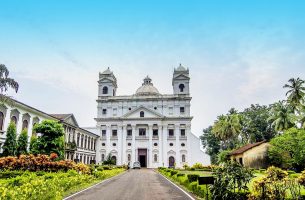
St Cajetan Church, Goa

St Cajetan Church, Goa

St Cajetan church, Goa was built by the Italian Theatine Order in 1661 and is a UNESCO World Heritage Site

Type
Church
Country
India
Location
Velha Goa, Old Goa, Goa 403402
Scroll
01At a Glance

Amongst the many churches in Goa, and Goa does indeed have many, is the stunningly beautiful St Cajetan Church. Looming right behind the Se Cathedral , another Portuguese colonial era masterpiece, the St Cajetan church, Goa is an immaculate example of the Corinthian, the last of the three classical orders. Goa is generally associated with all things Portuguese, yet the St Cajetan church is one superb exception. The Italian heritage of the Theatines has contributed in no small measure in making this exceptionally well crafted edifice, stand proudly among its many Portuguese cousins . Dedicated to St Cajetan, an Italian Catholic priest and co-founder of the Theatine religious order, the church was completed in 1661. Three Italian Theatine priests were sent to India by Pope Urban VIII in 1639 to preach Christianity in Golconda. As the monks could not make much headway in the Sultanate, they returned to Goa in 1640 and joined the Evangelisation of the East. By 1643, they had begun work on a hospital but drew the ire of the Portuguese Viceroy Filipe Mascarenhas. Being foreigners, they were considered unwelcome and banished from Goa in 1645. Fr Pedro Avitabili, the leader of the Theatine priests, secured an audience with King John IV of Portugal, and convinced the ruler that the Theatines posed no threat to the Portuguese priests in Goa, but would actually be of great help in the evangelisation effort. Armed with Royal permission, the Theatines were more welcome this time around and managed to resume work on the hospital in 1650. By 1655, King John had also permitted the Theatines to construct a church and a small convent beside it. What followed was the extravagant church of St Cajetan, built under the supervision of the renowned Italian architects, Carlo Ferrarini and Francesco Maria Milazzo. Modelled on the St Peter’s Basilica, the church has also been noted for its likeness to the Sant’Andrea della Valle, which is a minor basilica in Rome and serves as the seat of the Theatine order. Four statues of St Paul, St Peter, St John the Evangelist and St Matthew wrought in basalt, adorn the facade. The inscription ‘Domus mea, domus orations’ meaning, ‘My House is a House of Prayer’ is etched prominently at the entrance. A lesser known fact about the Theatines was their egalitarian commitment to the teachings of Christ. It might come as a surprise in this era, but Holy Communion was distributed only to the higher classes amongst Indian Catholics. On the demand of the Theatines, the Archbishop convened a public conference, where the Theatines quoting extensively from the Scriptures, strongly argued their case, and were thus able to establish a more equitable and fair approach to this Holy Sacrament. St Cajetan church, Goa is built in the pattern of a Greek cross, its massive vault inscribed with passages from the Gospel of St Matthew in Latin. Of the seven altars in the church the main one is dedicated to Our Lady of Providence. The altar to St Cajetan is on the right. When pitted against the six other monuments in the UNESCO list of World Heritage Sites, it is no surprise to find this lone Italian holding its own against its equally illustrious peers.

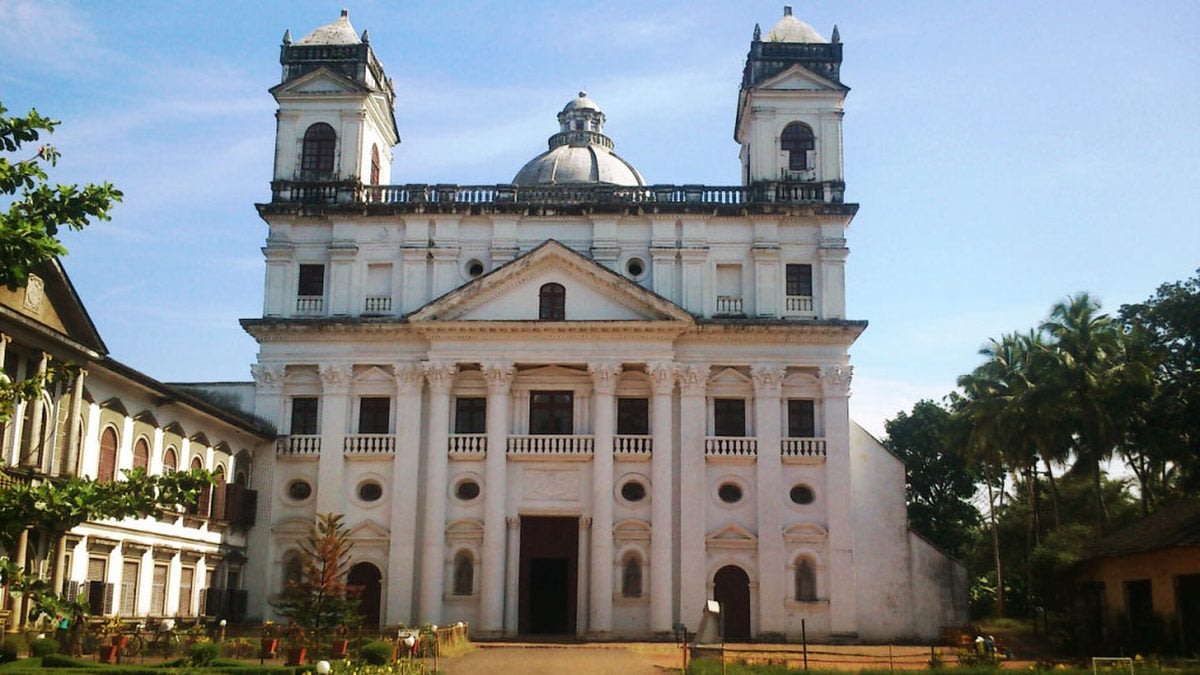
1

Dedicated to St Cajetan, an Italian Catholic priest and co-founder of the Theatine religious order, the church was completed in 1661

2

What followed was the extravagant church of St Cajetan, built under the supervision of the renowned Italian architects, Carlo Ferrarini and Francesco Maria Milazzo

3

Four statues of St Paul, St Peter, St John the Evangelist and St Matthew wrought in basalt, adorn the facade

4

St Cajetan church, Goa is built in the pattern of a Greek cross, its massive vault inscribed with passages from the Gospel of St Matthew in Latin

5

Of the seven altars in the church the main one is dedicated to Our Lady of Providence

02Plan Your Visit
Getting There
Church of St Cajetan, Old Goa, North Goa, Goa 403402

Immediately next to the Se Cathedral in Old Goa. All Old Goa transport directions apply: 10 km from Panaji, 30 minutes by bus or taxi. From Goa airport: 45 minutes. Walk between the Se Cathedral, St Francis of Assisi, and St Cajetan in sequence.

Open in Google Maps →
IST (UTC+5:30)
--:--:--

St Cajetan is often overshadowed by the more famous Se Cathedral and Basilica of Bom Jesus nearby, but its interior is arguably the finest Baroque space in Goa. Plan time to sit quietly inside. The exterior dome is best seen from the Old Goa forecourt.

Opening Hours
Church7:00 AM - 6:30 PM daily
03Must See

What to seek out, and why it matters

I
Exterior from the forecourt

The Roman Baroque Dome

The dome of St Cajetan — the only dome in Old Goa — rises above the Baroque facade in a way that makes the church feel transported from the Piazza Navona to the Konkan coast. Seen from the Old Goa forecourt, alongside the asymmetrical Se Cathedral, the dome establishes the distinctively Roman character of the Theatine contribution to Old Goa.

II
Inside the church

The Interior Baroque Programme

The interior of St Cajetan reproduces the atmosphere of a Roman Baroque church of the 17th century: gilded altars, painted walls, classical pilasters and arches, and the proportional harmony of the barrel-vaulted nave leading to the domed crossing. It is more intimate than the Se Cathedral and more richly decorated than most of the Old Goa churches.

III
At the altar end

The High Altar and the Crypt

The high altar of St Cajetan is a particularly fine piece of 17th-century Goan Baroque woodwork. Beneath it, though not accessible to visitors, is the crypt of the Portuguese governors of Goa — naturally mummified, a remarkable and slightly uncanny feature of the building's history that adds to its depth as a historical site.

IV
Inside the church

The Theatine History

The Theatines were one of the reform orders of the Counter-Reformation — founded by St Cajetan and Cardinal Carafa to renew the clergy by example and radical evangelical poverty. Reading the church in this context — as the Asian outpost of an Italian reforming order, built by friars who came to convert India and ended up in Goa — is a way of understanding the complex intersection of missionary zeal, imperial politics, and genuine sanctity that created Old Goa.

V
From the road

The Old Goa Complex View

The view of Old Goa from the main road — with the Se Cathedral, St Francis of Assisi, St Cajetan's dome, and the Viceroy's arch visible together — presents one of the most complete surviving colonial sacred landscapes in the world. The UNESCO inscription captures this: not individual buildings but an entire landscape of faith and empire.

04Masses & Events
Daily Mass7:30 AM

Morning Mass at the Theatine church

Sunday Mass9:00 AM

Solemn Sunday celebration

Feast of St CajetanAugust 7

The patronal feast of the Theatine founder

5Reflection & Prayer

The Theatines who built this church were going to Golconda. The Mughal ruler said no. So they came to Goa and built what they had planned for Hyderabad — a Roman Baroque church with a dome. The dome ended up in the wrong place, by someone else's decision, and became the finest dome in Goa. St Cajetan himself was often redirected: he had planned a career in canon law, then a career in curia administration, then founding a hospital for incurables, then the Theatines. The thing that was supposed to happen was never what happened. What happened was always better.

Romans 8:28

And we know that in all things God works for the good of those who love him, who have been called according to his purpose.

Read in full on Bible Gateway →
A Pilgrim's Prayer

God who redirects, who closes the road to Golconda and opens the road to Goa, who turns the plan that failed into the building that lasts — I trust the redirection. I have been redirected more times than I can count. Each time I thought it was loss. Each time it became something better than what I had planned. Work for the good of those who love you. I am trying to love you. Work. Amen.

06More

Amongst the many churches in Goa — and Goa does indeed have many — is the stunningly beautiful St Cajetan Church. Looming right behind the Se Cathedral, another Portuguese colonial-era masterpiece, the St Cajetan church is an immaculate example of the Corinthian, the last of the three classical orders.

An Italian Heritage

Goa is generally associated with all things Portuguese, yet the St Cajetan church is one superb exception. The Italian heritage of the Theatines has contributed in no small measure to making this exceptionally well-crafted edifice stand proudly among its many Portuguese cousins. Dedicated to St Cajetan, an Italian Catholic priest and co-founder of the Theatine religious order, the church was completed in 1661.

The Theatines in Goa

Three Italian Theatine priests were sent to India by Pope Urban VIII in 1639 to preach Christianity in Golconda. As the monks could not make much headway in the Sultanate, they returned to Goa in 1640 and joined the evangelisation of the East. By 1643, they had begun work on a hospital but drew the ire of the Portuguese Viceroy Filipe Mascarenhas. Being foreigners, they were considered unwelcome and banished from Goa in 1645.

Fr Pedro Avitabili, the leader of the Theatine priests, secured an audience with King John IV of Portugal, and convinced the ruler that the Theatines posed no threat to the Portuguese priests in Goa, but would actually be of great help in the evangelisation effort. Armed with royal permission, the Theatines were more welcome this time around and managed to resume work on the hospital in 1650. By 1655, King John had also permitted the Theatines to construct a church and a small convent beside it.

Architecture

What followed was the extravagant church of St Cajetan, built under the supervision of the renowned Italian architects Carlo Ferrarini and Francesco Maria Milazzo. Modelled on St Peter’s Basilica, the church has also been noted for its likeness to Sant’Andrea della Valle, a minor basilica in Rome that serves as the seat of the Theatine order. Four statues — of St Paul, St Peter, St John the Evangelist and St Matthew — wrought in basalt, adorn the facade. The inscription ‘Domus mea, domus orationis’, meaning ‘My House is a House of Prayer’, is etched prominently at the entrance.

A Commitment to Equality

A lesser-known fact about the Theatines was their egalitarian commitment to the teachings of Christ. It might come as a surprise in this era, but Holy Communion was distributed only to the higher classes amongst Indian Catholics. On the demand of the Theatines, the Archbishop convened a public conference, where the Theatines, quoting extensively from the Scriptures, strongly argued their case, and were thus able to establish a more equitable and fair approach to this Holy Sacrament.

Visiting

St Cajetan church is built in the pattern of a Greek cross, its massive vault inscribed with passages from the Gospel of St Matthew in Latin. Of the seven altars in the church, the main one is dedicated to Our Lady of Providence. The altar to St Cajetan is on the right. When pitted against the six other monuments in the UNESCO list of World Heritage Sites, it is no surprise to find this lone Italian holding its own against its equally illustrious peers.
Saints Associated With This Site
More from India
Church of St John the Evangelist (Afghan Church), Mumbai
Shahid Bhagat Singh Road, Navy Nagar, Colaba
All Saints Cathedral, Allahabad
Sarojini Naidu Marg, Civil Lines, Prayagraj (Allahabad)
Archdioceasan Heritage Museum, Mumbai
Archdiocesan Heritage Museum, St Pius X College, Aarey Road
Basilica of Bom Jesus, Goa
Basilica of Bom Jesus, Old Goa Road, Bainguinim